
A billion years of Earth's rock record vanished. New models point deep underground
A Nature study blames the slow churn of Earth's mantle, not chance, for the gaps in North America, northern Europe and North China, and explains why the break is still visible today.
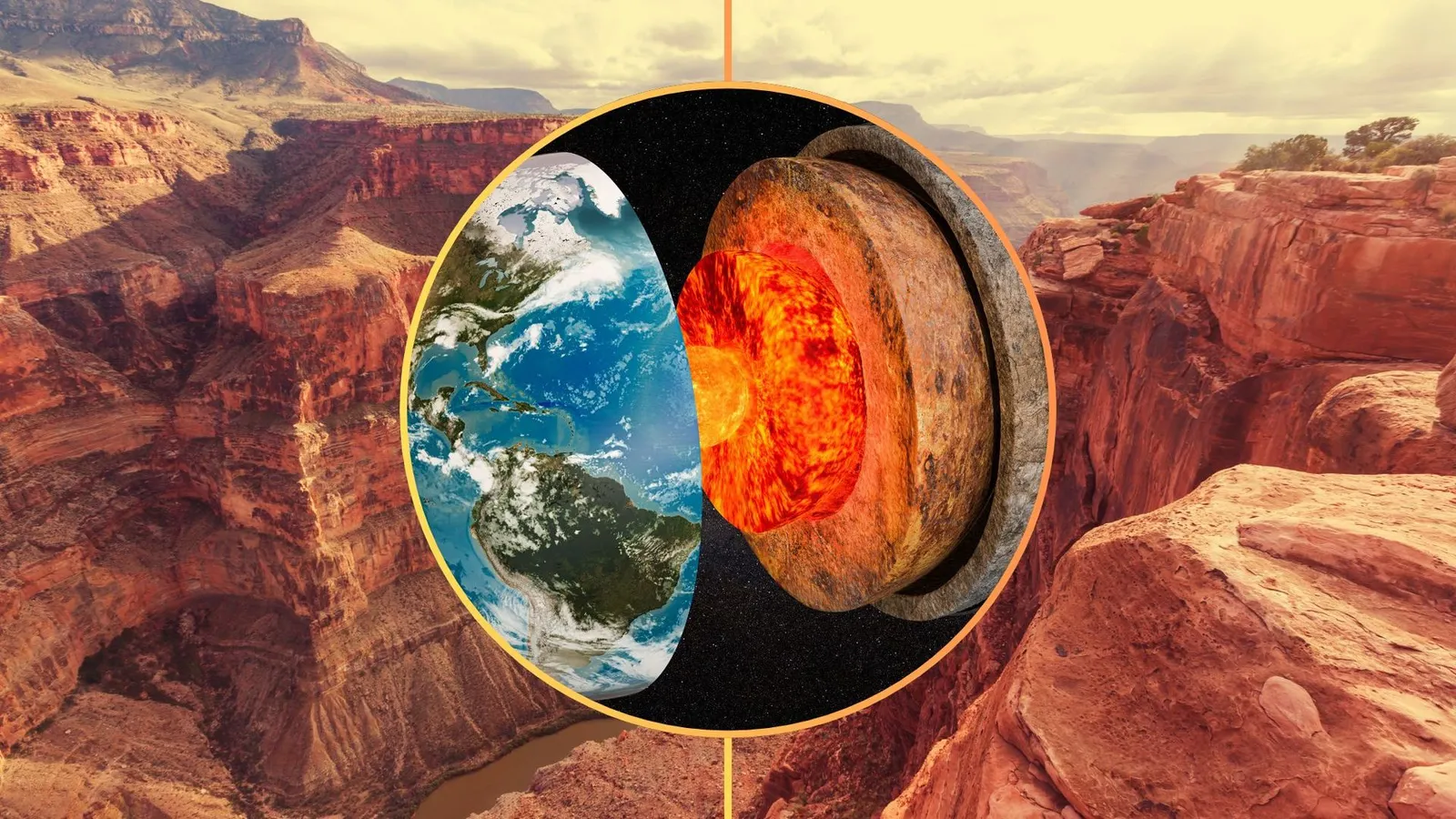
Santosh Dhungana and co-author Nicolas Flament, publishing in Nature, used computer models of mantle circulation to explain the Great Unconformity, the gaps of roughly 200 million to more than a billion years in Earth's rock record across Laurentia, Baltica and North China. For decision-makers, the result reframes missing geological intervals as a predictable consequence of deep-Earth processes rather than random loss, which matters to anyone who treats the rock record as a complete ledger.
Earth is missing more than a billion years of its own history, and a new study in the journal Nature argues the culprit was not chance but the slow, hot churn of rock far beneath our feet. Santosh Dhungana, the study's lead author, and co-author Nicolas Flament ran computer models of how convection in Earth's mantle, the thick layer of hot rock between the crust and the core, may have pushed entire continents upward over hundreds of millions of years. Uplift exposed ancient rock. Exposure invited erosion. And erosion, given enough time, is a brutally efficient way to delete a geological record.
The gap has a name: the Great Unconformity. Its most famous portrait sits in the Grand Canyon, where rock layers separated by hundreds of millions of years rest directly on top of one another, as if the intervening chapters were torn out of the book. The postcard version is 550 million year old Tapeats Sandstone sitting on 1.7 billion year old Vishnu Schist in Blacktail Canyon along the Colorado River in Grand Canyon National Park. "Imagine a book where a huge section in the middle has been ripped out," Dhungana said in a statement. "The Great Unconformity is that gap in Earth's story, with the narrative jumping from the early chapters straight to a much later part of the story. Our research suggests these pages weren't lost by chance."
To understand why that matters, start with how the record is supposed to work. Sediment settles in layers over time, compacts into rock, and stacks up in order. Older layers generally end up beneath younger ones, which lets geologists reconstruct ancient environments and read Earth's past the way you read a shelf of dated diaries: climate, oceans, life, one era at a time. The Great Unconformity breaks that contract. Similar gaps have been identified across Europe, Australia, Africa and Asia, and depending on the location the missing interval runs from approximately 200 million years to more than a billion years. That is not a missing page. That is a missing library wing.
Dhungana and Flament tested whether activity far below the surface was to blame. Their models suggest three major ancient continental regions were gradually pushed up during the Neoproterozoic Era, roughly one billion to 540 million years ago: Laurentia, which is modern North America; Baltica, which is northern Europe; and North China. Lifted land sits in the weather. Water, wind and other processes would have had hundreds of millions of years to wear away rock that formed much earlier, stripping out the layers geologists would otherwise expect to find in between.
Removing rock, however, only solves half the problem. It does not explain why the gaps are still visible today, because erosion normally leaves a scar rather than a clean, readable break. The models offer an answer. The same regions subsequently began to sink. As sea levels rose relative to the land, sediment accumulated over the older, eroded surfaces, sealing them under fresh layers and creating the sharp divide between ancient and younger rocks that is still on display. The timing is the part that matters most. The researchers found that the simulated continental uplift and sinking was consistent with geological evidence from North America, northern Europe and North China, which points to movements deep within Earth's mantle as a major force shaping the record we can actually see.
For context, the puzzle has been a stubborn one, and the erasure has never had an obvious surface explanation. What is new here is the marriage of deep-Earth modeling with field evidence from three continents, plus the suggestion that the missing rock was never simply erased in place. It was lifted into harm's way first, then buried again once the land sank and the seas moved in.
Why should anyone outside a geology department care? Because the rock record is the ledger everyone else relies on. Sedimentary layers are how the planet's history of climate, ocean chemistry and life gets dated and correlated, and a gap running hundreds of millions of years is a hole in the accounting. Understanding that these gaps are systematic, tied to where continents sat above a churning mantle, gives researchers a way to anticipate where the record is likely to be broken and where it may survive intact. It also reframes the absences as evidence in their own right: not noise, but a signature of forces operating far below the surface.
The study does not claim to recover what was lost. Those pages are gone, weathered away and washed into ancient seas. What Dhungana and Flament offer is a mechanism for why they went missing and why the break is so clean. For a planet that keeps most of its early paperwork buried, that is a rare thing: an explanation for the silence, written in the rock that remains.
This story's Key Insights and Take-aways are locked.
Create a free account to unlock Executive Actions for one credit.
Register to UnlockAlways free for Executives Club members. Join the Club
More in Science

Anthropic's I.P.O. Made Rank-and-File Researchers Worth Tens of Millions
Researchers who joined just a few years ago are now worth tens of millions, and the windfall resets the pay benchmark for every private A.I. lab still paying in paper.

Sea Lion Culling Strategy Fails: New Model Says Killing Them Won't Save Salmon
The latest research from AAAS overturn a long-held conservation assumption, forcing policymakers to rethink critical resource allocation in marine ecosystems.

Microplastics do more than pile up: they react with water to damage cells
Scientists have found that plastic particles can generate highly reactive molecules in water, a mechanism that could explain links to heart attacks, strokes, and neurological disorders.