
A star ate its neighbor in 7 orbits. Webb caught it 47 days later
The first-of-its-kind merger in Andromeda, nicknamed Bao, gave astronomers the earliest-ever look at a supergiant swallowing its companion, and the first mass estimate for a star that no longer exists.
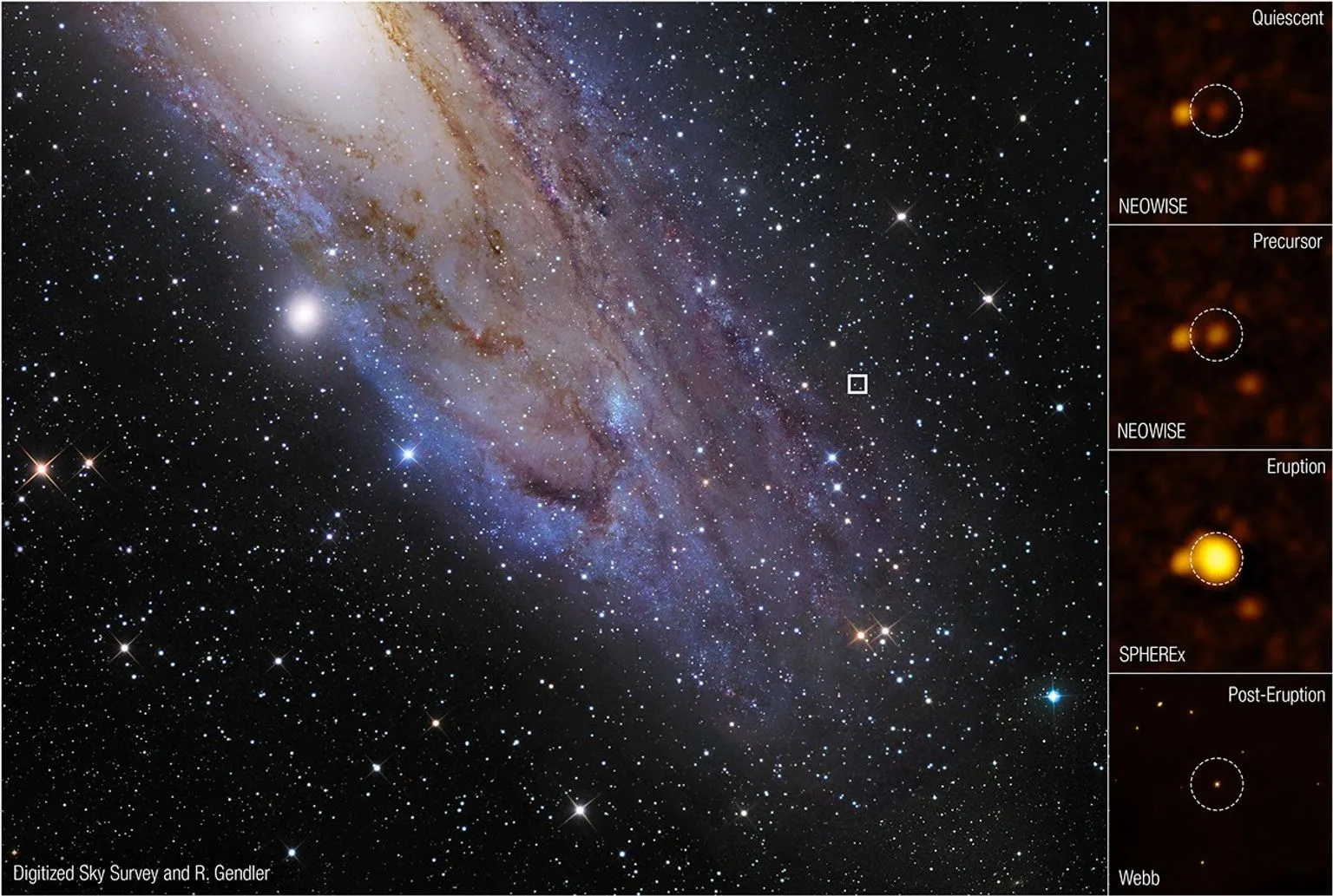
Viraj Karambelkar of Columbia University and a team of researchers used NASA's James Webb Space Telescope, plus a decade of survey data, to fully reconstruct the merger of a binary star system nicknamed Bao in the Andromeda galaxy, published in Nature. The result turns a rare, unpredictable event into a measurable case study of common envelope evolution, the process that decides whether binary stars merge or survive to become black holes, neutron stars, and gravitational-wave sources.
Somewhere at the outskirts of Andromeda, a star slightly less massive than the Sun spiraled into a puffy supergiant and disappeared. From first contact with the giant's surface to unification took seven orbits, roughly seven years. Other known binary mergers, the ones involving two smaller stars, have stretched across thousands of orbits. And in a field where the central problem is that stellar mergers are, in the words of first author Viraj Karambelkar, "very, very difficult to observe in real time because they are hard to predict," this team got the rarest thing in the discipline: warning. They noticed something odd in 2023, kept watching, and when the system erupted in 2025, NASA's James Webb Space Telescope was on it just 47 days after peak, the earliest-ever follow-up of an event like this. The paper, with Karambelkar, a NASA Hubble Fellow at Columbia University in New York, as first author, published Wednesday in Nature.
Webb's December 2025 observations supplied the final piece of evidence, the one that let researchers fully reconstruct what happened before, during, and after the merger of the binary nicknamed Bao. The newly single star may even be "rejuvenated" by the collision. What makes Bao a first of its kind is not that two stars merged, it is that anyone can prove it. The telescope's mid-infrared data let the team see the dust the more massive primary star had shed over centuries, which anchored the simulations and let the researchers rewind the tape. "Webb observed Bao only 47 days after the stars' eruption peaked," Karambelkar said. "The telescope's data helped us characterize what the system looked like before, during, and immediately after the merger, which is absolutely mind-blowing."
Before the ending, there were millennia of quiet. The two stars orbited placidly as a binary pair. Then the smaller star touched the giant's surface, and the clock started. "When a companion star begins to interact with the outer surface of the primary star, it produces a subtle effect, a slow brightening, which we clearly saw in Bao's data," said co-author Kishalay De, an assistant professor at Columbia University. "As the companion continues its orbit, it keeps peeling off the primary star's outer layers, and that gas flows away into the surrounding space." That shared gas is the common envelope, and drag through it bleeds the companion's orbital energy until it cannot stay in orbit. This is the stage the team caught in motion, and it moved far faster than the textbooks suggested. "We thought an outburst from such an extended star would take years," said co-author Nadia Blagorodnova, an associate professor at the University of Barcelona in Spain. "One day, its brightness started rising and within a week, it peaked!"
Merging was never the only possible outcome. In other systems both stars survive the same process, shedding a lot of mass but staying independent in tight orbits. Those survivors are the interesting ones down the line: over time such pairs can become neutron stars and black holes, explode as supernovae, produce ripples in space-time known as gravitational waves, and create millisecond pulsars. Which branch a system takes depends on how efficiently the envelope carries away energy and angular momentum, and that efficiency is exactly what Bao let the team measure rather than assume.
To get there, the researchers updated their ongoing simulations until one matched Webb's mid-infrared view of that centuries-old dust. The pre-merger primary came out enormous: seven times the Sun's mass, 350 times its radius, and 18,000 times brighter. "It was an absolute beast of a star, completely outshining its companion in the data," said co-author Karel Temmink, a Ph.D. student at Radboud University in Nijmegen, Netherlands, who led the simulations. Hence Big Bao. The modeling also produced the first mass estimate for the smaller companion, the one that no longer exists: Little Bao was likely about 0.7 solar masses, with a slightly smaller radius than the Sun and fainter.
After the masses were in, the model hinted at leftover energy that might let Little Bao flee the scene. Further analysis killed that ending. Little Bao was dragged into Big Bao's core. Their encounter was, in De's words, "almost like a bomb exploding inside a living star." What Bao is now, and how its heft eventually settles, is a question for future observations.
The detection itself was a masterclass in patience plus infrastructure. Bao first caught the team's attention in February 2023, in data from NASA's now-retired NEOWISE mission: before 2018 the object had held a consistent luminosity. The Wide-field Infrared Transient Explorer in September 2024 showed it brightening and spewing dust. NASA's SPHEREx caught it serendipitously during a routine survey in July 2025, fading in visible light and brightening in infrared. The Zwicky Transient Facility detected the eruption on Oct. 17, 2025, as the stars rapidly brightened and radically heated up. In November 2025 came fast-turn observations from NASA's now-retired Neil Gehrels Swift Observatory. The team had even published a first paper right before the eruption.
Why should anyone outside astrophysics care? Because common envelope evolution is the bottleneck in the story of how binary stars become the exotic objects that ripple spacetime, and it has been chronically under-measured, since it usually happens too fast and too unpredictably to catch. Bao converts a rare accident into a calibrated data point, and it does so using a supply chain of telescopes, some already decommissioned, one brand new, that most institutions treat as sunk cost. The strategic read for any organization that depends on rare events: the win came from continuous monitoring of something unremarkable, then a rapid-response capability that existed before the emergency. Seven orbits of warning is only useful if you are still watching.
This story's Key Insights and Take-aways are locked.
Create a free account to unlock Executive Actions for one credit.
Register to UnlockAlways free for Executives Club members. Join the Club
More in Science

Anthropic's I.P.O. Made Rank-and-File Researchers Worth Tens of Millions
Researchers who joined just a few years ago are now worth tens of millions, and the windfall resets the pay benchmark for every private A.I. lab still paying in paper.

Sea Lion Culling Strategy Fails: New Model Says Killing Them Won't Save Salmon
The latest research from AAAS overturn a long-held conservation assumption, forcing policymakers to rethink critical resource allocation in marine ecosystems.

Microplastics do more than pile up: they react with water to damage cells
Scientists have found that plastic particles can generate highly reactive molecules in water, a mechanism that could explain links to heart attacks, strokes, and neurological disorders.