
A star swallowed another star. Webb caught the aftermath in 47 days
Astronomers watched a small star spiral into a giant 18,000 times brighter than the Sun in Andromeda, and Webb's 47-day follow-up is rewriting how stellar mergers get studied.
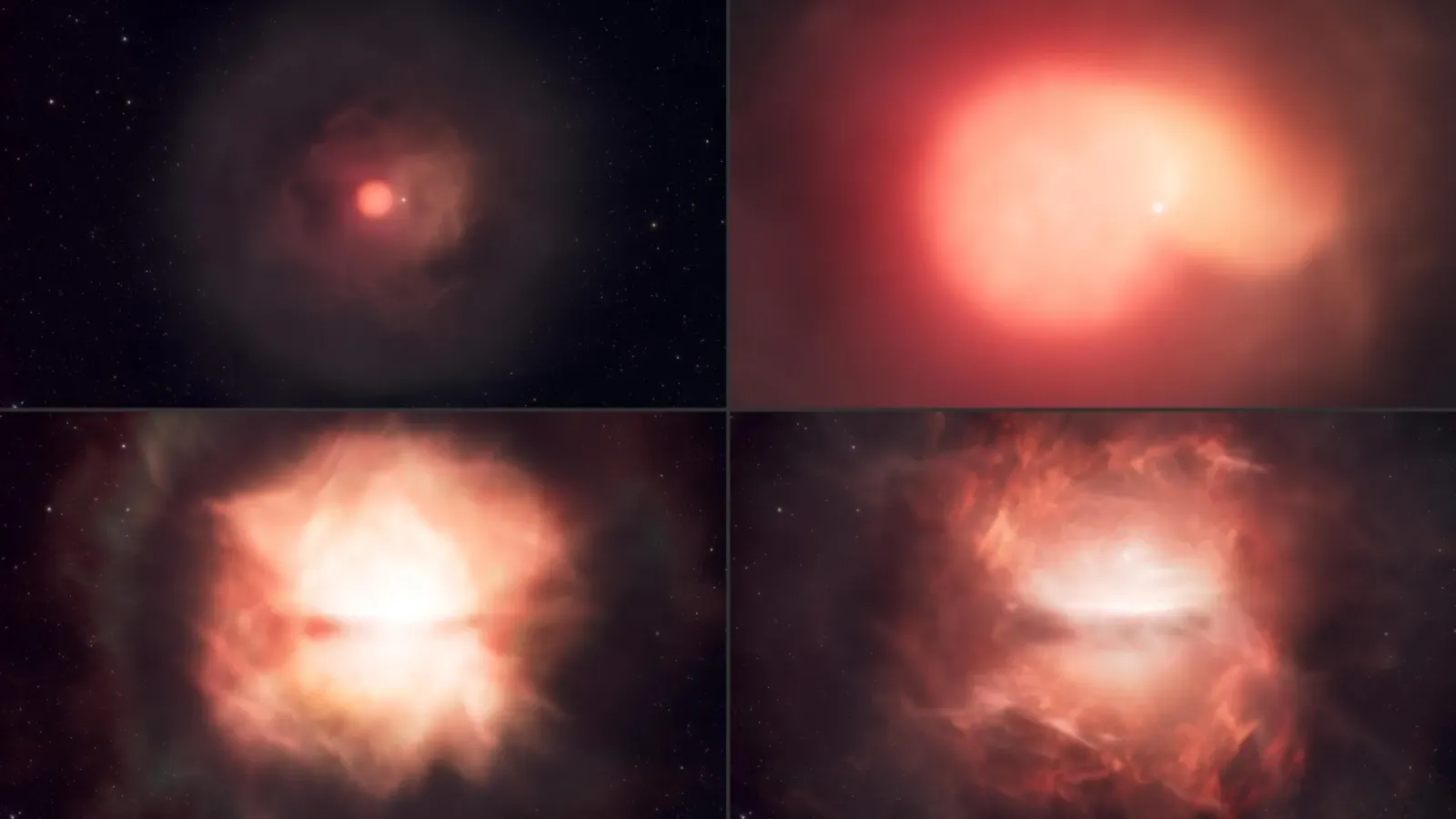
Astronomers have witnessed a small star spiral into a giant star 18,000 times brighter than the Sun in the Andromeda galaxy, triggering a violent eruption that NASA's James Webb Space Telescope imaged just 47 days later. The catch gives researchers their clearest look yet at how two stars merge into one, and it shows that rapid follow-up, not raw telescope size, is what turns a fleeting cosmic event into usable data.
Astronomers have watched a star die inside another star. In the Andromeda galaxy, a small star spiraled into a giant star 18,000 times brighter than the Sun, triggering a violent eruption. NASA's James Webb Space Telescope then captured the aftermath just 47 days later, and what it recorded is filling in one of the murkiest chapters in stellar physics: how two stars become one.
The 47 days is the part that should make you sit up. Stellar mergers are not slow, tidy events you can book into a calendar. They are brief, violent, and usually buried in the dust they throw off. Catching the immediate aftermath, rather than a scar that has had centuries to cool, is the difference between watching a fire and studying ash. For context, space telescope observing time is typically allocated months in advance through competitive proposals, which makes a 47-day follow-up a statement about how fast the machinery can move when something rare appears.
Here is the plain-English version of what happened. Most stars are not solitary; a large share orbit in pairs or larger groups. When one member of a pair swells into a giant, its outer layers can engulf its smaller companion. The companion does not simply crash. It spirals, dragged inward as the giant's envelope saps its orbital energy, and the end of that spiral is a merger. The energy released in the final plunge is what astronomers saw as an eruption. The driver is not malice but gravity and drag, the same physics that slows a satellite in thin atmosphere, scaled up to an object 18,000 times brighter than our Sun.
Andromeda is the right place to catch one. It is the nearest large galaxy to our own, roughly 2.5 million light-years away, close enough that individual stars can be picked out rather than blurred into a smear of light. Astronomers have historically treated it as the closest analogue to our own Milky Way, which makes anything observed there immediately comparable to home. That proximity is why a single event in Andromeda can be studied in detail instead of inferred from a brightness curve. Distance, in astronomy, is resolution.
Webb's contribution is wavelength. Eruptions like this fling material outward, and that material typically blocks the visible light that older observatories rely on. Infrared light cuts through much of that dust, which is why an infrared telescope can resolve structure in the aftermath that would otherwise stay hidden. The result is not just a sharper picture. It is a measurement of what a merged system looks like days, not decades, after the collision, which is precisely the window models have historically had to guess at.
The broader payoff is about how stars end up. Mergers are one route by which binary systems collapse into a single, stranger object, and the details matter: how much mass is shed, how fast, what the remnant looks like. Those details feed models of stellar evolution, of the odd stars that seem too heavy or too chemically strange to have formed alone, and of the explosive endpoints that follow. The same physics shows up in the exotic objects that populate the sky, the ones that refuse to fit neatly into a single-star story. Every well-timed observation of a merger tightens those models.
Strip away the astrophysics and there is an operating lesson that travels well outside astronomy. Rare, high-value events reward whoever is instrumented and ready to move. This result was not won by aperture alone. It was won by a system that could point a flagship asset at a target within weeks and pull data out of a scene that was actively fading. Organizations that build fast follow-up into their default posture, rather than treating it as an exception, tend to be the ones holding the evidence when it counts.
What to watch next is not a single headline but a pattern. If mergers like this one can be caught in their immediate aftermath, the question shifts from whether they happen to how often, and how much of what we call stellar evolution is really stellar collision. For now the ledger reads: one small star, one giant 18,000 times brighter than the Sun, one eruption, and 47 days for NASA's Webb to arrive and look.
This story's Key Insights and Take-aways are locked.
Create a free account to unlock Executive Actions for one credit.
Register to UnlockAlways free for Executives Club members. Join the Club
More in Science

AI that nails brain-activity tests may be solving them the wrong way
A new discovery suggests strong neural-prediction scores do not prove a model works like the brain, a warning for labs, neurotech investors, and anyone selling brain-like AI.

Scientists Want to Test Whether a Clock Can Run on Two Flows of Time
An atomic-clock experiment has been proposed to catch a never-observed quantum effect, a result that would redraw the boundary between time and gravity.

Westminster Abbey's mystery skeleton: new dating points to a medieval abbot
Radiocarbon evidence suggests a high-ranking medieval abbot was buried in a centuries-old recycled Roman coffin, closing a 150-year question at Britain's most famous church.