
Westminster Abbey's mystery skeleton: new dating points to a medieval abbot
Radiocarbon evidence suggests a high-ranking medieval abbot was buried in a centuries-old recycled Roman coffin, closing a 150-year question at Britain's most famous church.
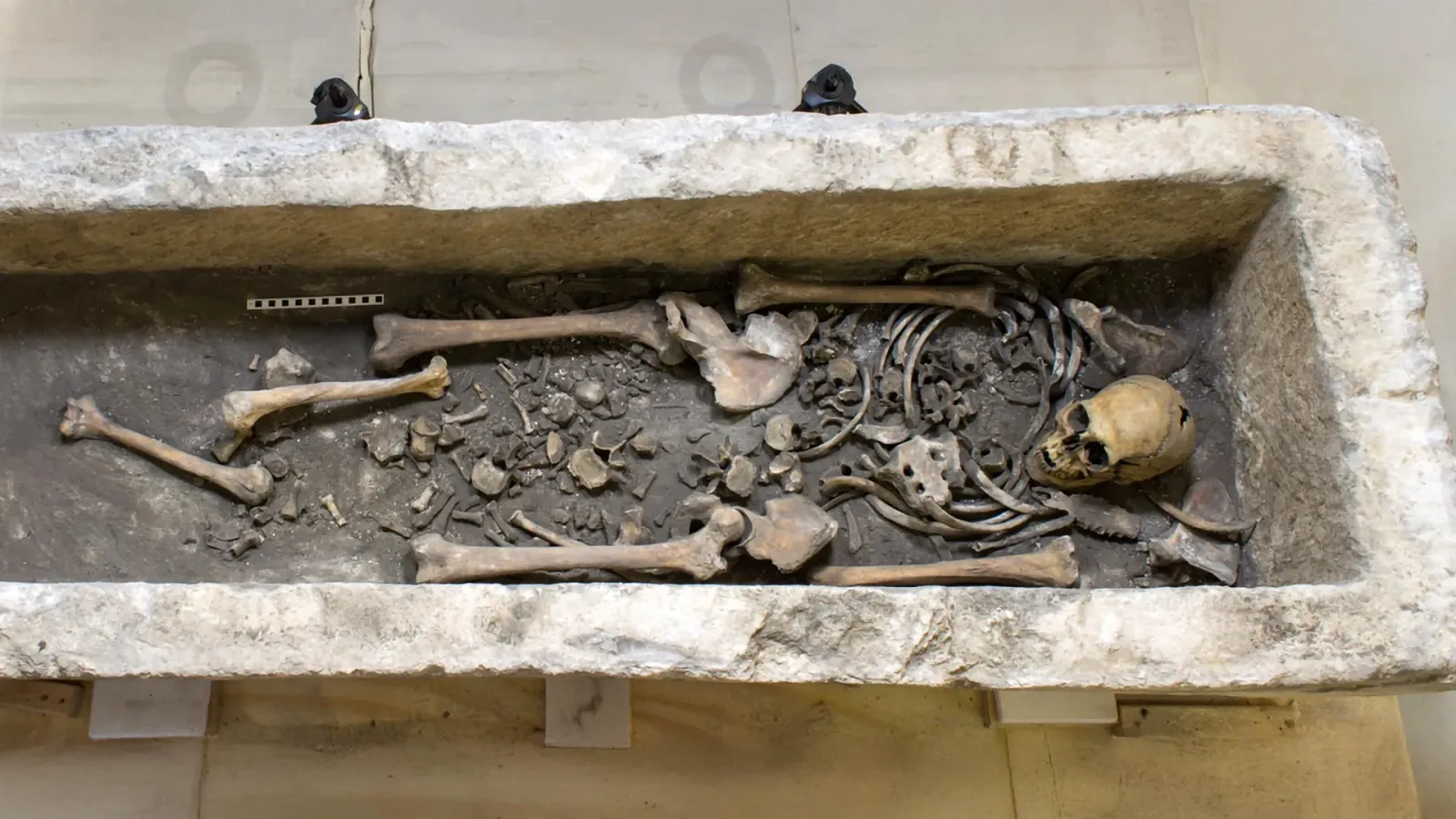
New dating evidence suggests a skeleton found in a Roman sarcophagus at Westminster Abbey, unidentified for more than 150 years, belonged to a high-ranking medieval abbot who was buried inside a recycled coffin. For any institution sitting on pre-modern collections, the case shows how cheap re-analysis can rewrite a story that visitors, donors and curators assumed was settled.
For more than 150 years, a skeleton found inside a Roman sarcophagus at Westminster Abbey has been one of British archaeology's quietest open files. It may now have an answer, and the answer is a job title. New dating evidence suggests the remains belonged not to a Roman but to a high-ranking medieval abbot, a man buried inside a coffin that was already centuries old when he died. The Roman sarcophagus, in short, was not his. It was recycled.
That reversal is the entire story. The coffin is Roman. The occupant, on the new evidence, is medieval. For a century and a half the assumption ran the other way: Roman stone, therefore Roman bones. The dating work separates two questions that had been treated as one, namely when the container was carved and when the person inside it was buried. Split them apart and the puzzle stops looking like a contradiction and starts looking like a habit.
Reusing older stone is not an oddity in the archaeological record. It is closer to the norm. Roman sarcophagi were cut from marble and other fine stone, and they survived in large numbers across Italy, Gaul and Roman Britain. For medieval churchmen and builders, they were premium material sitting in plain sight: already carved, already hollowed out, already associated with the dead. Historians typically describe this practice as reuse or, in the Latin, spolia. A medieval abbot laid to rest in a Roman coffin is therefore not a scandal or a mistake. It is a status signal and a practical decision arriving at the same time.
Where it happened is what makes the identification interesting. Westminster Abbey has been the setting for royal coronations and royal burials for centuries, and its medieval abbots were not minor officials. They ran one of the wealthiest religious houses in England, operated close to the centre of political power, and were frequently buried inside the church they governed. A high-ranking abbot interred within the abbey walls fits that pattern exactly. It also explains why the coffin was worth reusing in the first place: burial inside the abbey was reserved for people the institution intended to remember.
So why did it take more than 150 years? Because the tools did not exist when the skeleton was found. The discovery dates to the 19th century, well before radiocarbon dating was developed in the mid-20th century. Early investigators had to reason from typology, inscriptions, location and the objects found nearby. Those methods are good at telling you what a coffin is. They are far weaker at telling you when the person inside it died, particularly when the coffin is older than the burial. Radiocarbon dating measures the decay of carbon-14 in organic material such as bone, which gives an independent clock for the body rather than for the box around it.
The Westminster case is a small, vivid example of a much larger shift. Cathedrals, museums and national collections are full of objects whose labels were written before modern analytical techniques existed. Re-testing them is cheap relative to excavation, and it often produces the same effect seen here: the object stays the same, the story changes. That is a provenance problem and an opportunity in one package. Institutions that re-examine their own holdings can correct the record, generate fresh research, and hand visitors a reason to return.
There is a second-order effect that matters more than the headline. Once a body's date is fixed, every other assumption attached to it becomes testable: the coffin's own date, the burial's position within the abbey's chronology, the objects found with it, and any documentary record of abbots buried in that part of the church. Each of those is a separate research question, and each one is now anchored to a firmer fact than it was before. That is how a single re-dating quietly reorganises an entire file.
For the people who run those institutions, the lesson is about where the value actually sits. Westminster Abbey is a working church, part of a UNESCO World Heritage Site, and a major visitor attraction whose appeal rests on the density of its stories. The marginal cost of re-dating a skeleton already in storage is trivial next to the cost of a new gallery or a blockbuster exhibition. What it buys is a better story, and better stories are what fund conservation, staffing and access in the first place.
The abbot, if the dating holds, gains something most anonymous skeletons never get: a role. He becomes evidence of how medieval England handled death, status and salvage, and a reminder that the past recycles itself. The open question is the one the evidence cannot yet settle, which abbot, and whether records held inside the abbey can put a name to the bones. Until then, the headline finding stands on its own. The Roman coffin at Westminster Abbey was never Roman. It was a hand-me-down, and the man inside it was a senior figure in the medieval church.
This story's Key Insights and Take-aways are locked.
Create a free account to unlock Executive Actions for one credit.
Register to UnlockAlways free for Executives Club members. Join the Club
More in Science

AI that nails brain-activity tests may be solving them the wrong way
A new discovery suggests strong neural-prediction scores do not prove a model works like the brain, a warning for labs, neurotech investors, and anyone selling brain-like AI.

Scientists Want to Test Whether a Clock Can Run on Two Flows of Time
An atomic-clock experiment has been proposed to catch a never-observed quantum effect, a result that would redraw the boundary between time and gravity.

A star swallowed another star. Webb caught the aftermath in 47 days
Astronomers watched a small star spiral into a giant 18,000 times brighter than the Sun in Andromeda, and Webb's 47-day follow-up is rewriting how stellar mergers get studied.