
A sun-like star spiraled into a supergiant. The survivor is named Bao
Webb's quick-turn infrared follow-up, cross-checked against space and ground data, confirms a first-of-its-kind merger on Andromeda's outskirts and hands astronomers a named test case for stellar rejuvenation.
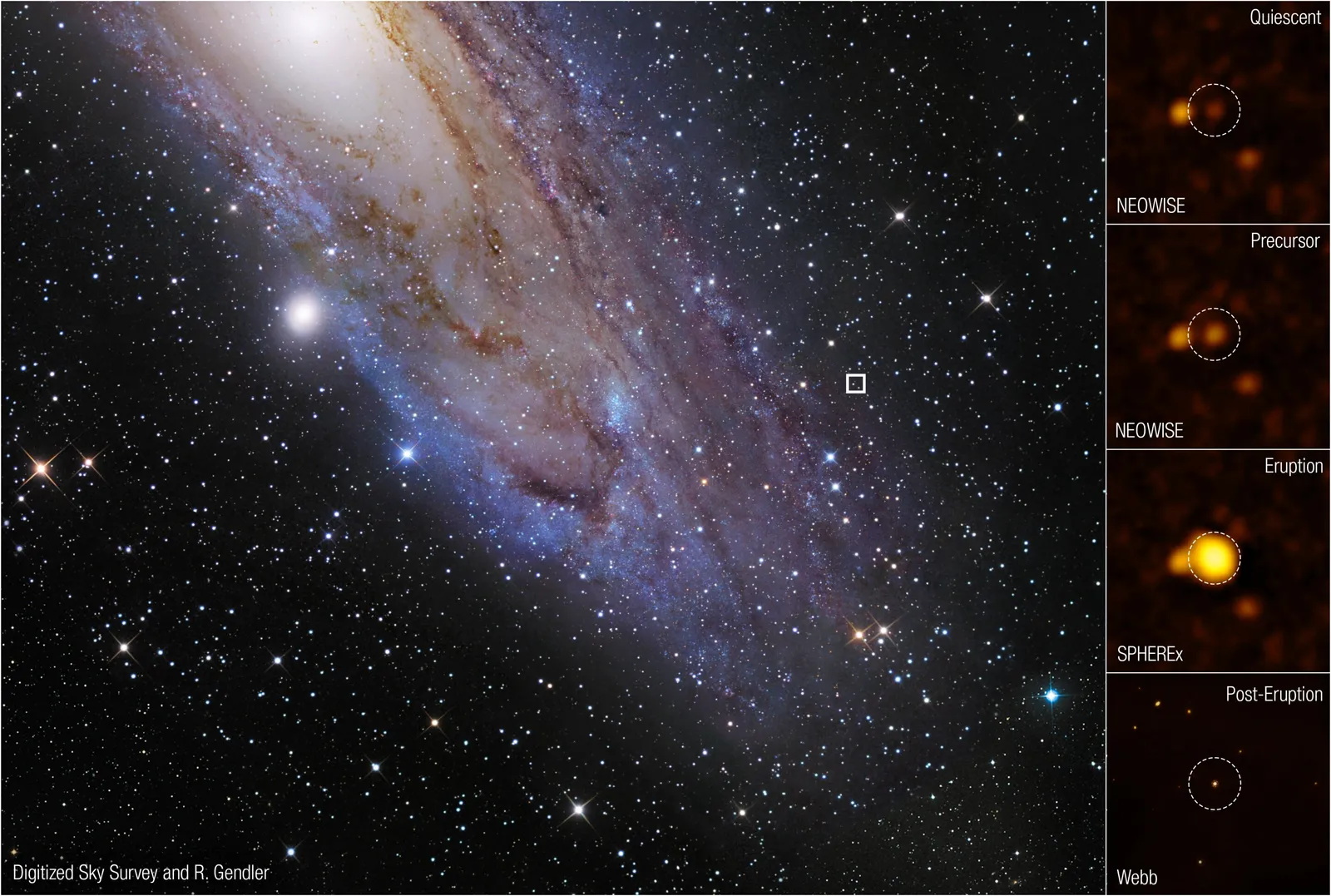
Researchers have identified a first-of-its-kind event: a star slightly less massive than the sun spiraled into and merged with a puffy supergiant on the outskirts of the Andromeda galaxy, leaving a single star they nicknamed Bao. The finding, bolstered by quick-turn James Webb Space Telescope observations cross-referenced with extensive space- and ground-based data, gives astronomers a rare direct case of a merger rather than an inference from stellar oddities.
Somewhere on the outskirts of Andromeda, a star slightly less massive than the sun spiraled into a puffy supergiant and did not come back out. What remains is a single star, and the researchers who found it nicknamed it Bao. It is a first of its kind: no merger quite like this one had been identified before. The discovery was then bolstered by quick-turn observations from NASA's James Webb Space Telescope, carefully cross-referenced with extensive data from telescopes in space and on the ground. Two stars went in. One came out. That is the whole story in a sentence, and it is exactly why astronomers are paying attention.
The word the researchers reached for is "rejuvenated," and they put it in quotes for a reason. In stellar astronomy, a rejuvenated star is one that looks younger than its history says it should: hotter, bluer, or brighter than a star of its age has any right to be. Historically, astronomers have inferred mergers this way, by spotting stars that sit in the wrong place on their charts and reasoning backward to a violent past. Bao is a different kind of evidence. Here, the merger itself was identified, and the potentially rejuvenated star is the aftermath rather than the only clue.
The physics of the spiral is where the story gets interesting. A supergiant is not a tidy sphere. It is a puffy object with an enormous, loosely held outer envelope, and that puffiness is the opening. A smaller companion that orbits close enough can bleed orbital energy into those outer layers, sink inward, and end up inside the bigger star. What follows is less a collision than an absorption: the smaller star is swallowed, the system settles, and a single object is left behind. The mass budget changes, the envelope changes, and the star that remains can look nothing like either of its parents.
That is where Webb came in. Quick-turn observations matter because events like this do not wait for a convenient observing schedule. The telescope's infrared view, cross-referenced against extensive data from other space- and ground-based instruments, gave the team a fast second look at the same target rather than a single snapshot from one machine. The result is a case built on agreement: multiple instruments, multiple wavelengths, one conclusion. That is the difference between a candidate and a confirmed first.
Location matters too. Andromeda is the nearest large spiral galaxy to our own, roughly 2.5 million light-years out, close enough to be a laboratory rather than a postcard. The outskirts of a galaxy are a quieter neighborhood than the crowded core, with less of the churn that complicates a clean read. Finding this system there gives researchers a comparatively legible case, one where the merger can be studied without a dozen other effects shouting over it.
Mergers are not exotic in theory. Dense stellar environments are thought to be full of them, and the evidence has typically been circumstantial: odd colors, odd masses, odd positions on a chart. Catching a specific merger and being able to point at the survivor is a different level of proof. It converts a class of inference into a named object with a nickname, which is how a research result becomes something the public can hold onto.
The stakes are bigger than one odd star. Mergers rewrite the mass ledger of a stellar population, and mass is what determines how a star lives and how it dies. A population with mergers in it is not the same population you would predict from birth alone. Every confirmed case sharpens the models astronomers use to age star clusters, estimate what will explode and when, and account for the chemical elements those explosions scatter. Bao is one data point, but it is a data point of a kind that was previously missing.
The broader lesson is about follow-up. A candidate detection is cheap; a confirmed one requires a telescope that can turn quickly and a team that can cross-check across instruments. That is the machinery that turned this from a curiosity into a first. The interesting part is not only that a star ate its neighbor. It is that the system was built to catch it.
This story's Key Insights and Take-aways are locked.
Create a free account to unlock Executive Actions for one credit.
Register to UnlockAlways free for Executives Club members. Join the Club
More in Science

Anthropic's I.P.O. Made Rank-and-File Researchers Worth Tens of Millions
Researchers who joined just a few years ago are now worth tens of millions, and the windfall resets the pay benchmark for every private A.I. lab still paying in paper.

Sea Lion Culling Strategy Fails: New Model Says Killing Them Won't Save Salmon
The latest research from AAAS overturn a long-held conservation assumption, forcing policymakers to rethink critical resource allocation in marine ecosystems.

Microplastics do more than pile up: they react with water to damage cells
Scientists have found that plastic particles can generate highly reactive molecules in water, a mechanism that could explain links to heart attacks, strokes, and neurological disorders.