
After 15 years of nothing, Rubin spots two asteroids tailing Neptune
The Vera C. Rubin Observatory caught two rare L5 Trojans within three weeks of starting a test run, and simulations say they will keep pace with Neptune for another billion years.
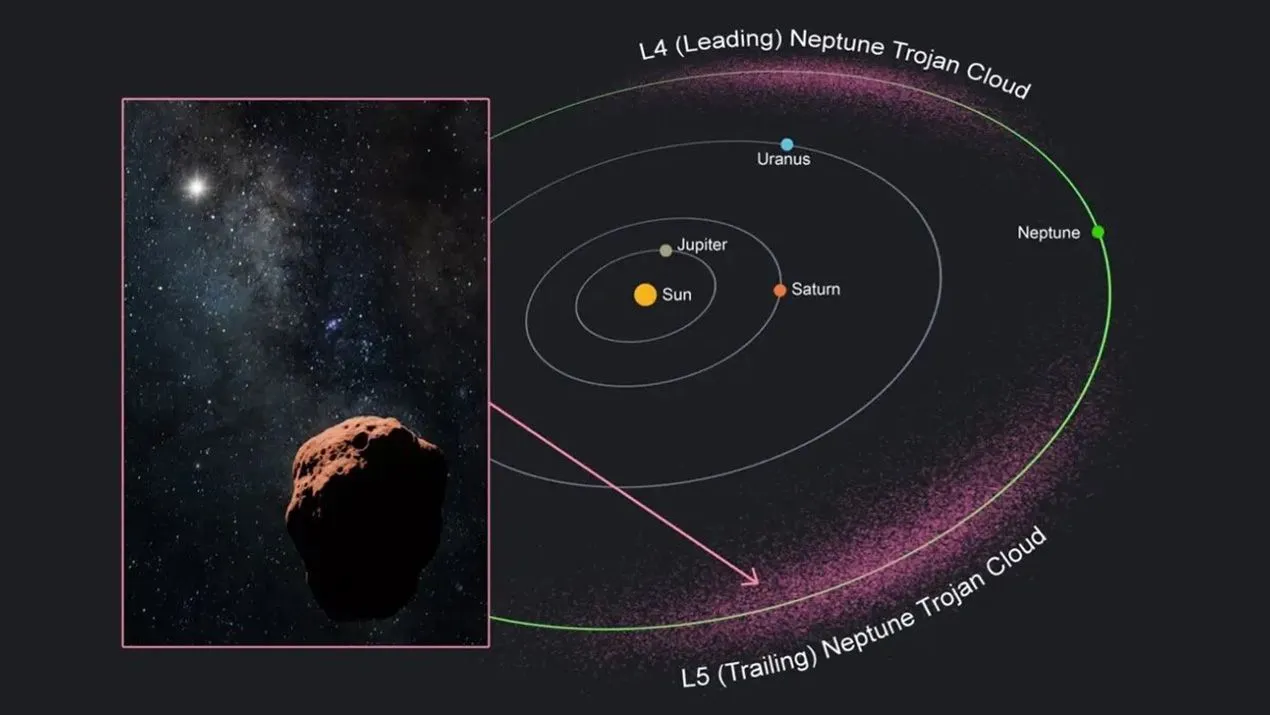
Astronomers Megan Schwamb of Queen's University Belfast and Kathryn Volk of the Planetary Science Institute reported two Neptune L5 Trojan asteroids found in Vera C. Rubin Observatory data, the first such discoveries in 15 years, published Oct. 15 in The Astrophysical Journal Letters. The find signals that the observatory's decade-long LSST survey is likely to surface far more of these ancient planetary building blocks, sharpening the picture of how the solar system formed.
Two asteroids have been tailing Neptune around the sun, and for 15 years nobody could see them. Astronomers working with data from the Vera C. Rubin Observatory have now confirmed them, making these the first new Neptunian Trojans spotted in a decade and a half. The pair are L5 Trojans, which means they sit roughly 60 degrees behind the planet along its orbital path. The study was published Oct. 15 in The Astrophysical Journal Letters, with Megan Schwamb, a Queen's University Belfast researcher who studies how planets and their building blocks form and evolve, as first author, and Kathryn Volk, a scientist at the Planetary Science Institute in Arizona, as co-author.
Context for the rarity: before this, astronomers had confirmed only 28 Neptunian Trojans in total, and just two of those were long-term L5 members. The new find takes the confirmed population to 30, and the long-term L5 club to four. That is a very small number against a very large prediction. A 2005 study suggested Neptune could host up to 10 times more Trojans than Jupiter, and Jupiter's swarm is already the most famous in the solar system, with the International Astronomical Union's Minor Planet Center counting an incredible 15,000 discovered so far.
Trojan asteroids are icy, rocky bodies that live in a planet's neighborhood without orbiting it. Instead they orbit the sun on the same path as the planet, clustered in two swarms roughly 60 degrees ahead of and behind it. Those spots are Lagrange points 4 and 5, where the gravitational pulls of the sun and the planet balance each other and essentially lock the asteroids in place, according to NASA. Very few Trojans actually hang around for billions of years, which is exactly why the survivors matter: they are likely leftover planetary building blocks from the solar system's infancy.
So why the 15-year drought? Two reasons, and only one of them was about the rocks. The Neptunian Trojans are extremely faint, which is the obvious problem. The bigger one was geometry. For nearly 15 years, the L5 population's position in the sky as seen from Earth overlapped with the central region of the Milky Way, and bright background stars made it nearly impossible to discern the tiny, faint asteroids, Schwamb told Live Science in an email. Then, from 2025 onward, the L5 group began to drift, extremely slowly, away from the galactic plane. The window reopened on its own.
Rubin walked through that window with the right hardware. The observatory scans the entire Southern Hemisphere sky with what its website describes as the world's largest digital camera, has a field of view equivalent to seven full moons, and can detect objects 100 billion times dimmer than Venus. "Rubin is pretty uniquely suited to being excellent at discovering Neptune Trojans," Volk told Live Science in an email. "The on-sky density of these objects is not particularly high, so having a large field of view helps a lot!" Translated: when your targets are scattered thin across an enormous sky, the winning move is to look at a lot of sky at once, deeply, over and over.
The detections came out of the Rubin Science Validation Survey, a three-month test run held in mid-2025 ahead of the observatory's flagship decade-long Legacy Survey of Space and Time, which is now underway. By chance, the validation run covered the patch of sky holding Neptune's L5 Trojans, and the asteroids were photographed within three weeks of the survey's start. A rehearsal that pays off inside a month is a strong leading indicator of what the main event might produce.
After the discoveries, the team built computer models to pin down the asteroids' orbits. The simulations showed the duo will keep tagging behind Neptune for a billion years, and that their trajectories have been stable for several billion, meaning they may have been running these routes since the early solar system. The team also found a third object in Rubin's data, but it held a stable orbit in only some of the simulations, so it is classified as a candidate Trojan rather than a confirmed one. That distinction is the real work: detection is the cheap part, confirmation is the grind.
The orbits also carry a story. The two confirmed Trojans are highly tilted, just like the previously discovered L5 asteroids, which suggests Neptune captured these objects as they were hurtling past rather than letting them form in place alongside it. For anyone trying to reconstruct the solar system's infancy, when the giant planets are believed to have migrated to their present-day positions, these captured rocks are a flight recorder. "Determining the properties of both the Jovian and Neptunian Trojan asteroids will help researchers understand what happened during the solar system's infancy," Volk said.
Schwamb expects the LSST to unveil many more of the hypothesized Neptunian Trojans, especially because it will survey this same patch of the sky repeatedly over the next several months. Repeat scanning is the entire point. A single pass finds objects; repeated passes turn them into orbits, and orbits turn them into history. Against a hypothesized population up to 10 times Jupiter's, a confirmed count of 30 is not a rounding error. It is a starting line.
The broader lesson travels well beyond planetary science. Rubin's edge was not one clever observation but a combination: a structural blocker, galactic glare, cleared by slow orbital drift; a purpose-built instrument with an enormous field of view; and a validation phase that happened to sweep the right coordinates. None of those three were controlled by the researchers. What they controlled was being ready when all three lined up, and having the models in place to convert raw detections into a claim about a billion years of orbital stability.
For anyone watching the observatory's decade-long survey, the near-term metric to track is not the headline count of Trojans. It is the conversion rate: how many detections survive into confirmed orbits. If a three-month rehearsal produced two confirmed billion-year Trojans and one candidate in three weeks, the follow-up pipeline, not the telescope, becomes the constraint worth watching. The solar system's leftovers are finally visible. The question now is how fast anyone can do the bookkeeping.
This story's Key Insights and Take-aways are locked.
Create a free account to unlock Executive Actions for one credit.
Register to UnlockAlways free for Executives Club members. Join the Club
More in Science

Anthropic's I.P.O. Made Rank-and-File Researchers Worth Tens of Millions
Researchers who joined just a few years ago are now worth tens of millions, and the windfall resets the pay benchmark for every private A.I. lab still paying in paper.

Sea Lion Culling Strategy Fails: New Model Says Killing Them Won't Save Salmon
The latest research from AAAS overturn a long-held conservation assumption, forcing policymakers to rethink critical resource allocation in marine ecosystems.

Microplastics do more than pile up: they react with water to damage cells
Scientists have found that plastic particles can generate highly reactive molecules in water, a mechanism that could explain links to heart attacks, strokes, and neurological disorders.