
AI writes the resume, then AI screens it. The double bias filter.
One model drafts a woman's resume, another scores it, and when both carry the same gender stereotypes the bias compounds before a human ever reads a page.
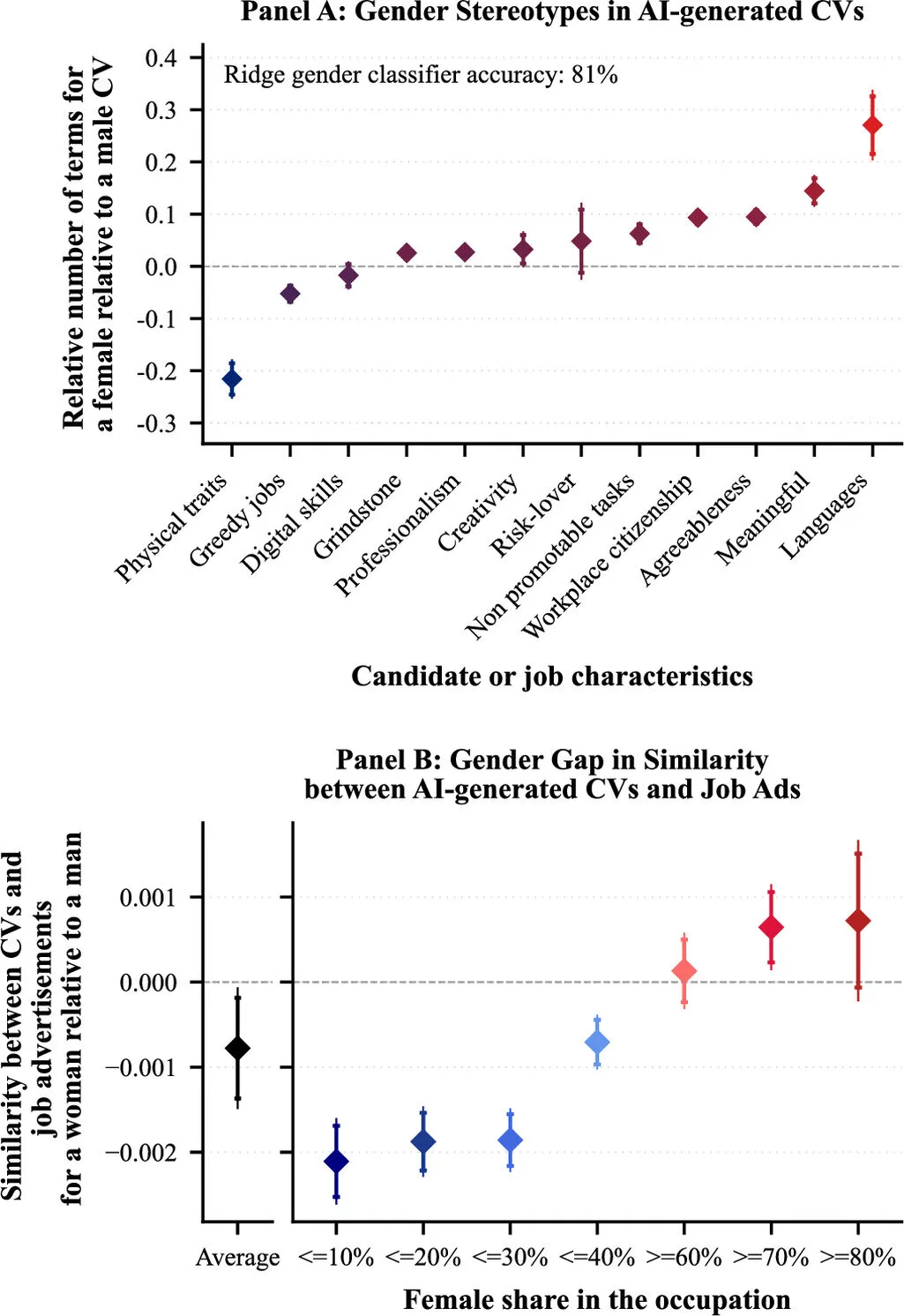
AI resume-writing tools and AI hiring-assessment models can share the same underlying training, so a woman's application can be shaped by gender stereotypes and then penalized for them by a second system, according to a Phys.org report on gender bias in resumes and hiring assessments. For employers, that means the two-vendor setup most companies assume is a safeguard can function as a double filter, compounding bias before a recruiter ever makes a call.
The double filter is the story. A woman asks an AI tool to help her write her resume. The system chooses the words, decides which qualities to highlight, and builds a profile. Then a second system, possibly built on the same underlying model, reads that text and scores it. If both reproduce gender stereotypes, the bias does not cancel out. It compounds. Bias enters the application at the drafting stage, then gets reinforced by the person making the final selection. That is the mechanism Phys.org reported, and it is the kind of quiet design flaw nobody notices until the hiring data gets audited.
Here is why the pipeline matters more than either tool on its own. Most employers now treat AI resume help and AI screening as two separate purchases, often from two separate vendors, and assume the separation provides a check. It does not, if the models share a lineage. Two systems trained on overlapping text inherit overlapping associations about which words sound like leadership and which sound like support work. The writer optimizes the resume for the screener. The screener rewards whatever the writer produced. A closed loop forms, and the candidate never sees it.
The drafting stage is where the damage starts, because it looks like help. When a model chooses words and highlights qualities, it is making editorial judgments about what a strong candidate sounds like. Those judgments are drawn from patterns in the training data, and the training data is the working world as it has been, not as employers say they want it to be. For context, human resume coaches have warned for years that identical accomplishments described with different verbs read differently depending on who is reading. Automating the rewrite does not remove that effect. It scales it, and it hides it behind a polished, consistent format that feels objective.
Then the second model reads. If it was fine-tuned from the same base model, or trained on similar resume corpora, it is likely to reward the same signals the first model inserted. The result is a candidate penalized twice for the same pattern: once in how her experience is described, once in how that description is scored. The reverse also holds. A candidate whose AI-assisted resume happens to match the model's preferred vocabulary gets a boost that has nothing to do with ability.
The human reviewer is not the firewall people assume. The Phys.org report notes that bias is reinforced by the person selecting from the shortlist. A recruiter facing hundreds of near-identical, AI-polished resumes leans harder on the score, the ranking, the summary the tool provides. The tool's judgment becomes the tiebreaker, and the tiebreaker is where the stereotype lives.
For context, the regulatory floor is rising. New York City has required bias audits and candidate notice for automated employment decision tools since 2023, and federal agencies have signaled that existing anti-discrimination law applies to algorithmic screening the same way it applies to a human interviewer. In the EU, employment-related AI is treated as high risk under the AI Act, which brings documentation, logging, and human-oversight obligations. None of those rules require a company to prove intent. Disparate impact is enough, and a two-model pipeline that compounds a stereotype is exactly the fact pattern regulators look for.
The practical fix is unglamorous. Audit both ends of the pipeline, not just the screener. Ask vendors whether their writing and evaluation products share a base model or training data, and get the answer in writing. Test the same candidate profile with names and pronouns swapped, then compare the outputs. Keep a human in the loop who has the authority to override the score and a reason to use it. Log the decisions, because the first question in any investigation will be what the system recommended and who followed it.
The strategic stake is simple. Hiring is one of the few functions where a company's stated values meet a measurable outcome, and AI has quietly inserted itself into both the pitch and the verdict. A firm that deploys these tools without auditing the handoff is not just risking a complaint. It is narrowing its own talent pool, filtering out candidates whose only real flaw is that a model was trained on the world as it was. The companies that catch this early will hire better people. The ones that do not will keep wondering why their pipeline looks so uniform.
This story's Key Insights and Take-aways are locked.
Create a free account to unlock Executive Actions for one credit.
Register to UnlockAlways free for Executives Club members. Join the Club
More in Science

Anthropic's I.P.O. Made Rank-and-File Researchers Worth Tens of Millions
Researchers who joined just a few years ago are now worth tens of millions, and the windfall resets the pay benchmark for every private A.I. lab still paying in paper.

Sea Lion Culling Strategy Fails: New Model Says Killing Them Won't Save Salmon
The latest research from AAAS overturn a long-held conservation assumption, forcing policymakers to rethink critical resource allocation in marine ecosystems.

Microplastics do more than pile up: they react with water to damage cells
Scientists have found that plastic particles can generate highly reactive molecules in water, a mechanism that could explain links to heart attacks, strokes, and neurological disorders.