
Alcaraz buries injury doubts, goes perfect in ATP Finals group stage
Alcaraz answered the injury questions by taking Flavio Cobolli apart, banking a perfect group-stage record and handing the rest of the ATP Finals field a problem it hoped to avoid.
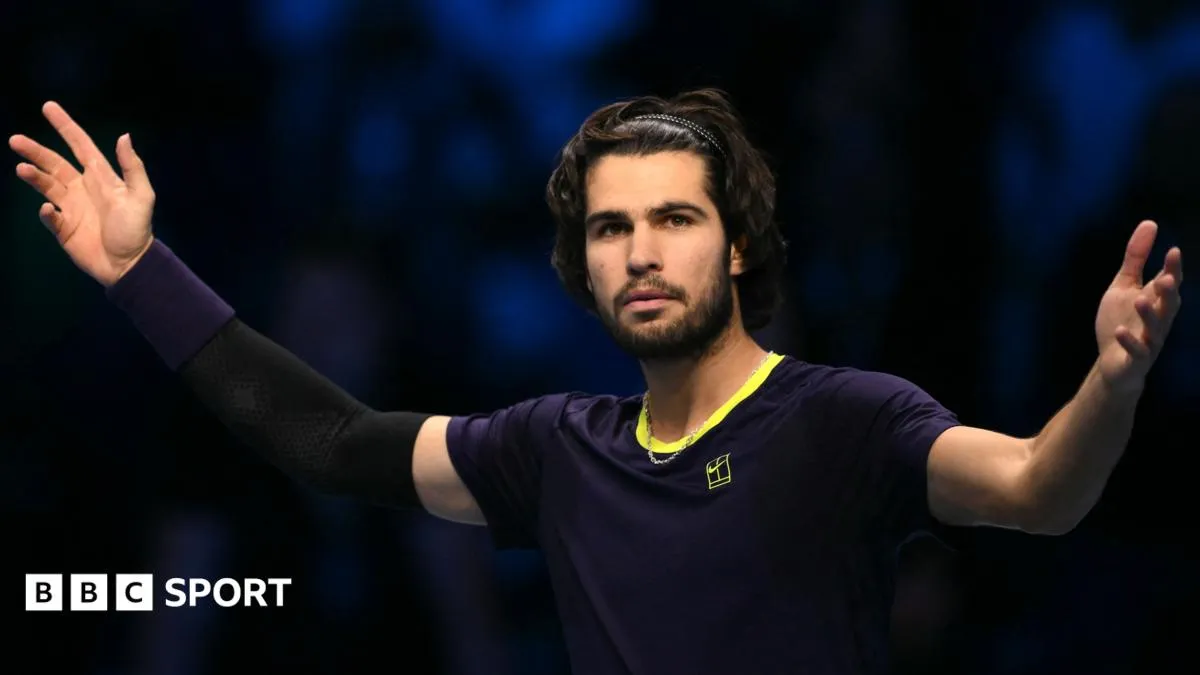
Carlos Alcaraz dismantled Flavio Cobolli at the ATP Finals to complete a perfect round-robin group stage, setting aside the injury concerns that followed him into the tournament. For the event's broadcasters, sponsors and every rival still alive in the draw, an unbeaten and visibly healthy Alcaraz is the most consequential variable left in the men's season.
Carlos Alcaraz walked into the ATP Finals carrying injury concerns and walked out of the group stage without a single loss. His dismantling of Flavio Cobolli was ruthless, the kind of performance that turns a match into a formality, and it sealed a perfect record in round-robin play at the season-ending championship. Put that in context: the ATP Finals gathers the eight best players on the men's tour, splits them into groups, and makes them play each other before anyone reaches a semifinal. Going unbeaten through that is not a hot streak. It is a statement.
The format is the point. Unlike a standard knockout draw, where one bad afternoon sends you home, the ATP Finals forces every player to survive three round-robin matches against opponents who qualified by being among the best in the world. Historically, the group stage rewards consistency over brilliance: you can lose once and still advance, which is exactly why a clean sweep carries extra weight. It means no tiebreak arithmetic, no sweating a result elsewhere in the group, no relying on a rival's collapse to sneak through. Alcaraz removed all of it. He now arrives at the knockout rounds as the player the other group did not want to draw.
The injury concerns are the more interesting thread, because they explain why this performance mattered as much as the result. The ATP Finals is the last major appointment of the men's season, typically staged indoors and scheduled after a ten-month grind that has already sorted the field by ranking. Players arrive carrying whatever their bodies accumulated along the way. The incentive to push through is enormous: this is one of the richest prize pools in the sport, it pays ranking points that shape seeding for the season that follows, and it is the final chance of the year to decide how the sport remembers you. A player who withdraws, or limps through the group stage, hands the last word of the season to someone else. Alcaraz chose the other option.
For Cobolli, the night was a different kind of lesson. He belongs to a deep Italian generation that has turned the country into a production line of top-level talent, and reaching the ATP Finals field is itself a credential. But there is a gap between qualifying for this tournament and surviving it, and Alcaraz closed that gap quickly. The value of these defeats, historically, is that they are the fastest education the sport offers: you learn exactly how far your level sits from the top, and you learn it in front of the entire tennis world. Cobolli's night is a data point about Alcaraz. If he is the player his generation suggests, it is also a receipt he will want to tear up next season.
The second-order effect runs through the rest of the field. In a round-robin, every player in a group is effectively scouting everyone else, and an opponent who wins three straight without visible strain changes how the others prepare. Typically, aggression goes up, because passive tennis against a fit Alcaraz is a slow defeat. Margins get tighter on serve, because you cannot donate free points. Coaches start game-planning for a semifinal they had hoped to avoid. That psychological tax compounds: a player who has to redline his game to survive a semifinal often reaches a final with nothing left in the tank.
Then there is the commercial layer. The ATP Finals is a product built on the premise that the best players show up healthy, and any event built on star power knows how quickly that premise can break. A marquee name arriving unbeaten, with the injury question answered on court rather than in a press conference, is worth more to a tournament than most marketing budgets can buy. Broadcasters get a storyline that writes itself. Sponsors get an asset that does not require a medical update. Ticket buyers get the version of the player they paid to see. Every one of those constituencies was quietly holding its breath before this match. None of them is holding it now.
For anyone who runs an organization with a single irreplaceable performer, the pattern is familiar. The most valuable asset on the roster is also the one whose availability you cannot take for granted, and the call on when to push and when to protect is rarely made with complete information. Alcaraz and his team made that call, and the scoreboard validated it. That is not luck. It is risk management with a public result.
What to watch now is whether the body holds through the knockout rounds. The group stage answers questions about form. The semifinal and the final answer questions about durability, because the field narrows and the margins shrink with it. Alcaraz has banked the advantage that matters most at this stage: he has not lost, he has not looked vulnerable, and everyone else in the draw now has to solve a problem they were hoping would solve itself. The injury concerns are not gone. They are simply no longer the headline.
This story's Key Insights and Take-aways are locked.
Create a free account to unlock Executive Actions for one credit.
Register to UnlockAlways free for Executives Club members. Join the Club
More in Entertainment

GTA 6 banks $3.8bn in one day, torching every launch record
One game just out-earned every video game launch and every single-day film box office haul in history, and the fallout lands on every media CEO's forecast.

GTA VI Racked Up $3.79 Billion in a Single Day, Topping Every Film Ever
A 13-year wait produced a $3.79 billion day, more than any movie has made in its entire run, and it resets the launch math for every studio, streamer, and brand chasing the same attention.

GTA 6 sells 32.5M pre-sales and $3.79B day one, torches 13-year record
Rockstar's sequel didn't just beat Grand Theft Auto V's 13-year-old benchmark; it reset what a launch can be, with 32.5 million pre-sale copies and $3.79 billion in a single day.