
An asteroid-hunting telescope just caught a star exploding 50 million light-years away
SN 2026ahvu was spotted while still brightening in the spiral galaxy NGC 1433, giving researchers a rare front-row seat to a Type Ia blast.
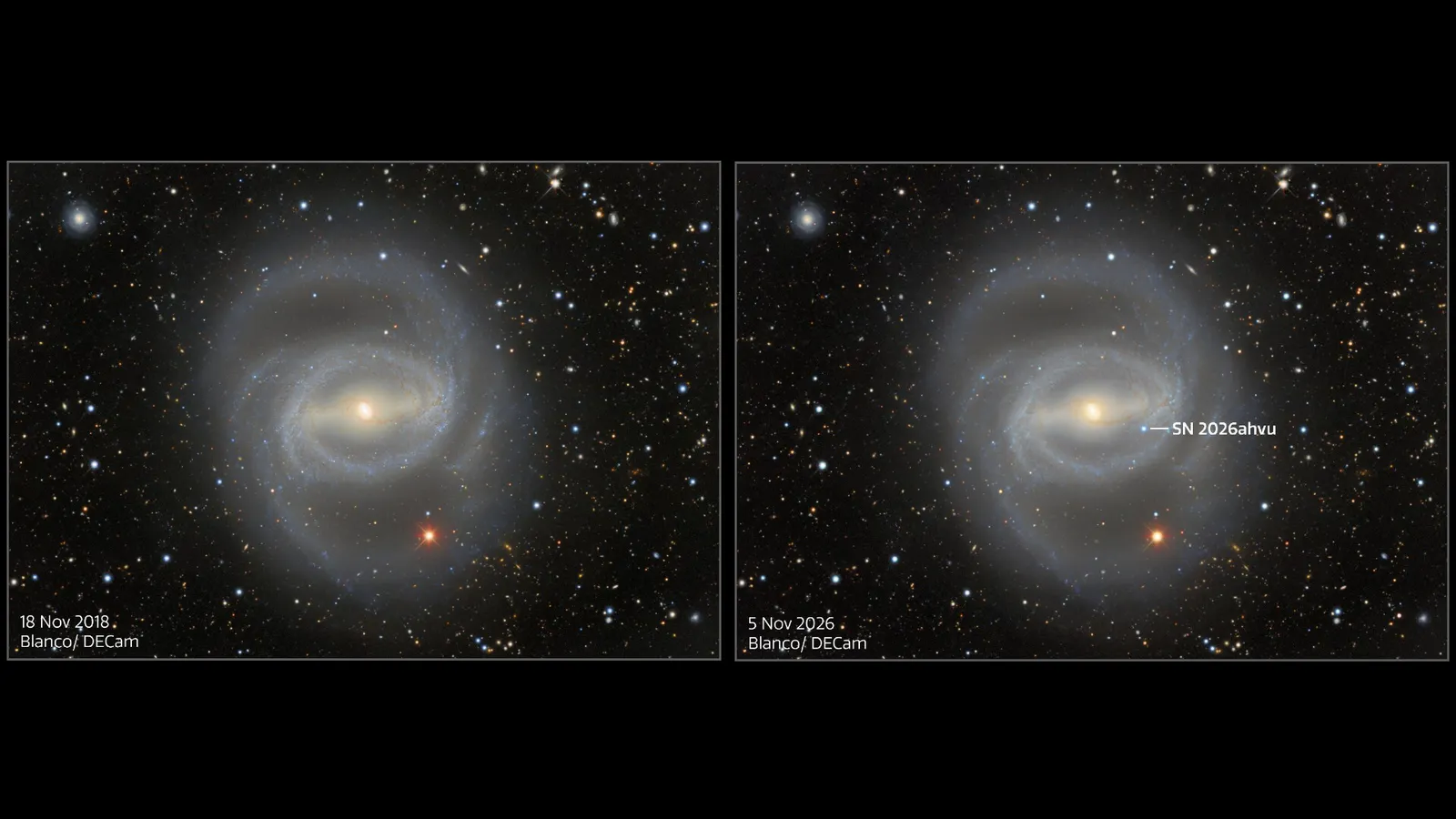
Researchers using the ATLAS asteroid survey have discovered SN 2026ahvu, a Type Ia supernova in the spiral galaxy NGC 1433 about 50 million light-years from Earth, and caught it while it was still getting brighter. The early capture, followed up by NOIRLab's Dark Energy Camera and the Gemini South telescope, hands scientists a rare before-during-after record of a stellar explosion and a clean case study in dual-use detection infrastructure.
An asteroid-hunting telescope just caught a star blowing itself apart, and it caught it at the best possible moment. Researchers have identified a new supernova, designated SN 2026ahvu, in the spiral galaxy NGC 1433, roughly 50 million light-years from Earth. The discovery came from ATLAS, the Asteroid Terrestrial-impact System, a robotic astronomical survey built from telescopes across both hemispheres and designed to spot incoming near-Earth objects before they can reach us. It found something else instead: a Type Ia supernova, spotted while it was still getting brighter.
That last detail is the whole story. If a supernova is already dimming when researchers find it, they can only infer that the event is ending. SN 2026ahvu was discovered while brightening, according to the details shared when it was first spotted and confirmed by later observations. That indicates the supernova was likely caught early in the process of exploding, handing researchers a unique opportunity to watch the event as it takes place, rather than reconstructing it from the aftermath.
Type Ia supernovae happen in binary systems, where two stars orbit one another and typically one of them is an exploding white dwarf. During most Type Ia events, the white dwarf pulls material away from the other star until enough accumulates on its surface to trigger an explosion. Finding galaxies where stellar explosions are taking place is not a rarity. Catching one at the start, while the light curve is still climbing, is.
By exploring observations of NGC 1433 before, during, and, in the future, after the supernova event, researchers can investigate this Type Ia supernova and how it affected the system in which it took place. The before images are the part that cannot be recreated. Astronomers either hold a baseline of that galaxy or they do not, and no future budget buys a picture of what a star looked like prior to detonating. For context, Type Ia supernovae have historically served as standard candles in cosmology, brightness markers used to gauge distances across the universe, which is why the class draws outsized attention relative to how often it occurs.
The instrument story is the second surprise. ATLAS is essentially an asteroid impact early warning system, a robotic survey scanning the sky to catch incoming near-Earth objects. But a system built to find objects moving through space can also find objects that change. In this instance it captured observations of the supernova, and the detection triggered follow-up work using NOIRLab's Dark Energy Camera, known as DECam, and the Gemini South telescope. The before-and-after imagery documenting the new appearance of SN 2026ahvu comes from the Dark Energy Survey, a collaboration involving the Department of Energy, Fermilab, DECam, CTIO, NOIRLab and NSF AURA, with principal investigators G. Narayan and T. Murphey of the University of Illinois at Urbana-Champaign and image processing by M. Zamani and D. de Martin of NSF NOIRLab.
That is the pattern worth noticing: infrastructure funded for one mission quietly paying off on another. The marginal cost of the second discovery is close to zero once the telescope, the software and the alert pipeline already exist. The scarce resource is not the glass; it is the handoff, the hours between a detection flag and a follow-up observation on a larger instrument. ATLAS flagged it, DECam and Gemini South characterized it, and the archive supplied the baseline that makes the whole sequence readable.
Future observations will track what happens after the explosion, completing the before, during and after sequence. For anyone who funds, builds or operates detection systems, the lesson travels well beyond astronomy. Instruments designed for a single threat often turn out to be general-purpose sensors, and the organizations that capture the second, third and fourth use cases are the ones that treat their data pipelines as products rather than exhaust.
SN 2026ahvu is one supernova in one spiral galaxy 50 million light-years away, and it will not move a budget line this quarter. But it is a clean demonstration of a durable principle: the value of a detection network is set by what it notices that it was not built to notice, and by how fast it can hand that notice to someone positioned to act on it. That holds for asteroid surveys, and it holds for every monitoring system a company runs.
This story's Key Insights and Take-aways are locked.
Create a free account to unlock Executive Actions for one credit.
Register to UnlockAlways free for Executives Club members. Join the Club
More in Science

Anthropic's I.P.O. Made Rank-and-File Researchers Worth Tens of Millions
Researchers who joined just a few years ago are now worth tens of millions, and the windfall resets the pay benchmark for every private A.I. lab still paying in paper.

Sea Lion Culling Strategy Fails: New Model Says Killing Them Won't Save Salmon
The latest research from AAAS overturn a long-held conservation assumption, forcing policymakers to rethink critical resource allocation in marine ecosystems.

Microplastics do more than pile up: they react with water to damage cells
Scientists have found that plastic particles can generate highly reactive molecules in water, a mechanism that could explain links to heart attacks, strokes, and neurological disorders.