
Astronomers finally caught a giant star swallowing its neighbor, then exploding
A decade-long engulfment in the Andromeda Galaxy ended in a late-2025 eruption, giving Columbia-led researchers the first direct look at a process theorized since the 1970s.
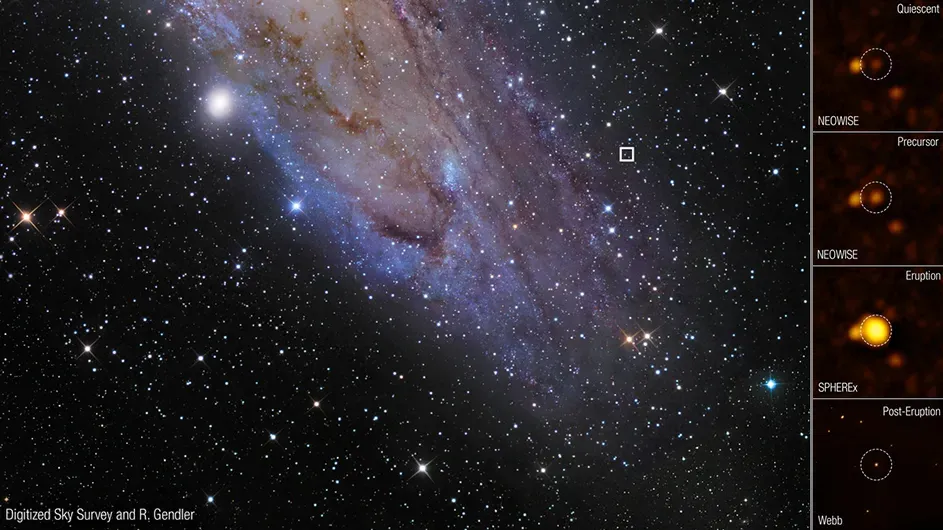
Astrophysicist Viraj Karambelkar of Columbia University led a Nature study that captured, for the first time, a giant star in the Andromeda Galaxy engulfing its smaller companion over nearly a decade before erupting in late 2025. The observation converts a 1970s theory about how the universe's tightest star pairs form into a directly witnessed event, and it is a case study in why continuous monitoring beats prediction when the rarest events are also the fastest.
In the Andromeda Galaxy, a giant star about seven times as massive as the Sun spent nearly a decade slowly swallowing its much smaller companion. Astronomers led by Viraj Karambelkar, an astrophysicist at Columbia University, caught the entire spectacle, from the decades before the engulfment began to the eruption that ended it in late 2025. The work is published in Nature, and it is the first time anyone has watched this process happen rather than inferring it from the aftermath.
The process has a name: common envelope evolution. Astronomers proposed it in the 1970s to explain a stubborn puzzle. Some pairs of stars orbit so close to each other that they could not possibly have formed at that distance, which means their orbits must have shrunk after the fact. Common envelope evolution is the leading explanation for that shrinkage. Until now, it had only ever been modeled, never observed from start to finish.
Here is the mechanism. When one star in a binary grows old, it expands into a giant, and its outer layers can engulf its companion. The two then share a single, loosely bound envelope of gas. As the engulfed star drags through that envelope, it loses orbital energy to friction and spirals inward. Depending on how much of the envelope gets lost, the pair either ends up in a much tighter orbit or merges outright. One process, two very different endings, and the outcome hinges on how much gas escapes along the way.
That is what makes the observation so hard to land. "It lasts for a few years, maybe a few decades," Karambelkar said. "Stars evolve on time scales of millions of years. So, it's really like a blip on the entire cosmic time scale." A blip is exactly the problem. To see one, you have to be pointed at the right star at the right moment, and you have to notice that something unremarkable has started behaving strangely. Most of the sky, most of the time, is not being watched that closely.
That is essentially how this one surfaced. A recent brightening turned out to be coming from a star orbiting inside another. The flare was the tell. Follow the light backward and you get a decade-long engulfment, a companion spiraling through shared gas, and a finale that arrived in late 2025. The team did not just catch the explosion. They reconstructed the slow meal that set it up.
Why should anyone outside astrophysics care? Because common envelope evolution is one of the quiet arbiters of the universe's stellar architecture. It decides which pairs survive as tight binaries and which collapse into a single object. It is the difference between two stars and one, and it runs on a clock that is almost impossible to catch. Now there is a fully witnessed case, with a beginning, a middle, and an end, to test the models against. A theory that has stood since the 1970s just got its first hard data point, and that tends to reshuffle how confident researchers are in the details.
For the people who fund and run sky surveys, the lesson is about coverage, not luck. Rare, fast events reward instruments that keep watching and pipelines that flag anomalies instead of discarding them. This event was found because a brightening was noticed and followed up, not because anyone predicted the date. That is a portfolio argument for continuous monitoring over one-off campaigns, and it applies well beyond astronomy. Anomaly detection is the asset. The telescope is just the sensor.
Karambelkar's framing keeps the scale honest. A few decades is a rounding error against millions of years of stellar evolution, which is precisely why a single caught event carries so much weight. The theory has been on the books since the 1970s. The evidence took until 2025. And the next one is already underway somewhere, in a galaxy we may or may not be watching.
This story's Key Insights and Take-aways are locked.
Create a free account to unlock Executive Actions for one credit.
Register to UnlockAlways free for Executives Club members. Join the Club
More in Science

Anthropic's I.P.O. Made Rank-and-File Researchers Worth Tens of Millions
Researchers who joined just a few years ago are now worth tens of millions, and the windfall resets the pay benchmark for every private A.I. lab still paying in paper.

Sea Lion Culling Strategy Fails: New Model Says Killing Them Won't Save Salmon
The latest research from AAAS overturn a long-held conservation assumption, forcing policymakers to rethink critical resource allocation in marine ecosystems.

Microplastics do more than pile up: they react with water to damage cells
Scientists have found that plastic particles can generate highly reactive molecules in water, a mechanism that could explain links to heart attacks, strokes, and neurological disorders.