
Astronomers Watched a Dying Star Swallow Its Neighbor in Real Time
The collision may have fused two stars into one rejuvenated remnant, giving researchers a live look at a process they usually only reconstruct from the wreckage.
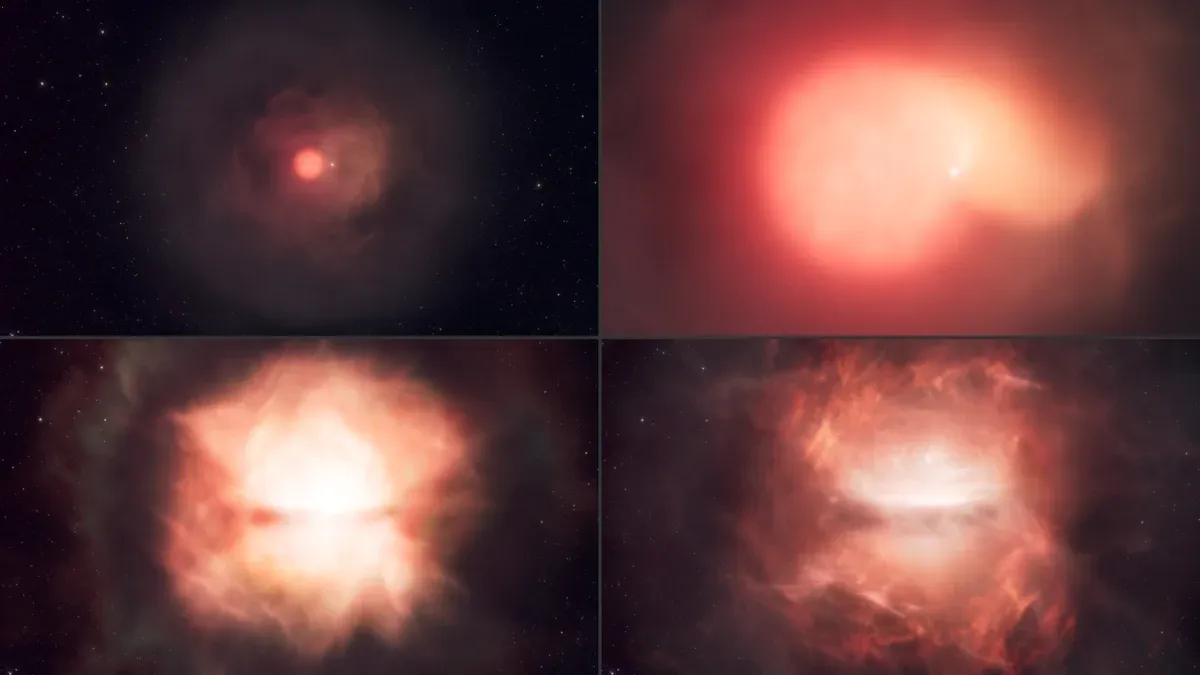
Astronomers say they witnessed a dying star collide with and consume its smaller companion in real time, a merger that may have left behind a single, rejuvenated remnant. The observation matters because stellar mergers are normally inferred after the fact, and catching one live gives researchers a direct test of models that shape how we understand stellar death and the explosions used to measure cosmic distances.
Astronomers say they watched a dying star swallow its smaller companion in real time, a collision that may have left behind a single, rejuvenated remnant. That is the finding, and it is a rare one. Stellar collisions are not exotic in principle. The universe is full of stars that orbit in pairs and triples, and gravity eventually gets its way. What is rare is the live view. Most of what astronomers know about these events is reconstructed after the fact, from the strange leftovers: stars that spin too fast, burn too hot, or sit in orbits that do not match their age. This time, according to the report, the process itself was caught in the act.
The word 'rejuvenated' is doing real work in that sentence. It implies the surviving object does not look like either of its parents. When a dying star engulfs a smaller companion, the standard picture is that the two spiral together and merge, and the merged object ends up with more mass and more angular momentum than either star started with. More mass and more spin typically mean a hotter, bluer, faster-spinning star, one that appears younger than everything around it. Astronomers have long catalogued stars that seem to have cheated their way into youth, and they have spent decades arguing about how such objects form. Watching a merger happen is a way to stop arguing and start measuring.
The mechanics explain why the event is hard to catch. In a close binary, one star runs out of fuel first and swells into a giant. If it grows enough, it engulfs its companion, and the companion begins plowing through the giant's outer layers. That drag bleeds orbital energy, the orbit shrinks, and the two spiral inward. The endgame is fast by astronomical standards and violent by any standard. Historically, astronomers have inferred this sequence from the population of merged stars they observe afterward, the way a crash investigator reconstructs a pileup from the wreckage. Catching the collision live is the equivalent of having a camera on the intersection. That is the difference between a snapshot and a movie, and movies are what let you see causality instead of just consequence.
Why should anyone outside an observatory care? Because mergers are not only endings. They are beginnings. The objects they produce are candidates for some of the most consequential events in the sky. Astronomers have long debated whether merging compact stars trigger certain classes of supernovae, the explosions that, for context, serve as standard candles used to measure distances across the universe. If mergers sit upstream of that chain, then understanding how they happen is not a curiosity. It is part of how the cosmos gets calibrated. A single live observation does not settle that debate, but it adds a data point that no amount of after-the-fact inference can supply.
There is also a data story here that anyone running an operation will recognize. Events like this are typically found by wide-field survey telescopes that image the sky repeatedly and flag anything that changes. Those surveys generate enormous volumes of alerts, far more than any human team can inspect. The bottleneck is not observation. It is triage. The teams that catch rare events are the ones with the best filters, the fastest follow-up, and the discipline to discard the overwhelming majority of alerts that turn out to be noise. For context, modern surveys are built to detect change, not to explain it; explanation is a separate, slower, human process. Cheap sensing, expensive attention: a familiar shape.
The strategic lesson is about where you put your sensors. Post-hoc reconstruction is cheap and always available. Real-time observation is expensive and only sometimes possible. Organizations that only ever study their own wreckage learn slowly and late. The ones that instrument the process, whether that is a supply chain, a trading book, or a customer journey, get to see the mechanism instead of the aftermath. Astronomy has been drifting in that direction for years, as surveys got wider and software got better. This is what the payoff looks like when it works.
One caveat matters, and the source is explicit about it. The single, rejuvenated remnant is what the collision may have left behind, not what it definitively did. Confirming it means follow-up work: checking whether the surviving object's mass, spin, and chemistry line up with a merger, and ruling out the possibility that the companion is still there, just hidden. Astronomers will keep watching the object, and the next round of data will either strengthen the merger story or complicate it. That is how the claim gets tested, and it is the right way to read any first observation of a rare event. For now, the notable thing is not only the answer. It is that there was a witness.
This story's Key Insights and Take-aways are locked.
Create a free account to unlock Executive Actions for one credit.
Register to UnlockAlways free for Executives Club members. Join the Club
More in Science

Anthropic's I.P.O. Made Rank-and-File Researchers Worth Tens of Millions
Researchers who joined just a few years ago are now worth tens of millions, and the windfall resets the pay benchmark for every private A.I. lab still paying in paper.

Sea Lion Culling Strategy Fails: New Model Says Killing Them Won't Save Salmon
The latest research from AAAS overturn a long-held conservation assumption, forcing policymakers to rethink critical resource allocation in marine ecosystems.

Microplastics do more than pile up: they react with water to damage cells
Scientists have found that plastic particles can generate highly reactive molecules in water, a mechanism that could explain links to heart attacks, strokes, and neurological disorders.