
Bale Improvised Batman's Growl Mid-Audition. His Wife Said He Blew It.
A decade-old Val Kilmer cast-off, one unrehearsed gamble, and a director who loved it: how a last-minute call became a franchise's most durable asset.
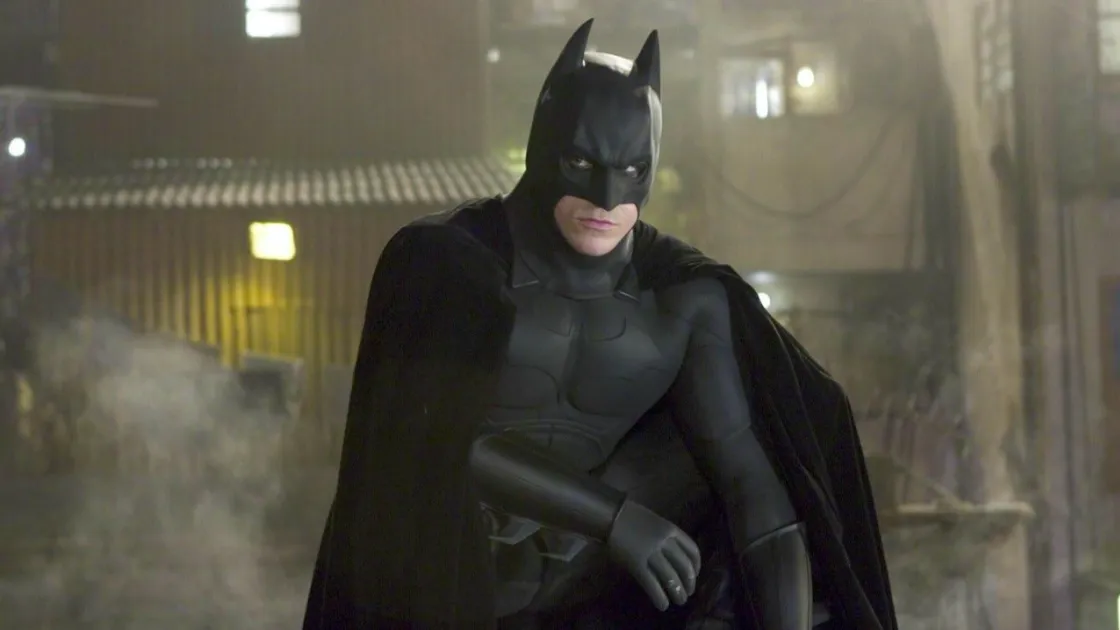
Christian Bale revealed on The Rich Eisen Show that he improvised Batman's gravelly voice at the last minute during his Batman Begins audition for Christopher Nolan, wearing Val Kilmer's ill-fitting cast-off suit from 1995's Batman Forever. The episode is a case study in succession risk: the signature that defined a trilogy was never scripted, budgeted, or approved, which is exactly why it is so hard for any successor to reproduce.
Christian Bale did not walk into his Batman Begins audition with a plan for the voice. He walked in wearing Val Kilmer's old suit. Appearing on The Rich Eisen Show, Bale said the gravelly growl that would come to define a trilogy was improvised on the spot, a last-minute gamble taken while he stood in an ill-fitting costume handed down from Kilmer's turn in 1995's Batman Forever, which made the suit roughly a decade old by the time Bale pulled it on. The trigger was simple self-consciousness. "Being in that suit, I just felt like it was really stupid just to talk normally," Bale said. So he did not.
The decision was not rehearsed. Bale described the moment as a swing he fully expected to miss: "And so on the day I went 'ah, they're going to hate it but I'm going to go for it.' And I started doing this more bestial guttural voice." He went home and showed his wife what he had done. Her verdict was blunt: "well, you've blown that one, haven't you?" She was wrong. Bale later learned that "Chris Nolan... loved it," and he was cast as Batman across the director's acclaimed Dark Knight trilogy. The uncomfortable lesson for anyone who runs a hiring process is that the single most durable asset Bale brought to the role was not in the script, not in the screen test, and not in the costume.
Bale has since articulated why the gamble was less random than it sounds. "I'm running around, a grown man dressed as a bat in rubber," he recalled of the audition. "I can't just talk like I'm hanging out. There's got be something deeper and darker and more monstrous to make this work." That is a product argument dressed up as a performance note. The suit, the cowl, and the premise were all absurd on their face; a normal speaking voice would have exposed the absurdity rather than absorbed it. Bale's instinct was to build a vocal layer that matched the physical one, so the audience would accept the whole package instead of laughing at it. Nolan, per Bale, bought it immediately.
Nolan then doubled down. For the trilogy's third entry he cast Tom Hardy as Bane, another "husky mouthbreather" whose dialogue sent audiences hunting for the subtitles. Whatever you make of the aesthetic, the pattern is instructive: once a franchise finds a signature that lands, the rational move is to lean into it rather than sand it down. Studios spend enormous sums trying to manufacture exactly this kind of recognizable texture, and here it arrived free, in a borrowed costume, because one actor decided mid-sentence that normal was not an option.
The voice outlived Bale's tenure. Robert Pattinson, the current Batman, told GQ that Bale's delivery had become "so kind of iconic, the voice he was doing in it," and that it was "almost impossible" for him not to slip into something similar when he picked up the cowl, even though he found it "really, really hard" to sustain across extended dialogue scenes. That is the double edge of a signature: it sets the standard every successor is measured against, and it is genuinely difficult to execute. Pattinson is next set to appear as the Dark Knight in The Batman: Part 2, which will now launch in February 2028. Per the report, his new commitment to James Bond could end his run as the DC hero, though that is not confirmed, which means someone else may soon have to cough up their own take on Batman's voice.
Strip away the cape and this is a story about succession risk and asset durability. A franchise, a brand, or a product line often rests on a handful of choices that were never written down, never budgeted, and never approved by a committee. Bale's voice was one of them, and it became load-bearing. When the person who made that choice moves on, the organization inherits an expectation it cannot easily reproduce, and the replacement gets judged against a standard that was set by accident. The same dynamic plays out inside companies every day: a founder's tone, a sales team's ritual, a support team's phrasing. None of it is in the operating manual. All of it is what customers actually recognize.
The practical lesson for anyone making high-stakes hiring or casting calls is not to improvise recklessly. It is to notice when the room, the costume, or the constraints are telling you that the standard playbook will read as wrong. Bale had one audition, a borrowed suit, and no leverage. He read the situation correctly and took a swing he expected to miss. His wife's reaction was the market's reaction. Nolan's was the one that mattered. For leaders, the harder question is whether their own process would have let that swing happen at all, or screened it out before anyone with authority ever saw it.
This story's Key Insights and Take-aways are locked.
Create a free account to unlock Executive Actions for one credit.
Register to UnlockAlways free for Executives Club members. Join the Club
More in Science

Anthropic's I.P.O. Made Rank-and-File Researchers Worth Tens of Millions
Researchers who joined just a few years ago are now worth tens of millions, and the windfall resets the pay benchmark for every private A.I. lab still paying in paper.

Sea Lion Culling Strategy Fails: New Model Says Killing Them Won't Save Salmon
The latest research from AAAS overturn a long-held conservation assumption, forcing policymakers to rethink critical resource allocation in marine ecosystems.

Microplastics do more than pile up: they react with water to damage cells
Scientists have found that plastic particles can generate highly reactive molecules in water, a mechanism that could explain links to heart attacks, strokes, and neurological disorders.