
BepiColombo Hits Mercury Orbit: Two Spacecraft Face a One-Year Mission Clock
The joint ESA-JAXA mission begins its high-stakes investigation into Mercury's magnetic field and core mysteries.
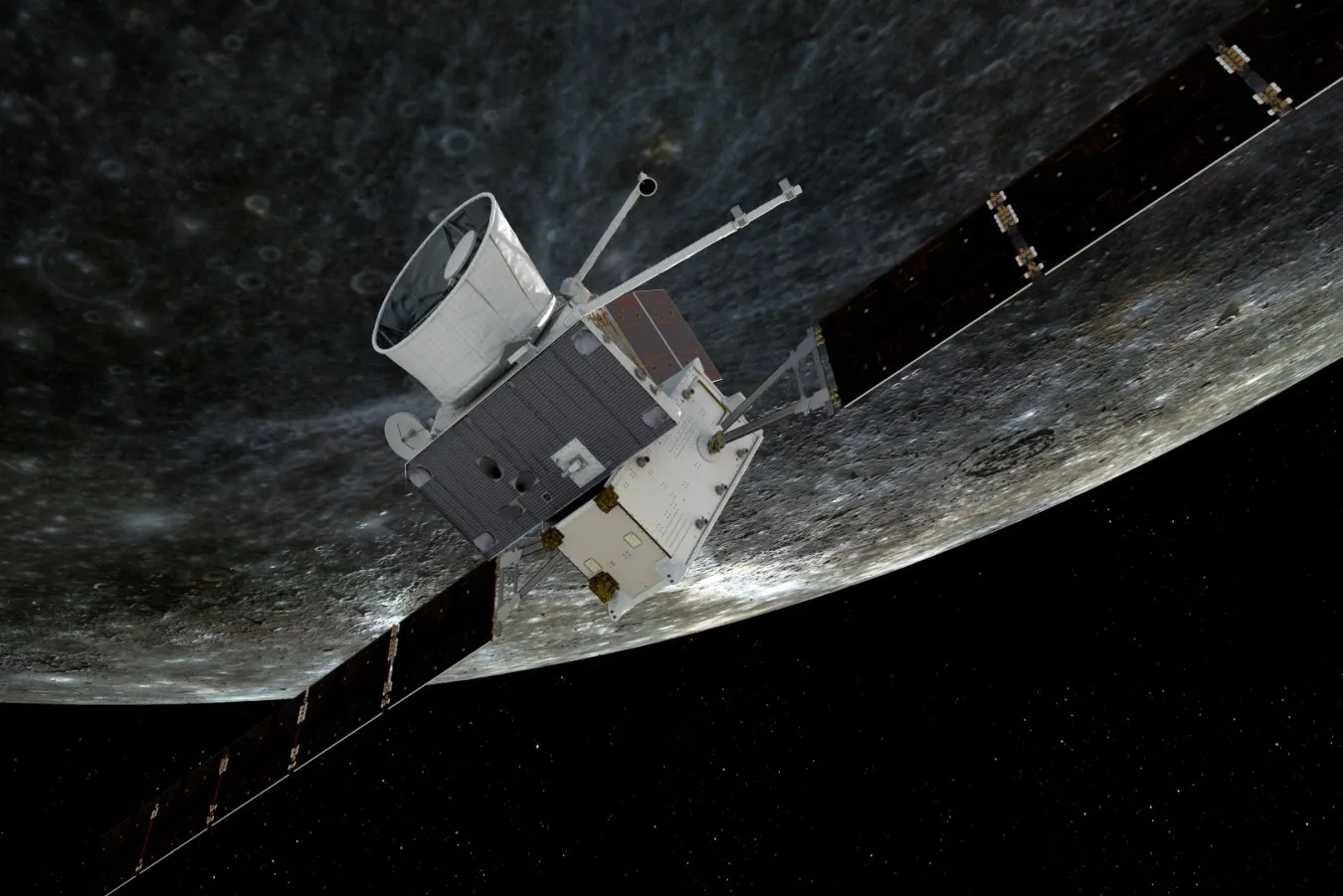
ESA and JAXA have successfully deployed the BepiColombo spacecraft into Mercury's orbit after an eight-year journey. This mission represents a critical test of long-term deep space engineering and provides vital data on planetary formation.
The BepiColombo spacecraft has officially entered Mercury's orbit, marking the culmination of an eight-year, complex journey toward the solar system's smallest and most enigmatic planet. This arrival, which occurred on November 21st, initiates a mission designed to unravel the deep-seated mysteries of Mercury's geology, its tenuous atmosphere, and its baffling magnetic field. This is not a single, monolithic mission; BepiColombo is actually a dual-system operation comprising two distinct orbiters: ESA’s Mercury Planetary Orbiter (MPO) and JAXA’s Mercury Magnetospheric Orbiter (MMO, or Mio). The immediate operational window is highly constrained, with the primary mission expected to last only one Earth year, which translates to slightly more than four Mercury years. This short window, coupled with the extreme thermal environment and limited fuel reserves, demands maximum efficiency from the scientific teams.
The journey itself was a masterclass in complex orbital mechanics and risk management. Mercury's extreme proximity to the Sun makes reaching it without overshooting and plunging into the solar furnace incredibly difficult. To navigate this challenge, the spacecraft was forced to take a long, looping trajectory over the past eight years, utilizing gravity assists from both Venus and Mercury multiple times to make subtle, precise trajectory adjustments. Even this highly engineered path faced a significant setback in 2024 when an issue with the thrusters necessitated a further extension of the journey. This delay pushed the arrival date from 2025 to the current timeline, underscoring the high-stakes nature of deep space missions where even minor mechanical failures can have massive schedule implications. The successful completion of this complex maneuver validates the engineering resilience of both ESA and JAXA.
To maximize scientific coverage, the two orbiters will separate in December to occupy distinct orbital regimes, each tailored to specific scientific objectives. The MPO, which is more than twice the size of the MMO, will settle into a near-circular path requiring 2.3 hours to complete an orbit. This orbiter is the primary platform for studying Mercury itself, equipped with 11 sophisticated scientific instruments. These instruments include various spectrometers designed to analyze the chemical makeup of the surface, a laser altimeter to map the planet's rugged terrain, and specialized tools to investigate the composition of Mercury's extremely thin atmosphere, known as an exosphere.
Meanwhile, the MMO, or Mio, will occupy a more distant, elliptical orbit with a 9.3-hour cycle. This strategic positioning allows Mio to study a broader, more encompassing area around the planet. Mio carries five sets of scientific instruments dedicated to investigating the magnetic field and the atmosphere of Mercury, as well as the intense solar wind that constantly blows through the region near the Sun. This division of labor is crucial, ensuring that both the surface-level details and the broader magnetospheric dynamics are captured simultaneously, providing a holistic view of the planet's environment.
The scientific stakes are monumental. Mercury presents a series of profound, unresolved puzzles that challenge current planetary formation theories. Its magnetic field, for instance, is bewildering because it originates 400 kilometers above the planet’s center, a location where it should have long since faded away. Furthermore, scientists are still uncertain exactly how Mercury's atmosphere is continuously supplied with material from the surface. Perhaps the biggest puzzle is its enormous iron core, which is proportionally larger than the core of any other planet in the solar system. Understanding how this massive core formed and evolved is key to understanding the entire solar system's early history. BepiColombo is designed to provide the data necessary to begin unraveling these convoluted tales.
For decision-makers and investors in the aerospace and scientific sectors, the BepiColombo mission serves as a powerful case study in long-term, multi-agency capital deployment. The success of this mission hinges not just on the science, but on the operational longevity of the spacecraft. The one-year operational limit is a hard constraint dictated by fuel efficiency and the brutal thermal extremes of Mercury's environment. Any extension beyond this initial year is highly unlikely without significant technological breakthroughs or a major re-allocation of resources. This underscores a critical lesson in deep space missions: mission planning must account for inevitable delays, mechanical failures, and finite operational lifespans from day one. The data gathered over the next twelve months will not only solve Mercury's mysteries but will also set new benchmarks for how we approach extreme environment exploration.
This story's Key Insights and Take-aways are locked.
Create a free account to unlock Executive Actions for one credit.
Register to UnlockAlways free for Executives Club members. Join the Club
More in Science

Anthropic's I.P.O. Made Rank-and-File Researchers Worth Tens of Millions
Researchers who joined just a few years ago are now worth tens of millions, and the windfall resets the pay benchmark for every private A.I. lab still paying in paper.

Sea Lion Culling Strategy Fails: New Model Says Killing Them Won't Save Salmon
The latest research from AAAS overturn a long-held conservation assumption, forcing policymakers to rethink critical resource allocation in marine ecosystems.

Microplastics do more than pile up: they react with water to damage cells
Scientists have found that plastic particles can generate highly reactive molecules in water, a mechanism that could explain links to heart attacks, strokes, and neurological disorders.