
Carlo Pulitano kept a human liver alive for seven weeks. The record was two.
A Sydney surgeon's automated perfusion rig tripled average organ survival to four weeks, and now the field is asking what seven weeks of extra life is actually for.
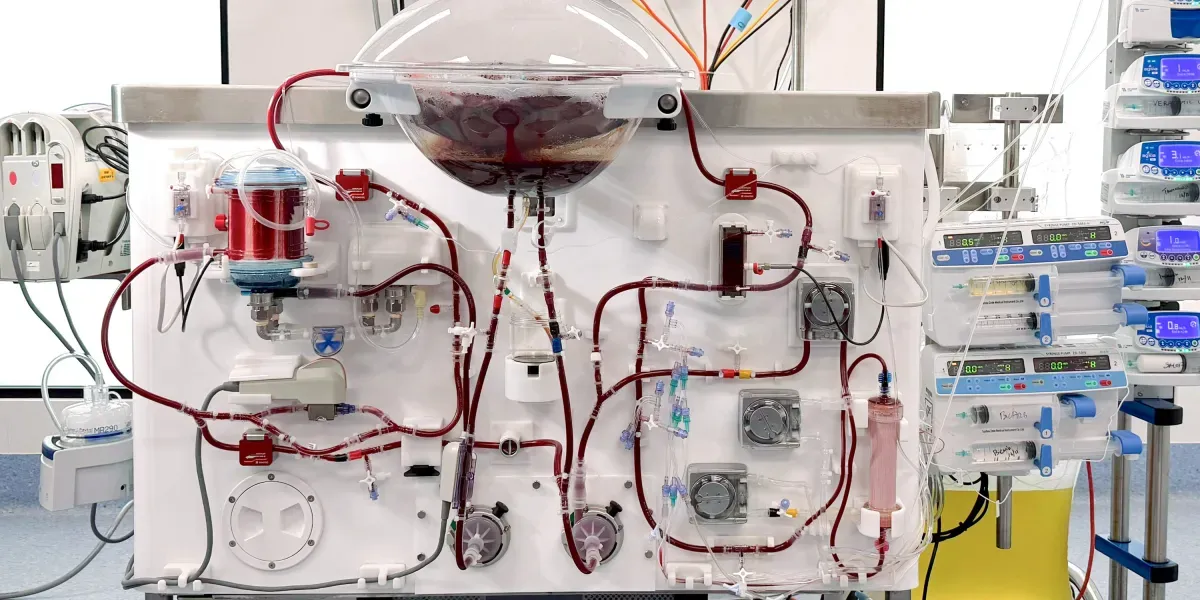
Carlo Pulitano, a transplant surgeon at Sydney's Royal Prince Alfred Hospital and a professor at the University of Sydney, says his team kept a donated human liver alive outside the body for seven weeks using an automated perfusion system, tripling the previous two-week record. The result, still pending publication, pushes organ life support toward what his team calls time-unlimited liver preservation, with consequences for transplant economics, drug testing, and organ manufacturing.
Carlo Pulitano says he has done something no one else has: kept a human liver alive, outside a human body, for seven weeks. The organ was donated, then connected in Sydney to a rig of automated pumps and sensors that fed it nutrients, supplied it with blood, and carried away its waste. Pulitano, a transplant surgeon at the Royal Prince Alfred Hospital and a professor at the University of Sydney, calls the machine the Extended Organ Perfusion System. In an interview he described it more simply, as "an artificial body." "Our group is the only one in the world to have maintained a human liver under fully normothermic, physiological conditions for seven weeks," he says. Normothermic means body temperature, roughly 37 °C. The previous record, set in Switzerland several years ago, was also a liver, and it lasted about two weeks.
That gap is the story. Most organs headed for transplant survive only a few hours in an ice bucket and have to be raced to their destination. Over the past decade surgeons have been switching to perfusion systems, which pump warm or cold fluid through an organ and can roughly double the time it can be held before it must be transplanted. Pulitano says the key to his record was automating the machinery that keeps the organ thriving. At a meeting in Switzerland earlier this year, his Sydney team described perfusing 55 human livers, one after another. Some ran on a system that had to be adjusted by hand. The ones on the automated system, including the seven-week survivor, averaged about four weeks, roughly triple the manual result. The details are still pending publication, and the stated goal is what Pulitano and his colleagues call "time-unlimited liver preservation."
Not everyone is sure what to do with the extra time. Waldemar Hoffmann, CEO and cofounder of Apersys, a startup formed to commercialize the technology, says people in the field believe the record is real but do not know how healthy the organ was at the end, or what nearly two months of extra life would achieve. "The key question is what the purpose for a seven-week perfusion would be," he says. The economics are already live. Paulo Martins, a transplant doctor at the University of Oklahoma, says about half the kidneys he transplants are now perfused, even though the process can add $100,000 to the cost of a transplant. Perfusion has also let doctors restart hearts from dead people and keep them beating outside the body.
There is a medical reason to push past simple storage. Perfused organs apparently start to repair themselves and grow stronger after a day or so, which is what led a Swiss team in 2022 to transplant a damaged liver that had been kept on perfusion for three days, the longest any internal organ had remained outside the body before a successful transplant, according to Hoffmann. Pulitano's own startup, Aeternum Life Technologies, will help run a planned trial in Sydney to transplant low-quality livers kept on perfusion for four days. That is the near-term commercial bet: rescue organs that would otherwise be thrown away.
Longer term, the pitch gets stranger. Pulitano says long-term machine perfusion could help grow new organs. In living donations, surgeons routinely take half of a person's liver for someone else, and after about two months both halves grow back almost to full volume. He has tried dividing a liver and then attaching the sections to the machine. If it works, one donor liver could become several full-size organs. Martins, the Oklahoma surgeon, says long-term life support could enable far-out concepts like artificial wombs, new types of organ manufacturing, and the chance to experiment directly on human organs outside the body for extended periods.
The frontier is not limited to livers. Bexorg, a US company, has been reanimating human brains using perfusion pumps to study what effects experimental drugs have on them. It perfuses brains for about a day and has said it wants to extend that to two weeks. Pulitano has already tried adding gene therapies to organs. "It gives us a living human organ model for translational research that no animal system can match, because the biology, the immunology, and the drug responses are human from the outset," he says. In Silicon Valley, patents filed by Altos Labs, a billionaire-backed longevity startup, describe attempts to introduce reprogramming genes into animal livers maintained outside the body. Altos scientists have speculated that they might temporarily disconnect a failing organ while it is still in a person's body, connect it to a perfusion machine, and douse it with ultra-powerful genetic treatments without risking the rest of the body.
The field is organizing. Doctors probing the limits of organ life support have now formed two new scientific societies. One, founded by Martins and called the International Society for Organ Preservation and Perfusion Therapy, will hold its inaugural meeting this year in Italy. The other, based in China, was launched in August to advance what doctors at the First Affiliated Hospital of Sun Yat-Sen University have termed "organ medicine": research at the level of whole organs kept alive by "bionic maintenance." "What is exploding is the idea of this technology that clearly goes beyond simply organ preservation," Pulitano says. "Basically, that's a concept that's entirely new."
For executives watching health tech, the signal is that organ preservation is quietly turning into a platform. Martins puts the cultural point plainly: "It's important to have people thinking outside the box and pushing the limits and creating possibilities for things that, right now, sometimes we don't even have a need for but are going to be needed in the future. That's how science moves." The open questions are the ones that decide whether this becomes a business: whether a seven-week liver is a healthy liver, who absorbs the extra $100,000 per transplant, and whether regulators will treat a machine-perfused organ as a device, a drug, or something new. Until the Sydney data is published, the record stands as a proof of concept with a very large question mark attached. The teams building around it are betting the question mark resolves in their favor.
This story's Key Insights and Take-aways are locked.
Create a free account to unlock Executive Actions for one credit.
Register to UnlockAlways free for Executives Club members. Join the Club
More in Science

Anthropic's I.P.O. Made Rank-and-File Researchers Worth Tens of Millions
Researchers who joined just a few years ago are now worth tens of millions, and the windfall resets the pay benchmark for every private A.I. lab still paying in paper.

Sea Lion Culling Strategy Fails: New Model Says Killing Them Won't Save Salmon
The latest research from AAAS overturn a long-held conservation assumption, forcing policymakers to rethink critical resource allocation in marine ecosystems.

Microplastics do more than pile up: they react with water to damage cells
Scientists have found that plastic particles can generate highly reactive molecules in water, a mechanism that could explain links to heart attacks, strokes, and neurological disorders.