
Carney can get away with a lot. The trade war's end is the test.
Canada's PM has banked historic public trust on the back of the US tariff fight; if that fight cools, the political capital gets repriced.

Canadian Prime Minister Mark Carney has banked enough public trust that he can, in the Guardian's framing, get away with a lot, with Ontario Premier Doug Ford celebrating a historic midterm rebuke of Donald Trump. The open question for executives with Canadian exposure is whether that popularity survives the end of the trade wars that helped create it.
Mark Carney has something most leaders in the developed world would pay dearly for: room to maneuver. Canada's prime minister is popular enough, in the Guardian's framing, that he can "get away with a lot" - and the question now hanging over Ottawa is whether that trust is a durable asset or a loan taken out against the trade war with the United States. Canadians have put a lot of trust in their prime minister. Some are openly asking whether it lasts the day the trade wars end.
The elation was real, and it was loud. In the hours after polls in the US midterm elections closed and it became clear that Donald Trump had been rebuked in historic fashion, Canadian politicians were jubilant. Doug Ford, the Ontario premier and a prominent critic of American tariffs, put it in terms no press release could match: "I was doing cartwheels down the street, and have you ever seen a big guy like me doing cartwheels?" That image is the whole story in miniature. Canada's political class has spent the Trump era braced for the next blow, and any signal that Washington's grip on the agenda is slipping reads as relief.
For context on why Carney specifically holds that trust: he came to politics with a central banker's resume, having led the Bank of Canada and then the Bank of England before entering elected office. That background shapes how the trust is structured. Voters are not backing a movement or a personality cult; they are backing a technocrat they believe can steer an economy through a tariff fight. The mandate is competence under pressure, and it is being graded in real time against one benchmark: how Canada fares against American trade pressure.
That is the classic rally-round-the-flag dynamic, and it is historically well documented. When a country faces a common external economic threat, support tends to consolidate behind whoever is in charge, and the opposition's usual lines of attack - competence, cost of living, the pace of government - get pushed down the agenda. The effect is powerful and it is also conditional. It runs on the threat. Remove the threat and the coalition that formed around it starts to loosen, because the thing holding it together was never agreement on domestic policy. It was agreement on who the problem was.
Which is exactly the risk the Guardian's question points at. If the trade wars were to end, the unifying pressure that has inflated Carney's standing would deflate, and the domestic arguments that a common external enemy tends to mute would come back to the front of the queue. Popularity built on a foreign adversary has a maturity date, and nobody sets it locally. It gets set in Washington, in trade negotiations, in the outcome of American elections. That is an uncomfortable place for any prime minister to park their political capital.
For executives with Canadian exposure, this is not an abstract political-science question. It is a risk-pricing question. Tariff uncertainty has become a tax on capital allocation across the border, shaping decisions on supply chains, energy projects, manufacturing footprints, and where the next plant gets built. A durable de-escalation would unlock some of that. But it would also remove the political cover that has let Ottawa make hard choices without the usual backlash. Boards should be modeling both directions: a world where the trade file cools and Carney's approval normalizes, and a world where it stays hot and his room to maneuver stays wide.
Watch three things. First, whether the trade file actually de-escalates or merely pauses - a pause keeps the threat alive and keeps the political math intact. Second, whether the opposition finds a domestic wedge sharp enough to compete with the tariff story; that is the moment the spell breaks, not the moment a deal is signed. Third, whether provincial premiers like Ford stay in the tent. Ford's cartwheels were about Washington, not Ottawa, and coalition partners who are united by an external enemy are the first to drift when the enemy softens.
The broader lesson travels well beyond Canada. Leaders across the developed world have discovered that standing up to American trade pressure is good politics at home, and several have ridden it. What none of them have answered is the follow-up: what happens to that popularity when the pressure lifts? Carney is the test case. His trust levels are high, his room to maneuver is wide, and both are currently underwritten by a conflict he does not control. That is the trade every leader in his position has made. The bill comes due when the Trump spell breaks.
This story's Key Insights and Take-aways are locked.
Create a free account to unlock Executive Actions for one credit.
Register to UnlockAlways free for Executives Club members. Join the Club
More in Politics

Cybersecurity Was an Afterthought for Decades. AI Is Now Sending the Bill
The internet's vulnerable code was never fixed, and AI is finding it faster than anyone can patch it, turning decades of technical debt into a live balance-sheet risk.

Hannity vows to name GOP lawmakers skipping votes before the majority expires
A prime-time host is turning the House attendance sheet into a public scoreboard, and Speaker Mike Johnson is sitting right next to him while the Republican majority runs out of days.
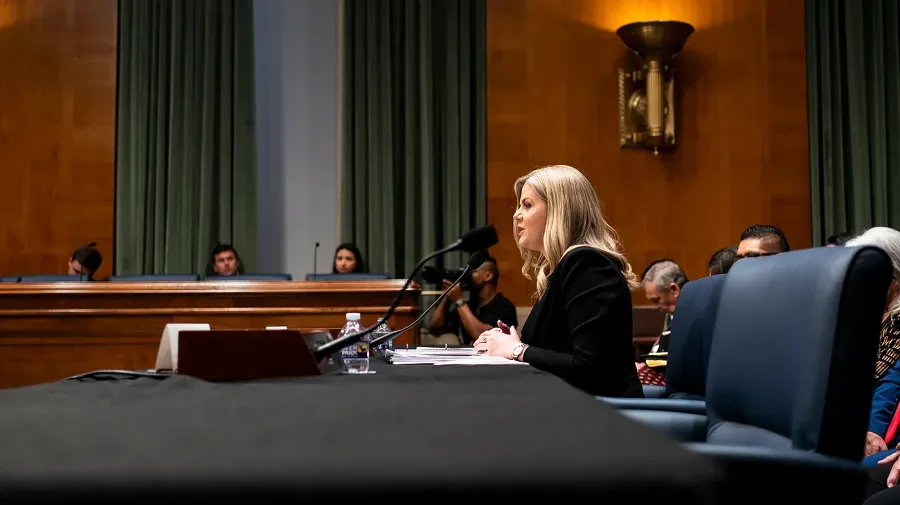
White House yanks FDA nominee, blindsiding senators and extending a six-month vacuum
Heidi Overton's abrupt withdrawal leaves the FDA without a confirmed commissioner six months after the last one resigned, and the Senate committee that would vet a replacement found out at the last minute.