
Congo's rare Ebola strain has no approved vaccine. Researchers are closing in.
Researchers studying the Bundibugyo strain in the Democratic Republic of Congo are mapping a virus that the licensed Ebola vaccines and treatments were never built to target.
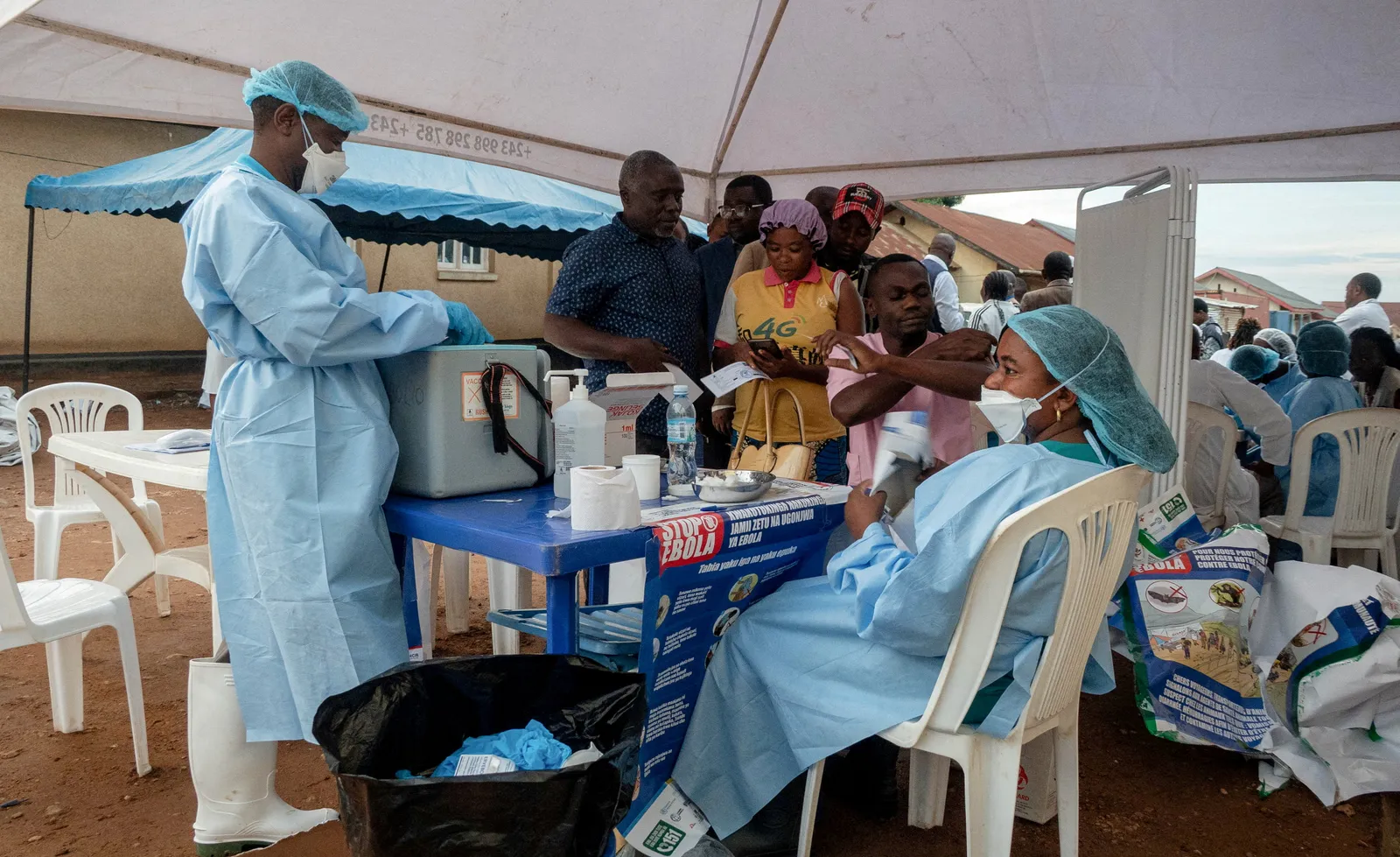
Researchers are gaining insights into the rare Bundibugyo strain of Ebola amid an ongoing outbreak in the Democratic Republic of Congo, hoping to control its spread. The catch for decision-makers: the licensed vaccines and antibody treatments that made recent Zaire ebolavirus outbreaks containable do not target this strain, leaving containment to classic public health and making surveillance speed the decisive variable.
Researchers studying the Ebola outbreak in the Democratic Republic of Congo are piecing together how the rare Bundibugyo strain behaves, with the goal of controlling its spread. That work matters more than it might sound, because the world's Ebola toolkit was built for a different virus. The licensed vaccines and antibody treatments that turned recent Zaire ebolavirus outbreaks into containable events were not designed to target Bundibugyo. So while researchers gain ground on the science, responders on the ground are working without the single most powerful tool in the modern Ebola playbook: a vaccine you can ring around a case.
Bundibugyo is one of the ebolaviruses, and it is rare in the most literal sense. It was first identified in Uganda in 2007, and it has surfaced only intermittently since. The DRC has confronted it before, which is part of why this outbreak is being watched closely rather than treated as routine. Historically, case fatality rates for Bundibugyo have been reported lower than those for Zaire ebolavirus, but "lower" is a relative term in a disease family where outcomes without supportive care can still be severe. Rare also means under-studied: fewer outbreaks, fewer samples, fewer published papers, and less certainty about how the virus moves through a community.
When researchers say they are gaining insights, the work typically runs along a few tracks. Genomic sequencing lets scientists read the virus's genetic code and trace how cases connect, which is how responders figure out whether they are looking at one transmission chain or several. Serology, which means testing blood for antibodies, helps establish how many infections were missed. Clinical observation tells teams whether this strain presents differently from the Zaire virus that clinicians have learned to recognize. Each of those answers changes the response: where to focus contact tracing, how to staff treatment units, and how to talk to communities about risk.
Without a licensed Bundibugyo vaccine, the response falls back on classic public health: isolating and treating the sick, tracing and monitoring everyone they came into contact with, making burials safe, and tightening infection control inside health facilities. That is the playbook that contained Ebola outbreaks for decades before the Zaire-specific vaccines arrived. It works, but it is labor-intensive, it depends on community trust, and it is far more fragile in places where health systems are thin or where security makes it hard to reach patients. For context, the DRC's eastern provinces have repeatedly been the epicenter of Ebola outbreaks, and armed conflict and displacement there have historically made each response slower and more expensive.
The scientific work is typically a collaboration: the DRC's national biomedical research institute, the World Health Organization, Africa CDC, and international partners sequencing samples and sharing data. That architecture has matured considerably since 2014, when the West African outbreak exposed how slow the world was to react. But the gap here is not coordination, it is biology. A vaccine platform that works against one ebolavirus does not automatically work against another, and developing and testing a new one takes years, not weeks. In the meantime, the fastest lever is diagnostics and surveillance: finding cases early enough that isolation can do the work a vaccine cannot.
Here is why this belongs on your radar even if you never set foot in a hospital. Ebola outbreaks are a live test of global health security, and the Bundibugyo strain is a reminder that preparedness built around a single pathogen is preparedness with a hole in it. Companies with operations, suppliers, or staff in Central Africa watch these outbreaks for continuity reasons. Insurers and investors in pandemic-preparedness platforms watch them because each outbreak is a data point on how fast countermeasures can be developed and deployed. And governments watch them because the cost of a contained outbreak is a rounding error next to the cost of an uncontrolled one.
The strategic takeaway is uncomfortable but simple: the world got very good at fighting one version of Ebola. Bundibugyo is the test of whether that capability generalizes. Watch three things. Whether researchers can characterize transmission quickly enough to give responders a target. Whether existing vaccine platforms can be adapted, or whether this stays a classic containment fight. And whether the funding and attention that flowed into Ebola after 2014 hold up for a strain that will never generate the same headlines. Containment is a race against the virus's math, and right now the math gives the virus a head start.
This story's Key Insights and Take-aways are locked.
Create a free account to unlock Executive Actions for one credit.
Register to UnlockAlways free for Executives Club members. Join the Club
More in Science

Anthropic's I.P.O. Made Rank-and-File Researchers Worth Tens of Millions
Researchers who joined just a few years ago are now worth tens of millions, and the windfall resets the pay benchmark for every private A.I. lab still paying in paper.

Sea Lion Culling Strategy Fails: New Model Says Killing Them Won't Save Salmon
The latest research from AAAS overturn a long-held conservation assumption, forcing policymakers to rethink critical resource allocation in marine ecosystems.

Microplastics do more than pile up: they react with water to damage cells
Scientists have found that plastic particles can generate highly reactive molecules in water, a mechanism that could explain links to heart attacks, strokes, and neurological disorders.