
Edible Potatoes Grown in Simulated Moon Soil - With One Key Ingredient
Scientists have produced a safe-to-eat crop in a lunar soil analogue, and the deciding variable was not the seed but the organic matter mixed into it.
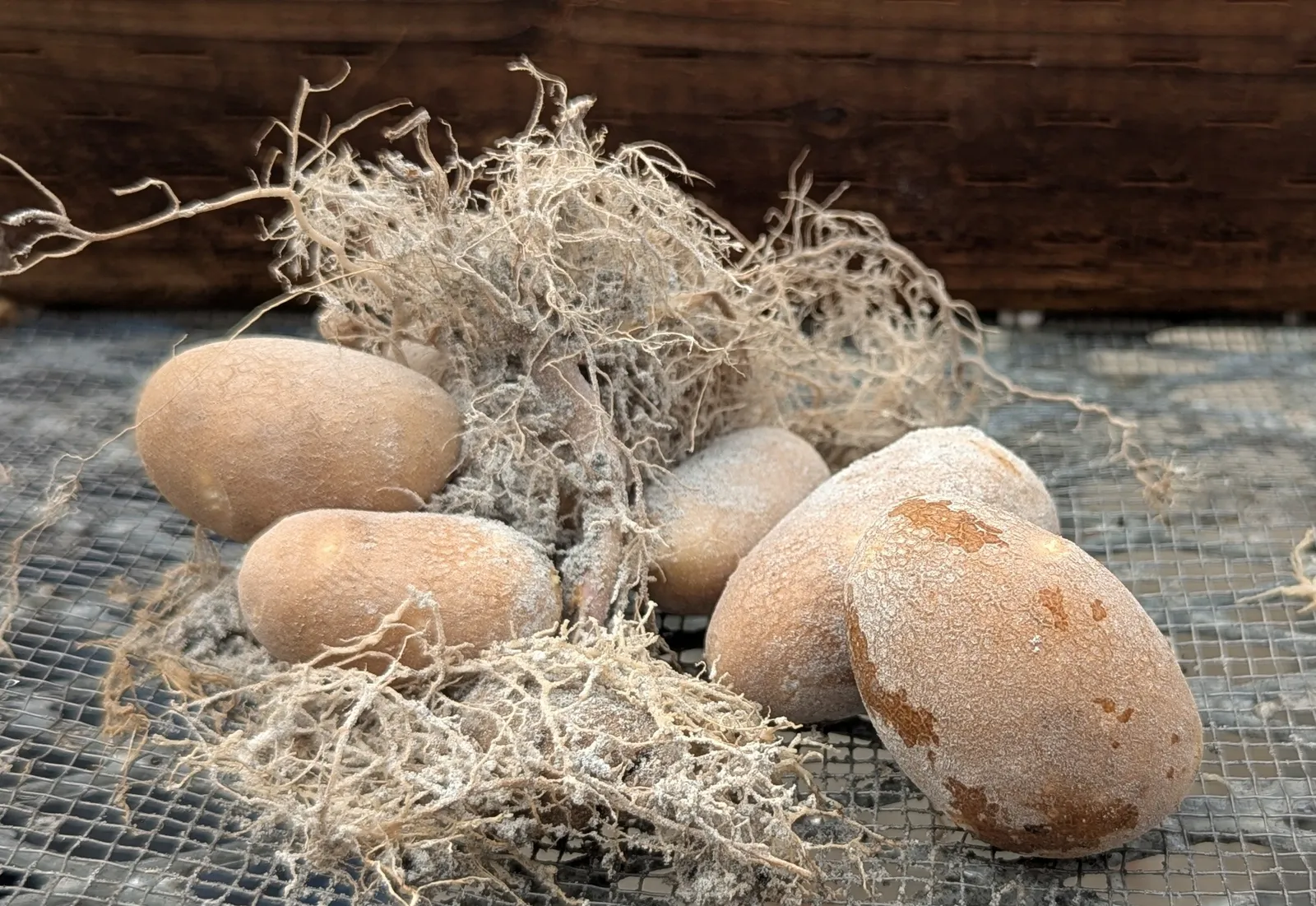
Scientists have succeeded in growing nutritious potatoes in simulated lunar soil that are safe to eat, according to Arab News, aiming at feeding astronauts who may staff bases on the lunar surface in the near future. The result matters to anyone modelling off-world operations because it moves food from a launched resupply line item toward something grown on site, while exposing organic matter as the binding constraint.
Scientists have now grown potatoes in simulated lunar soil that are nutritious and safe to eat, according to a report from Arab News, and the work is pointed at a specific target: feeding astronauts who may staff bases on the lunar surface in the near future. The unlock was not a new fertilizer, a gene edit, or a sealed greenhouse. It was organic material. The researchers supplemented the lunar simulant with it, and found that with enough of it the crop cleared the bar for human consumption. That single variable is the whole story. The soil analogue by itself was not the answer, and the quantity of added organic matter was what separated a plant that merely survived from a harvest that was actually edible.
Start with why potatoes. They are one of the most important crops on Earth, and the reasons travel. A potato delivers starch, vitamins, minerals and fiber in a compact, calorie-dense package, which is exactly the profile you want when every square meter of growing area and every watt of lighting is rationed. Leafy greens give you vitamins and morale. A tuber gives you something closer to a staple, a food you can build a diet around rather than garnish it with. For a base that has to feed people for months or years, that distinction is the difference between a salad bar and a food system.
The caveat is built into the word "simulated." Lunar simulants are engineered on Earth to mimic the chemistry and particle behavior of the real thing. They are not the real thing. Actual lunar soil sits under radiation, vacuum, wild thermal swings and electrostatic dust that behaves nothing like a bag of prepared material in a lab. So the correct read on this result is that plant biology has cleared a gate, not that a harvest date has been set. The experiment answers a narrower and still important question: is there anything in the soil chemistry itself that makes edible food impossible? The answer appears to be no, provided you fix the organic component.
That is where the hard engineering begins. Lunar soil is not dirt in the sense a farmer means. It lacks the organic carbon and available nitrogen that terrestrial topsoil gets from decaying matter and microbial life, and it has no living ecosystem recycling nutrients back into plant-available form. Adding organic material is therefore doing enormous work, and it immediately raises the logistics question: where does that material come from, and how many times can you reuse it? If the answer is "shipped from Earth," you have not solved the problem, you have renamed it. Every kilogram launched carries a cost in propellant, payload capacity and mission complexity, and a consumable input that must be continually topped up is a permanent tax on the base.
The strategic prize is a closed loop. If organic matter can be generated on site, from crop waste, human waste, composting or processed regolith, then food stops being a supply chain and becomes a system. That reframes the research agenda. The interesting questions are no longer only botanical. They are about nutrient recycling rates, contamination, shelf stability and whether a greenhouse can run for years without a resupply of the very input that made this experiment work. Agencies and commercial operators weighing surface habitats should treat organic-matter sourcing as a first-order design constraint, on par with power and water, not as an agricultural afterthought.
There is a terrestrial angle worth watching too. The techniques in play here, controlled-environment growing, soil substitution, nutrient supplementation, overlap heavily with the vertical farming and precision agriculture playbook being built on Earth for water-scarce and climate-stressed regions. Research budgets justified by space exploration have a long history of spilling back into food security, materials and life-support technology. Investors in agtech and controlled-environment agriculture should note that the bottleneck identified here, the organic input, is the same bottleneck that drives cost in terrestrial indoor farming.
So what should decision-makers actually take from this? First, the result is real and it is incremental in the right direction: a staple crop, in a lunar analogue, edible and nutritious. Second, it is a hypothesis confirmed under laboratory conditions, not a demonstration on the lunar surface, and the gap between those two is where missions fail. Third, the headline finding is quietly a supply chain finding. The constraint is not whether plants grow. It is whether the material that makes them grow can be produced, recycled and sustained without Earth. Whoever solves that owns the economics of living off this planet, and the teams still assuming food gets launched should revisit the assumption.
This story's Key Insights and Take-aways are locked.
Create a free account to unlock Executive Actions for one credit.
Register to UnlockAlways free for Executives Club members. Join the Club
More in Science

Anthropic's I.P.O. Made Rank-and-File Researchers Worth Tens of Millions
Researchers who joined just a few years ago are now worth tens of millions, and the windfall resets the pay benchmark for every private A.I. lab still paying in paper.

Sea Lion Culling Strategy Fails: New Model Says Killing Them Won't Save Salmon
The latest research from AAAS overturn a long-held conservation assumption, forcing policymakers to rethink critical resource allocation in marine ecosystems.

Microplastics do more than pile up: they react with water to damage cells
Scientists have found that plastic particles can generate highly reactive molecules in water, a mechanism that could explain links to heart attacks, strokes, and neurological disorders.