
Einstein's 1915 black hole math just passed its first independent audit
A CSIRO team rebuilt the M87* image with a model that had never seen a black hole, and the ring came back identical, validating general relativity and hinting at medical imaging spin-offs.
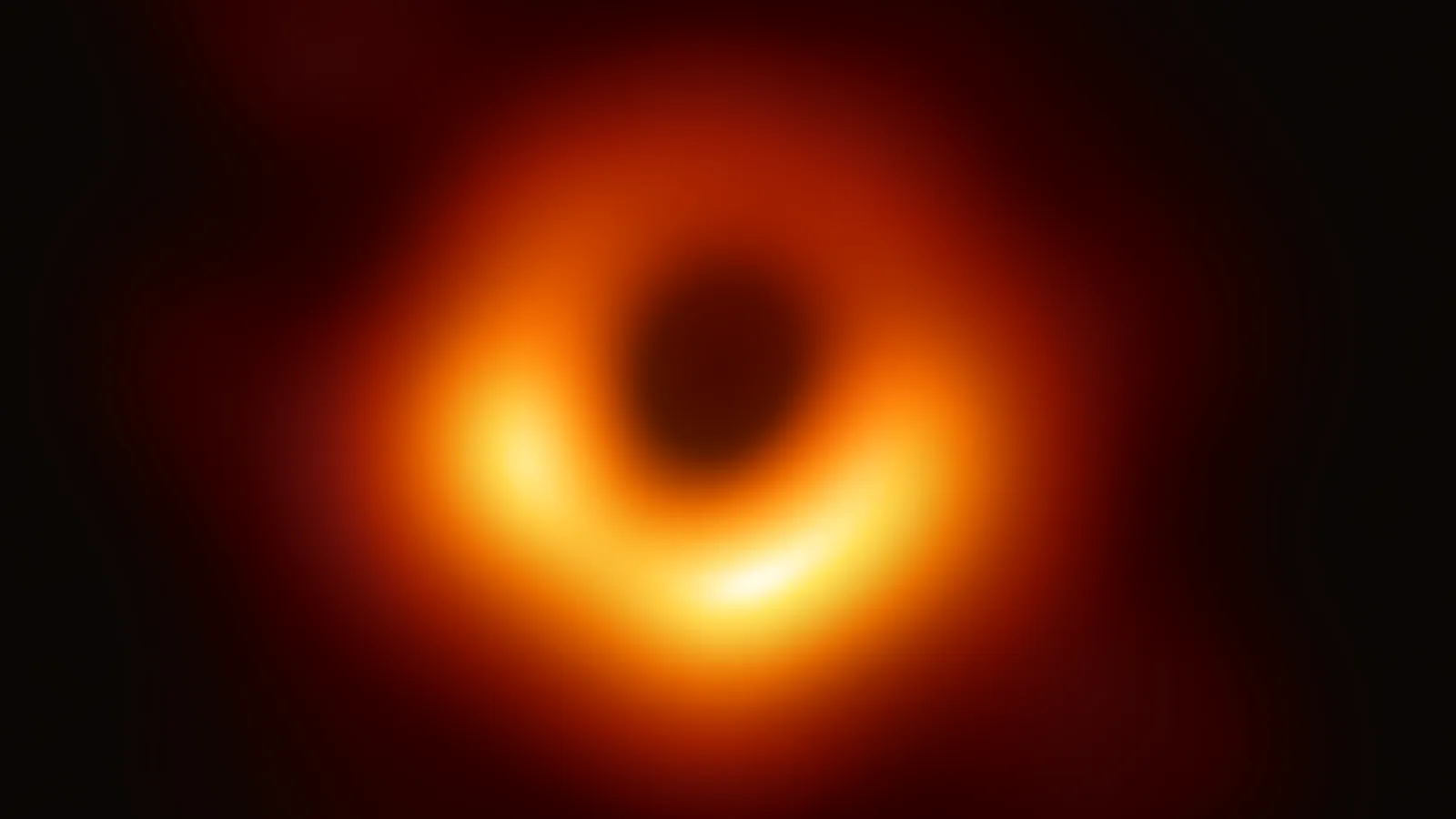
Samuel Lai's team at Australia's CSIRO independently rebuilt the Event Horizon Telescope's 2019 image of the supermassive black hole M87* using a machine-learning method called GenDIReCT, and the result matched, a first for the field, published Nov. 11 in Nature. For decision-makers, the episode is a working model of credible AI validation: a blind test, an independent method, and a technique with commercial spillover into medical imaging and seismic mapping.
The first photograph of a black hole just survived the audit that mattered. An independent team led by Samuel Lai, a researcher with Australia's Commonwealth Scientific and Industrial Research Organisation (CSIRO), rebuilt the image of M87* using a machine-learning technique called GenDIReCT and got back a black hole almost identical in size and shape to the one the Event Horizon Telescope (EHT) showed the world in 2019. The work was published Wednesday, Nov. 11, in the journal Nature. "This is the first truly independent validation of the EHT image, an important step in the scientific process," Lai said in a statement sent to Space.com.
Why did a landmark image need a second opinion at all? Because the original was assembled by a planet-sized instrument staring through a turbulent atmosphere. Lai's analogy: "It is like standing in your backyard and trying to take a photo of a doughnut on the moon." The EHT is not one telescope but a global network linked into an interferometer with an effective aperture the size of Earth. That trick delivers extraordinary resolution and also injects biases, because the gaps between dishes must be filled in mathematically. Lai's team built GenDIReCT to strip out interference from Earth's atmosphere and correct for the biases introduced by combining telescopes. The kicker: "our model had no idea what a black hole looked like when we applied it to the M87 data." It found the ring anyway.
The ring it found is the one Einstein effectively drew in 1915. General relativity recast gravity as the curvature of spacetime: mass bends the fabric, and the more mass, the sharper the bend. Karl Schwarzschild then solved the equations for an extreme case, an infinitesimal region of infinite mass whose curvature runs away, a singularity, wrapped in a spherical boundary where escape velocity exceeds the speed of light. That boundary is the event horizon. General relativity also predicted what the neighborhood would look like: a ring of superheated glowing plasma with the black hole's shadow cast upon it. Black holes were born on paper in 1915, decades before anyone found one and more than a century before the EHT saw one.
M87* sits at the heart of the galaxy Messier 87, 55 million light-years away, and packs roughly 6.5 billion times the mass of the sun. When the EHT image landed in 2019, researchers were struck by how closely it matched the 1915 prediction. The new result hardens that match, because it comes from a method that was never tuned to reproduce it. That distinction is the whole point. A confirmation produced by the same pipeline that produced the original is not a confirmation; it is a rerun.
"Independent validation is at the heart of the scientific process, and it is especially valuable for results as novel as those of the EHT," said Laurent Loinard, Director of the EHT Collaboration. "It is extremely gratifying to see that GenDIReCT, an elegant, entirely independent method, recovers the ring structure of M87* across several years, in excellent agreement with the EHT Collaboration's published results." He added that studies like this "strengthen our confidence in what we have learned about black holes, and enrich the toolkit available to the whole community."
The toolkit is the part executives should watch. CSIRO's technique is not black-hole-specific machinery; it is a way of pulling a weak signal out of noisy, biased data. The same approach could be pointed at medical imaging and at mapping earthquakes, according to the research team. That is a pattern that keeps repeating across applied AI: a method built for an exotic problem turns out to be a general-purpose instrument for extracting structure from mess. The organizations that spot those transfers early tend to capture the value before the technique becomes a commodity.
For leaders deploying models into high-stakes decisions, the M87* story is a template worth copying. The validation was credible precisely because the model was blind to the answer. It was not shown a black hole and asked to agree; it was handed raw data and asked to speak first. That is the difference between a demo and a verification, and it is the standard regulators, auditors, and boards are increasingly going to demand. The second lesson is about provenance. The EHT's original image was real, but it was also the product of reconstruction choices made by humans and algorithms. Independent replication is what separates a result you believe from a result you merely hope is right. Einstein's theory has now survived a century of tests. The method that confirmed it this time may end up mattering just as much.
This story's Key Insights and Take-aways are locked.
Create a free account to unlock Executive Actions for one credit.
Register to UnlockAlways free for Executives Club members. Join the Club
More in Science

Anthropic's I.P.O. Made Rank-and-File Researchers Worth Tens of Millions
Researchers who joined just a few years ago are now worth tens of millions, and the windfall resets the pay benchmark for every private A.I. lab still paying in paper.

Sea Lion Culling Strategy Fails: New Model Says Killing Them Won't Save Salmon
The latest research from AAAS overturn a long-held conservation assumption, forcing policymakers to rethink critical resource allocation in marine ecosystems.

Microplastics do more than pile up: they react with water to damage cells
Scientists have found that plastic particles can generate highly reactive molecules in water, a mechanism that could explain links to heart attacks, strokes, and neurological disorders.