
Elkhorn coral is functionally extinct in Florida. Vanguard's aquanauts move in
DEEP's habitat 17 metres down at Tennessee Reef lets scientists live a week at a time among transplanted corals, converting three-hour dive days into round-the-clock reef watch.
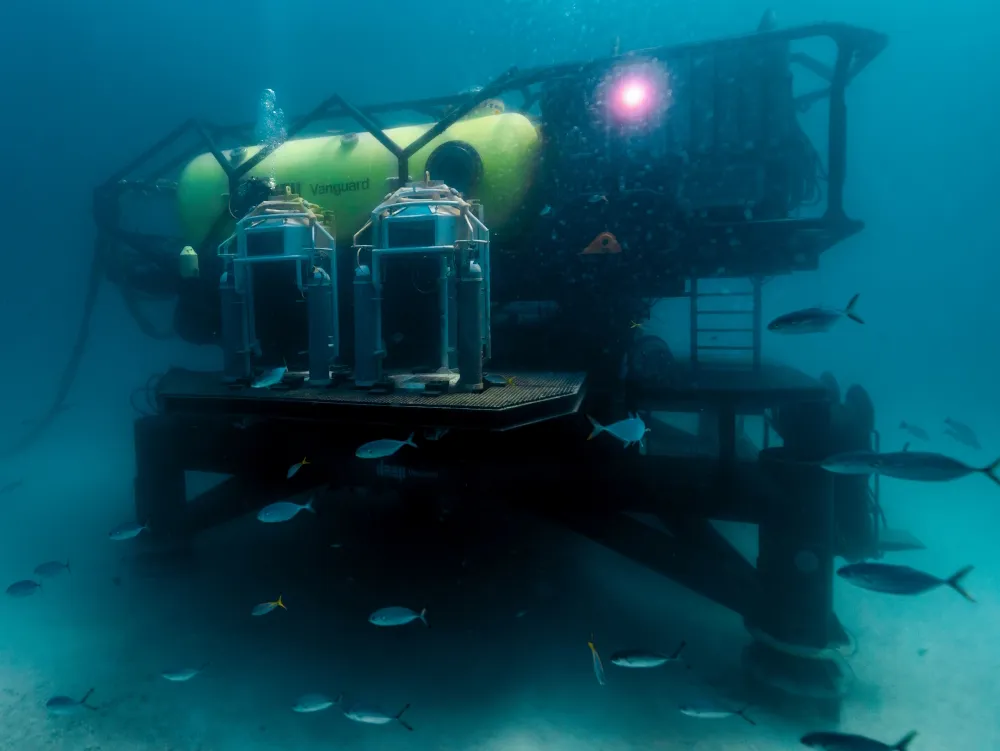
Jim Brittsan, founder and executive director of the non-profit Sustainable Ocean and Reefs, moved 11 coral species into a temporary nursery beside Vanguard, DEEP's subsea habitat deployed in June 2026 at Tennessee Reef in the Florida Keys National Marine Sanctuary. Because aquanauts can stay a week at a time instead of the roughly three hours of daily work divers get from a boat, the station turns reef restoration into continuous, night-inclusive monitoring and a proving ground for DEEP's plan to build a fleet of undersea habitats.
Florida has already lost the fight for two of its most important corals. Elkhorn (Acropora palmata) and staghorn (Acropora cervicornis), the branching species that build reefs, are considered functionally extinct in Florida waters. Which is why the move at Tennessee Reef matters: in September 2026, coral restoration non-profit Sustainable Ocean and Reefs (SOAR) received authorisation to relocate 11 different coral species into a temporary nursery sitting 15 metres from Vanguard, a newly deployed underwater habitat. Vanguard's aquanauts, the scientists who will live inside it, are not visiting the reef. They are moving in.
Vanguard was deployed in June 2026 on the seafloor of the Florida Keys National Marine Sanctuary, around 8 kilometres south of Long Key, 17 metres beneath the surface of the Atlantic. It is a long-stay underwater station for marine biologists, built by DEEP, the international design and engineering organisation whose stated aim is to make humans aquatic by establishing more subsea habitats. Jim Brittsan, founder and executive director of SOAR, arranged the nursery beside it, bringing corals from a site 10 metres closer to the surface where they faced increasing environmental stress. In the reduced temperatures below, they are starting to flourish, hosting their own marine life that is visible day and night from the residence 15 metres away. "This is really exciting," Brittsan says.
The case for living down there is arithmetic. Divers working from a boat can do about three hours of work a day at depth, Brittsan says, because bottom time is limited and ascent must be slow to avoid decompression sickness. Every round trip to the surface burns hours that could be spent watching. "It's much more efficient if we can just stay down there," he says. Once Vanguard is fully commissioned early in 2027, aquanauts will live in the habitat a week at a time, monitoring marine life around the clock. That is a step change in coverage, not a marginal gain in convenience.
The urgency behind it is thermal. Climate change brings elevated ocean temperatures, and warm water prompts corals to eject the algae living in their tissues, upending a mutually beneficial symbiosis in what is known as a bleaching event. Without algae and other symbionts, corals are left ghostly white, and if temperatures do not fall and the algae do not return, they eventually die. Moving corals deeper is a bet on temperature, and the early signal is encouraging. Transport was species-specific: acroporid corals travelled submerged in bins of seawater, while other corals were moved encased in seawater-soaked bubble wrap and placed in temperature-controlled coolers before being set into the nursery. A more permanent nursery will follow, with corals eventually planted on the seabed and their long-term survival assessed through monitoring.
Corals are only part of the picture. Brittsan's team has observed juvenile long-spined sea urchins (Diadema antillarum) that naturally recruited to Vanguard. "A lot of Diadema have started settling all over the habitat," he says. The species is considered a keystone because its grazing reduces algal cover on reefs, opening space for corals and other reef organisms to settle and grow. Diadema is also most active at night, which means short daytime dives would miss much of what needs monitoring. "That's where Vanguard really comes into play," says Thomas Potts, science program director at DEEP. DEEP is taking a holistic approach, also planning to build sponge nurseries outside the habitat. "You need corals, sponges, sea urchins and everything else," Potts says.
There is precedent for what prolonged submersion does to the people inside. Steve Gittings spent 27 years as chief scientist at the National Oceanic and Atmospheric Administration Office of National Marine Sanctuaries, and during that time logged many weeks living on Aquarius Reef Base, an ocean-floor habitat used for vital marine surveys. "We all know that if you really want to get to know a place, you should go and live there," he says. Living underwater, he argues, reveals how many phenomena sustain a healthy reef, "millions of things going on that are super-critical", and it changes people the way astronauts are changed by living in space. "There's an emotional connection to living underwater that keeps you dedicated and committed," Gittings says.
Vanguard is a proving ground as much as a laboratory. Potts calls it a great place to train scientists who might later work in different habitats on the continental shelf, and DEEP's longer-term vision is to build a fleet of undersea residences at other locations. Brittsan sees the model travelling: "This could be replicated throughout the Florida Keys and even in other parts of the world. It'll be a game-changer." The strategic read for anyone outside marine science is broader than reefs. When a monitoring bottleneck is expensive enough, the fix is not better sensors but permanent human presence on site, and the same logic applies wherever field time, not data quality, caps output. Gittings supplies the discipline that keeps the ambition honest. "Only nature can do the full restoration," he says. "Our role is to create the conditions that allow nature to do its thing."
This story's Key Insights and Take-aways are locked.
Create a free account to unlock Executive Actions for one credit.
Register to UnlockAlways free for Executives Club members. Join the Club
More in Science

Anthropic's I.P.O. Made Rank-and-File Researchers Worth Tens of Millions
Researchers who joined just a few years ago are now worth tens of millions, and the windfall resets the pay benchmark for every private A.I. lab still paying in paper.

Sea Lion Culling Strategy Fails: New Model Says Killing Them Won't Save Salmon
The latest research from AAAS overturn a long-held conservation assumption, forcing policymakers to rethink critical resource allocation in marine ecosystems.

Microplastics do more than pile up: they react with water to damage cells
Scientists have found that plastic particles can generate highly reactive molecules in water, a mechanism that could explain links to heart attacks, strokes, and neurological disorders.