
Escher Never Passed a Math Class. Mathematicians Still Study His Art
A new exhibition traces how a Dutch printmaker who failed mathematics became an enduring source of insight for the people who do it for a living.
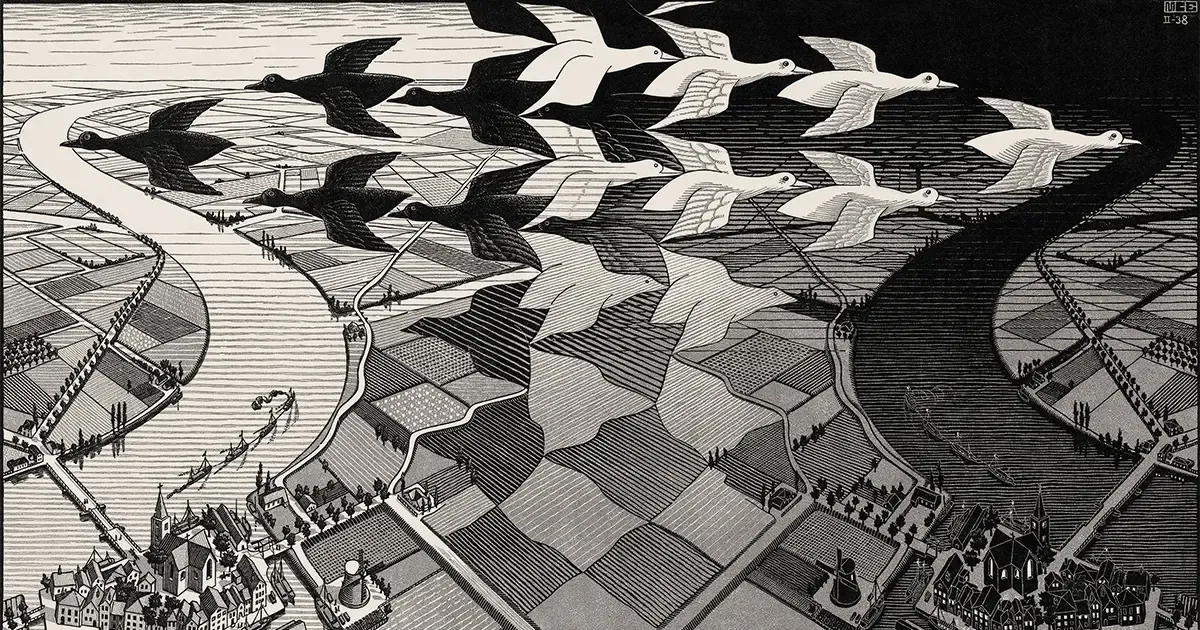
Maurits Cornelis Escher, the Dutch artist born in Leeuwarden in 1898, never earned a pass mark in mathematics and studied decorative arts and printmaking instead, yet a new exhibition shows the insights in his artwork became an enduring inspiration to mathematicians. For leaders, the case is a reminder that the ability to see structure without formal training is a scarce and underpriced input, especially as pattern generation becomes cheap.
Maurits Cornelis Escher never got a pass mark in mathematics. That is not a critic taking a swipe; it is the artist's own verdict on his school years. Born in 1898 in Leeuwarden, the canal-lined city in the Netherlands, Escher struggled with the subject as a student and once remarked that he "never got a pass mark." He did not go on to a mathematics chair. He studied decorative arts and printmaking instead. And yet, as a new exhibition makes plain, the insights worked into his artwork became an enduring inspiration to the people who do mathematics for a living.
That is the whole story compressed into one line: the man who could not pass the class ended up showing the class something it had not seen. Escher had no formal mathematical education. What he had was a habit of looking. He used his artwork to explore the strange rules of nature he found operating around him, and the rules he kept bumping into turned out to be the ones mathematicians cared about most.
For context, the territory Escher's prints are most often associated with is the geometry of pattern and the outer edge of the possible: how shapes tile a flat surface without gaps or overlaps, how symmetry behaves when you push it hard, how a surface can twist back on itself, how a staircase can climb forever and land exactly where it began. These are not decorative curiosities. They sit near the intersection of geometry, topology, and the study of symmetry, and they are the kind of problem that is far easier to see than to write down. That gap, between seeing and proving, is where Escher lived.
The exhibition's real argument is about where insight comes from. Escher reached these problems without the notation, without the proofs, and without the vocabulary. He reached them by drawing, iterating, and trusting his eye. That is a genuinely unusual route into mathematics, and it is the reason his work has kept its grip on the field for decades instead of fading into a period curiosity. Mathematicians did not adopt him out of sentiment. They adopted him because his pictures kept pointing at real structure.
Here is why that should matter to anyone who is not a mathematician. Pattern recognition is the raw material of most good decisions, and it rarely arrives with a proof attached. The person who notices that two unrelated things rhyme is often the person who finds the opening. Escher is a case study in a specific and underrated skill: the ability to hold a strange observation long enough for it to become a question, and then to keep working the question until the shape of an answer appears. He did it with a printing press and a burin rather than a blackboard, and the output still holds up.
There is a second, sharper lesson in the biography. Escher's lack of credentials did not disqualify him from contributing to a field he was never formally trained in. It just meant his contribution looked different. For anyone building a team, that is worth sitting with. The most useful person in the room is not always the one with the right degree on the wall. Sometimes it is the one who has been staring at the problem from an angle nobody with the degree would bother to take. Escher spent his career at that angle, and the mathematicians eventually came to him.
The timing of the exhibition matters too. We are in a moment when pattern generation has become cheap. Machines can produce infinite variation, infinite tiling, infinite symmetry, faster than any human hand. That makes the human part of Escher's method more interesting, not less. He was not valuable because he could produce a lot of patterns. He was valuable because he chose which patterns were worth looking at, and because he could tell when a picture was hiding a rule. Taste and selection are the scarce inputs. Generation is not.
So the takeaway is not that art and mathematics are secretly the same thing, or that you should go learn topology. It is narrower and more useful than that. Escher is proof that a person can be bad at the formal version of a subject and still see something true inside it, and that the seeing can outlast the formalism. He failed the class. The class is still studying him.
This story's Key Insights and Take-aways are locked.
Create a free account to unlock Executive Actions for one credit.
Register to UnlockAlways free for Executives Club members. Join the Club
More in Science

Anthropic's I.P.O. Made Rank-and-File Researchers Worth Tens of Millions
Researchers who joined just a few years ago are now worth tens of millions, and the windfall resets the pay benchmark for every private A.I. lab still paying in paper.

Sea Lion Culling Strategy Fails: New Model Says Killing Them Won't Save Salmon
The latest research from AAAS overturn a long-held conservation assumption, forcing policymakers to rethink critical resource allocation in marine ecosystems.

Microplastics do more than pile up: they react with water to damage cells
Scientists have found that plastic particles can generate highly reactive molecules in water, a mechanism that could explain links to heart attacks, strokes, and neurological disorders.