
Europe and Japan's BepiColombo reaches Mercury, lander could be next
The joint ESA-JAXA mission has arrived at the solar system's innermost planet, and its backers say the next step could be putting a spacecraft on a surface no mission has ever touched.
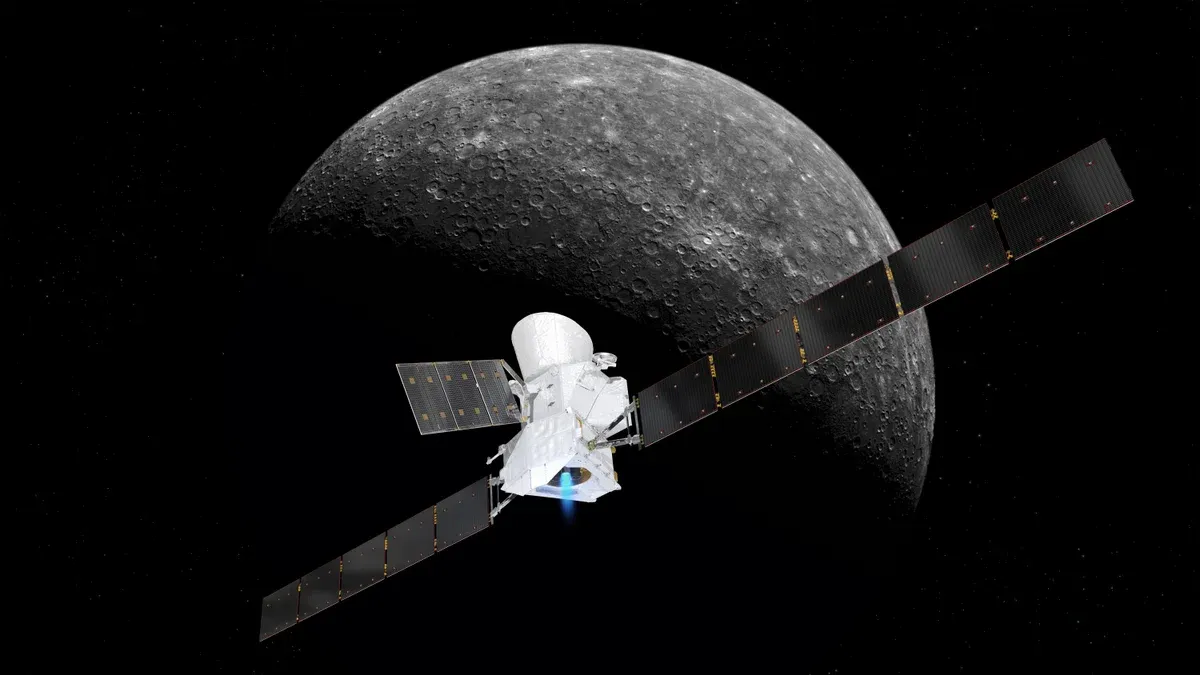
The European Space Agency and Japan's JAXA have brought their joint BepiColombo mission to Mercury, the solar system's innermost planet, in what the mission's backers describe as a possible last step before sending a lander. For space agencies, suppliers and investors, the arrival is a live test of whether multi-decade, multi-nation science programs can still be financed, flown and converted into the next, harder mission.
BepiColombo, the joint European-Japanese spacecraft, has arrived at Mercury. That is the news in one line, and it is a bigger deal than the flat phrasing suggests. The mission is a partnership between the European Space Agency and Japan's JAXA, and per the source, it "has reached our solar system's innermost planet." The kicker: it "might be the last step before we send a lander." So the arrival is not a photo op. It is the moment the hardest target in the solar system stops being theoretical and becomes a place we can study up close, and possibly touch.
For context, Mercury is the least-visited of the rocky planets. Historically, only two spacecraft have been there. NASA's Mariner 10 flew past three times in the mid-1970s, and NASA's MESSENGER orbited the planet from 2011 to 2015. No mission has ever landed on the surface. That is the gap BepiColombo is built to narrow, and it is why the phrase "before we send a lander" carries so much weight.
Getting there is its own story. Mercury sits deep in the Sun's gravity well, and a spacecraft cannot simply point and burn. Missions typically combine solar electric propulsion with a chain of gravity assists, swinging past Earth, Venus and Mercury itself to bleed off speed and line up the geometry. That is why a mission launched in 2018 is only now arriving, and why the cruise phase is measured in years rather than months. The payoff is a pair of orbiters, one built by ESA and one by JAXA, designed to study the planet and its magnetosphere from complementary angles.
Then there is the puzzle. Mercury is strange in ways that have kept planetary scientists busy for decades. It has an iron core that is enormous relative to the size of the planet, a global magnetic field that a body that small should not really have, and permanently shadowed polar craters that appear to hold water ice despite a day side hot enough to melt lead. Its crust also appears to be shrinking as the interior cools, wrinkling the surface into cliffs. None of that is fully explained, and a close-up look is how you start explaining it.
The lander question is where this gets genuinely hard. Mercury has essentially no atmosphere, so there is nothing to slow a descending craft with parachutes. Surface temperatures swing by hundreds of degrees between day and night, and the solar flux near the planet is intense. A lander would need propulsion to touch down softly, thermal systems that survive both extremes, and electronics hardened against radiation. That is a serious engineering program, not a bolt-on to an orbiter. It is also the only way to answer questions remote sensing cannot, like what the surface material actually is and how it behaves under those conditions.
One more thing worth flagging: Mercury is a natural laboratory for questions that reach well beyond it. Its polar ice is a case study in how volatiles survive in permanently shadowed regions, which is directly relevant to the Moon and to cislunar resource planning. Its oversized core and magnetic field bear on how rocky planets form and why some keep a magnetic shield while others, like Mars, lose theirs. Data from Mercury tends to show up in models of exoplanets, too, because close-in rocky worlds around other stars look a lot like this one.
Why should anyone outside the space community care? Because BepiColombo is a live test of a model that increasingly matters: two agencies, two countries, one shared bill. Deep-space science is expensive, slow and politically fragile, and the multi-nation structure is how agencies keep flagship missions alive when no single budget can carry them. For the companies that supply instruments, propulsion, thermal hardware and ground systems, missions like this are the demand signal that keeps capability warm between bigger programs. For investors watching the space economy, the lesson is that the science side of the market runs on decade-long cycles, and the winners are usually the suppliers who can stay qualified across them.
What to watch next is straightforward. The mission still has to settle into its science orbit and start returning data, and the lander idea remains a proposal rather than a funded program. The source frames the arrival as possibly the last step before a lander, not as a commitment to build one. That distinction matters, because the gap between "we could" and "we are" is where most ambitious space plans die. Watch the budget lines, not the press releases.
The bigger point is simpler. Mercury is the closest planet to us and one of the least understood, and for the first time in a decade a spacecraft is there to look at it. If a lander follows, it would be a first for humanity. If it does not, we still get the best look yet at a world that has been quietly defying expectations since the 1970s.
This story's Key Insights and Take-aways are locked.
Create a free account to unlock Executive Actions for one credit.
Register to UnlockAlways free for Executives Club members. Join the Club
More in Science

Anthropic's I.P.O. Made Rank-and-File Researchers Worth Tens of Millions
Researchers who joined just a few years ago are now worth tens of millions, and the windfall resets the pay benchmark for every private A.I. lab still paying in paper.

Sea Lion Culling Strategy Fails: New Model Says Killing Them Won't Save Salmon
The latest research from AAAS overturn a long-held conservation assumption, forcing policymakers to rethink critical resource allocation in marine ecosystems.

Microplastics do more than pile up: they react with water to damage cells
Scientists have found that plastic particles can generate highly reactive molecules in water, a mechanism that could explain links to heart attacks, strokes, and neurological disorders.