
Hayabusa's sampler never fired. It still returned 1,500 asteroid grains.
A sampler that never fired, a lander that vanished, and 1,500 grains of asteroid dust that turned a near-failure into Japan's entire sample-return playbook.
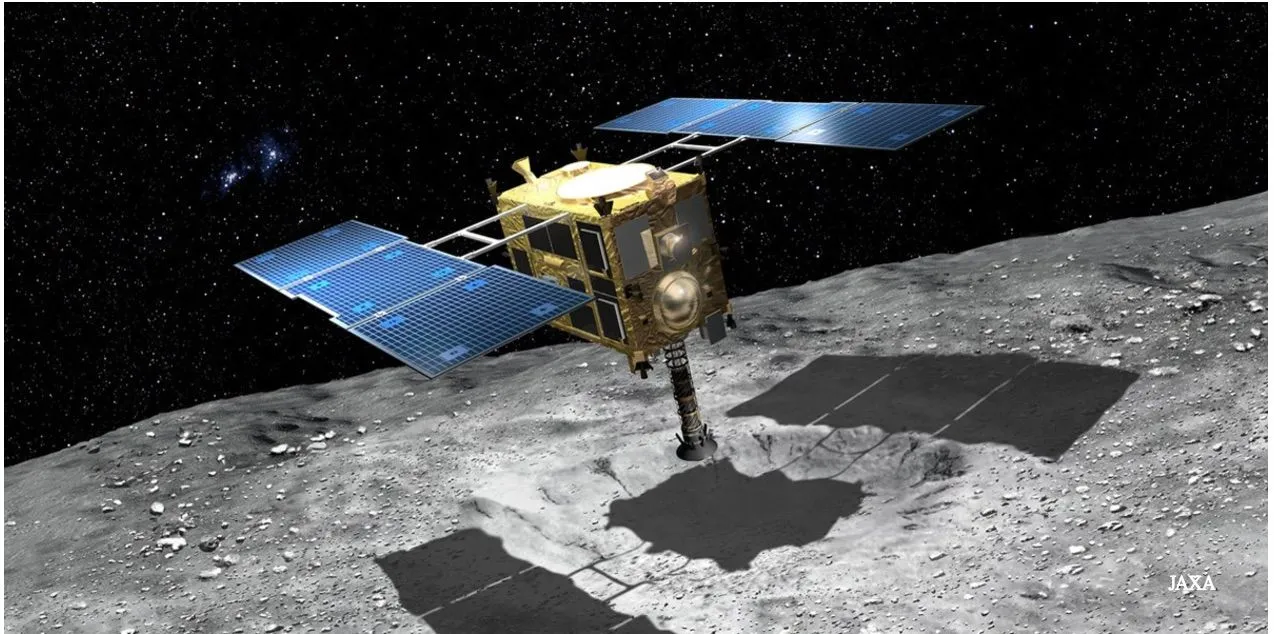
Japan's Hayabusa spacecraft, built and flown by JAXA, became the first probe to lift off from an asteroid on Nov. 19, 2005, after a three-hour communications blackout above Itokawa, and in November 2010 JAXA confirmed it had returned 1,500 dust grains despite a collector mechanism that never fired. For decision-makers, it is the cleanest case study available on carrying an unverifiable asset to term: the payoff landed five years after the touchdown and its success spurred Hayabusa2, which returned samples from asteroid Ryugu in December 2020.
Japan's Hayabusa spacecraft did not work the way it was designed to. Its sampler never fired. Its small lander vanished. It dropped into safe mode on both of its touchdowns on the asteroid Itokawa, and its controllers spent years unsure whether the probe had grabbed anything at all. Then, in November 2010, five months after Hayabusa's sample-return capsule touched down in Australia, JAXA delivered the number that ended the debate: 1,500 dust grains from Itokawa, material jammed into the collector by the two landings despite a collection mechanism that never fired. A mission that failed on its own terms still came home with the goods.
The first of those landings happened on Nov. 19, 2005, and it produced the first-ever liftoff from the surface of an asteroid by a spacecraft. The approach was ugly. Hayabusa descended to a point just 56 feet above Itokawa before going silent for three hours, according to an Associated Press report. When contact was restored, JAXA officials confirmed the probe had landed, and it eventually lifted off for a second attempt. "The spacecraft actually bounced off the surface a few times and spent about 39 minutes resting on the asteroid, but apparently the samplers never fired," Andrew Cheng, a Hayabusa science team member at Johns Hopkins University Applied Physics Laboratory, told Space.com at the time.
Getting to that moment took two and a half years and one badly timed solar storm. JAXA launched Hayabusa on May 9, 2003, with plans to arrive at the asteroid in the early summer of 2005. A solar storm degraded the probe's solar arrays, limiting the power available to its ion engines, and the arrival slipped to September. Hayabusa finally reached Itokawa on Sept. 12, 2005. It dropped a small lander onto the surface, and that probe was apparently lost. It then dropped a landing target marker on the asteroid and managed a touchdown about 99 feet from the marker, JAXA has said. The margin for error was measured in feet, and the spacecraft was already running on degraded power.
Here is the part worth sitting with: the liftoff record was never the point. The primary goal of the Hayabusa mission was to collect samples from an asteroid and return them to Earth. Everything else was improvisation. Each touchdown put the spacecraft into safe mode, and the team could not confirm whether any material had made it inside the collector. Cheng was blunt about the odds at the time. "After all the thrashing about... there is no way to confirm that," he said. JAXA sent the spacecraft home anyway, betting the return leg on a payload nobody could verify.
The second landing came a few days later, on Nov. 26, 2005. Then came the long silence of cruise and reentry. Hayabusa's sample-return capsule touched down in Australia in June 2010. In November 2010, JAXA announced that Hayabusa had in fact collected 1,500 dust grains from Itokawa, samples that were jammed into the collector by the two landings even though the collector mechanism never fired. The dust is not just dust. Asteroids are space rocks formed during the early solar system, and scientists study them to reconstruct that history. Hayabusa came back with a physical record of it.
The downstream effect is the part most operators miss. Hayabusa's ultimate success spurred the creation of another Japanese sample-return mission, Hayabusa2. That probe launched in December 2014, arrived at the asteroid Ryugu in 2018, collected its own samples, and returned them to Earth in December 2020. It is now on an extended mission to the asteroid 2015 BM510, which it will fly by in April 2028. It had planned to land on a strange asteroid, 1998 KY26, but engine trouble made that rendezvous impossible. Even a proven program inherits hardware risk.
That is the executive lesson buried in a space headline from 2005. Programs are not judged at the moment of the near-miss; they are judged at the moment of delivery, and the gap between those two moments can run five years, as it did from the Nov. 19, 2005 landing to the November 2010 confirmation. JAXA's decision to fly home an unverified collector is the kind of call that looks reckless in a quarterly review and visionary in a history book. The record books remember the liftoff. The science came from the dust, and the dust only existed because someone chose to finish the trip.
This story's Key Insights and Take-aways are locked.
Create a free account to unlock Executive Actions for one credit.
Register to UnlockAlways free for Executives Club members. Join the Club
More in Science

Anthropic's I.P.O. Made Rank-and-File Researchers Worth Tens of Millions
Researchers who joined just a few years ago are now worth tens of millions, and the windfall resets the pay benchmark for every private A.I. lab still paying in paper.

Sea Lion Culling Strategy Fails: New Model Says Killing Them Won't Save Salmon
The latest research from AAAS overturn a long-held conservation assumption, forcing policymakers to rethink critical resource allocation in marine ecosystems.

Microplastics do more than pile up: they react with water to damage cells
Scientists have found that plastic particles can generate highly reactive molecules in water, a mechanism that could explain links to heart attacks, strokes, and neurological disorders.