
Hayabusa2's last working engine fails, killing Japan's 2031 asteroid landing
JAXA swaps a 2031 touchdown on asteroid 1998 KY26 for a 2028 high-speed flyby of 2015 BM510 after its fourth and final ion thruster quits.
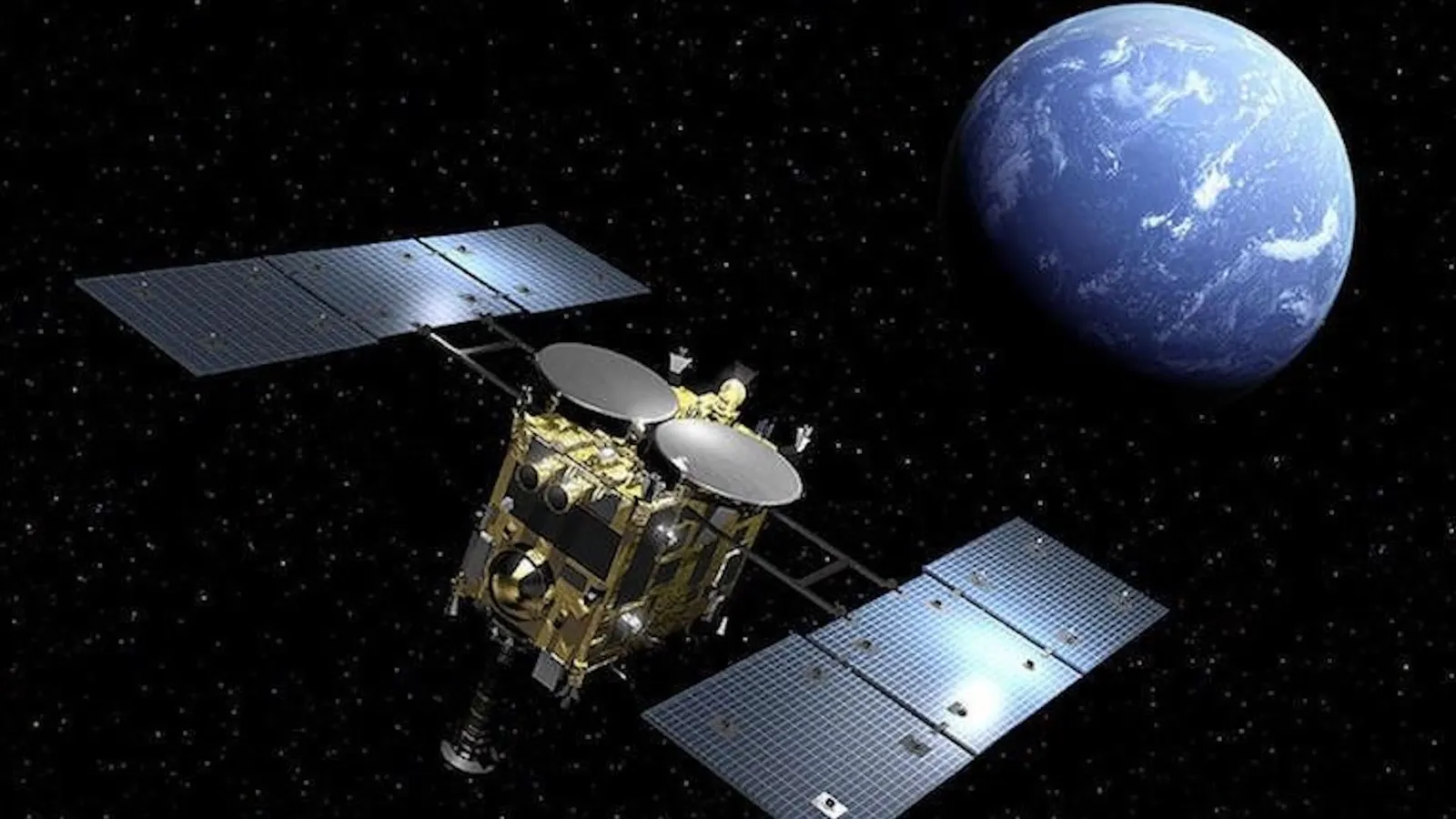
JAXA's Hayabusa2 spacecraft lost the last of its four ion thrusters in mid-August, forcing the agency to cancel a planned 2031 landing on asteroid 1998 KY26 and redirect to a 2028 flyby of 2015 BM510. For decision-makers, it is a live case study in how aging long-duration assets quietly rewrite multi-year science and capital plans.
Japan's Hayabusa2 spacecraft has run out of engines, and with them, its shot at landing on an asteroid. JAXA, the country's space agency, announced at a Tuesday (Nov. 17) press conference that the final functioning unit among Hayabusa2's four ion thrusters malfunctioned in mid-August, forcing it to scrap a planned 2031 rendezvous and touchdown on 1998 KY26, a near-Earth asteroid just 36 feet (11 meters) wide. The replacement plan is a different mission entirely: a high-speed flyby of another small asteroid, 2015 BM510, in April 2028. No landing. No sample collection. Just a fast pass.
The announcement came a day after a Cabinet Office space policy subcommittee meeting, and it caps an unusually eventful run for a probe that has already made history. Hayabusa2 launched in 2014, spent years traveling to the asteroid Ryugu, and in December 2020 dropped a reentry capsule toward Earth carrying material collected from that asteroid. The main spacecraft did not retire. It kept flying an extended mission, and in July it pulled off a super-close flyby of Torifune, a two-headed asteroid. Now the hardware is dictating the ending. "The deterioration of the onboard equipment... is becoming increasingly evident," Yuya Mimasu, team leader of the extended mission, told reporters, according to Japan Times.
Ion thrusters are the marathon runners of spaceflight. They typically generate tiny amounts of thrust, sometimes measured in fractions of a newton, but they can run for years on a trickle of propellant, which is exactly what a multi-year cruise to a small asteroid requires. Hayabusa2 launched with four of them. Losing one is survivable. Losing the last one is not, at least not for a mission that needs to slow down, match orbits with a 36-foot rock, and settle onto its surface. JAXA officials also said a sensor detected unexpected erosion of the spacecraft's surface during its long voyage in space, a reminder that deep space is not a passive environment. Radiation, micrometeoroids, and thermal cycling all take a toll, and extended missions are typically flown on borrowed time.
The science that disappears with the landing is specific and hard to replace. Rendezvous and touchdown on a tiny near-Earth asteroid would have let JAXA study a body small enough that forces larger asteroids shrug off could plausibly spin it, nudge it, or break it apart. Small asteroids are also the ones most likely to matter for planetary defense, because they are numerous, hard to spot, and occasionally cross Earth's path. A flyby still returns data, but at high speed the encounter is measured in minutes, not months. Instruments get one look, not a campaign.
The new target is not a consolation prize. 2015 BM510 is a D-type asteroid, a class scientists describe as organic-rich and comet-like, possibly formed in the outer solar system before drifting inward. It is already the primary target of a proposal for the European Space Agency's mini-Fast mission series, which means JAXA's 2028 flyby could feed directly into a broader European science case. For a mission that just lost its headline objective, that is a useful pivot: instead of being the only customer for a difficult landing, Hayabusa2 becomes a scout for a target other agencies want to understand.
Timing matters too. Around the same window as Hayabusa2's April 2028 flyby, JAXA is scheduled to launch its next asteroid mission, Destiny+. It will launch alongside ESA's Ramses mission, which is designed to study the asteroid Apophis ahead of its very close approach to Earth in 2029. After that, Destiny+ heads for asteroid 3200 Phaethon, the parent body of the Geminid meteor shower. In other words, the 2028 to 2029 stretch is shaping up as one of the densest asteroid-science calendars in history, and Hayabusa2 will now be a supporting act rather than the headliner.
For the people who fund and run space programs, the Hayabusa2 decision is a case study in a problem that is about to get much more common. Spacecraft are living longer than their designers assumed, and extended missions are cheap relative to new launches, so agencies keep flying them. But every extra year adds wear that no ground test fully replicates. JAXA's choice to redirect rather than retire the probe preserves some return on a 2014 investment, and it avoids the optics of a dead spacecraft. It also quietly resets expectations: the agency's next flagship asteroid mission, Destiny+, now carries more of the institutional ambition.
The broader lesson for anyone managing long-lived assets, whether a probe or a platform, is that redundancy buys time but not forever. Hayabusa2 had four ion engines and needed one. It ran out. The mission did not end, but its ambitions did shrink from landing to flyby, and that is the trade every operator eventually faces: keep the asset alive on reduced capability, or spend the capital to replace it. JAXA chose to keep flying. The asteroid 2015 BM510 will get a visitor in 2028, and the 2031 landing that was supposed to define the mission's final chapter will not happen.
This story's Key Insights and Take-aways are locked.
Create a free account to unlock Executive Actions for one credit.
Register to UnlockAlways free for Executives Club members. Join the Club
More in Science

Anthropic's I.P.O. Made Rank-and-File Researchers Worth Tens of Millions
Researchers who joined just a few years ago are now worth tens of millions, and the windfall resets the pay benchmark for every private A.I. lab still paying in paper.

Sea Lion Culling Strategy Fails: New Model Says Killing Them Won't Save Salmon
The latest research from AAAS overturn a long-held conservation assumption, forcing policymakers to rethink critical resource allocation in marine ecosystems.

Microplastics do more than pile up: they react with water to damage cells
Scientists have found that plastic particles can generate highly reactive molecules in water, a mechanism that could explain links to heart attacks, strokes, and neurological disorders.