
Mercury is about to get its best-ever look, after an eight-year voyage
The closest planet to the Sun is finally getting a close-up, and the eight-year wait is a case study in underwriting decade-long bets.
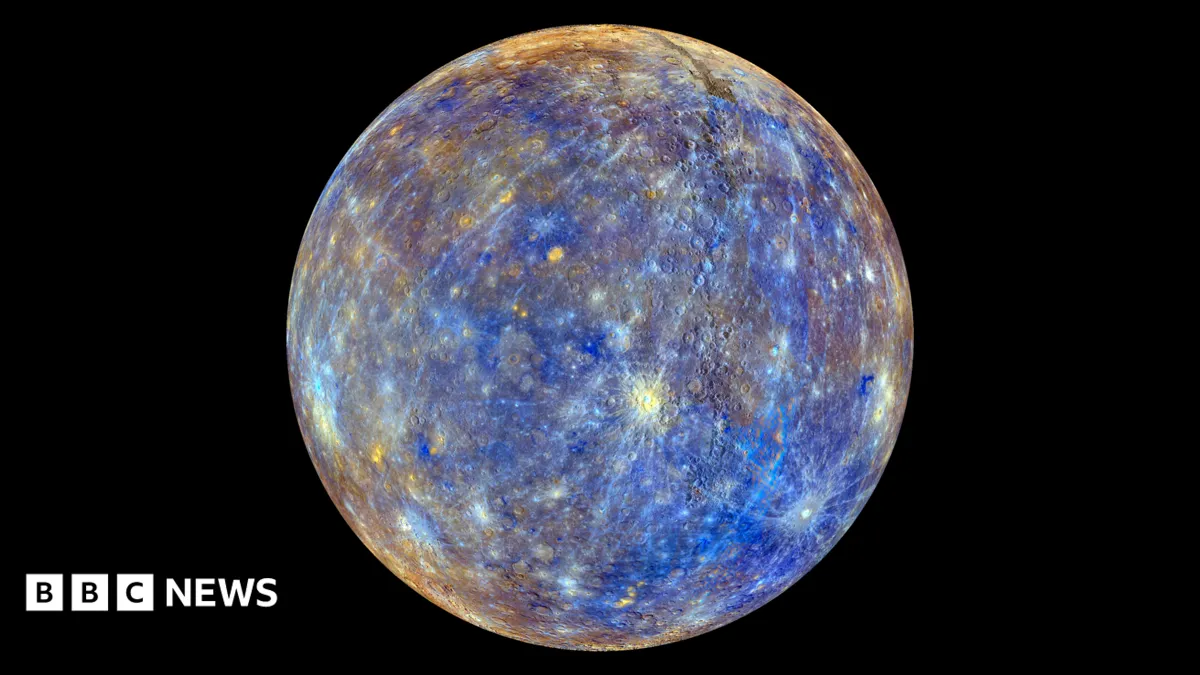
A spacecraft is about to arrive at Mercury, the closest planet to the Sun, after an eight-year voyage that is set to deliver the best ever view of a planet only two probes have ever visited. For decision-makers, the mission is a working example of how to fund, staff and hold together a bet whose payoff lands long after the people who approved it have moved on.
Mercury, the closest planet to the Sun, is about to get a visitor. After an eight-year voyage, a spacecraft is closing in on the smallest planet in the solar system, and the mission is set to hand us our best ever view of it. That is the headline, and it undersells what is actually happening. Mercury is the least understood rocky world we have, a planet that has hosted exactly two visitors in the entire history of spaceflight, and the one now arriving has spent nearly a decade in transit to get there.
Here is the counterintuitive part that makes the eight years make sense: Mercury is the hardest planet to reach, not the easiest. It looks close on a poster. In orbital mechanics, close to the Sun means deep inside the Sun's gravity well, and a spacecraft arriving there is moving far too fast to simply settle into orbit. It has to shed that speed, and the cheapest way to do it is not with fuel but with time, stealing energy from planets along the way. Missions typically fly a slingshot sequence past Earth, Venus and Mercury itself, each pass trimming a little more velocity. That is why a trip to the planet next door takes the better part of a decade while a trip to Mars takes months.
The visitor is BepiColombo, a joint effort between the European Space Agency and Japan's space agency JAXA, launched in 2018 and carrying two separate science orbiters stacked into a single spacecraft. For context, only two probes have ever been to Mercury: Mariner 10, which made three flybys in the mid-1970s, and MESSENGER, which orbited the planet from 2011 to 2015 before running out of fuel and being deliberately crashed into the surface. Everything we think we know about Mercury comes from those two missions. BepiColombo is built to go further, splitting the work between an orbiter focused on the planet's surface and interior and one designed to study its magnetic environment.
The mystery is not decorative. Mercury should not look the way it does. It has an iron core that takes up an unusually large share of its volume, a magnetic field that a planet that small should not be able to sustain, and ice hiding in polar craters that never see sunlight, on a world where the sunlit side gets hot enough to melt lead. It is also shrinking, its crust wrinkling as the planet cools, a process scientists have mapped but not fully explained. And its surface is a fossil record of the early solar system, largely untouched by the weather and plate tectonics that have erased that history on Earth.
So why should anyone outside a planetary science department care? Because BepiColombo is a live case study in the economics of long-horizon bets. The mission was approved, funded and built by agencies whose budgets are set by politicians who will be out of office long before the best data comes back. Many of the people who designed the instruments will have retired or moved on by the time the results land. That is the same structural problem every founder working on fusion, quantum computing, biotech or infrastructure knows intimately: the payoff sits beyond the horizon of the person who has to sign the check.
The second-order effects are where it gets interesting. Deep-space missions have historically been reliable engines of spillover technology: instruments, materials, power systems and software built for a one-off problem that later turn up in commercial products. They are also talent magnets. A mission that takes eight years to arrive is a training ground for engineers who then move into the private space sector, which now competes directly with agencies for the same people. And the data itself is a public good. Once the science is released, it is available to researchers, startups and anyone else who wants to build on it, at no cost.
There is a geopolitical layer too. BepiColombo is a European-Japanese collaboration, a reminder that the most ambitious science is rarely a solo act. As commercial launch and satellite constellations reshape the economics of near-Earth space, deep-science missions remain a domain where national agencies pool risk because no single budget can carry the whole thing. For executives watching the space sector, that split matters: the money and the speed are increasingly private, while the patience and the frontier science are still public.
The strategic takeaway for anyone underwriting a decade-long bet is not about Mercury at all. It is about how you keep an organisation coherent when the reward is eight years out and the people who started the work may not be there to collect it. BepiColombo's answer was to build in redundancy, split the science across two spacecraft, and accept that the timeline was the price of the destination. The best ever view of Mercury is coming. The more interesting question is what the organisations that can wait eight years for anything will do with that advantage.
This story's Key Insights and Take-aways are locked.
Create a free account to unlock Executive Actions for one credit.
Register to UnlockAlways free for Executives Club members. Join the Club
More in Science

Anthropic's I.P.O. Made Rank-and-File Researchers Worth Tens of Millions
Researchers who joined just a few years ago are now worth tens of millions, and the windfall resets the pay benchmark for every private A.I. lab still paying in paper.

Sea Lion Culling Strategy Fails: New Model Says Killing Them Won't Save Salmon
The latest research from AAAS overturn a long-held conservation assumption, forcing policymakers to rethink critical resource allocation in marine ecosystems.

Microplastics do more than pile up: they react with water to damage cells
Scientists have found that plastic particles can generate highly reactive molecules in water, a mechanism that could explain links to heart attacks, strokes, and neurological disorders.