
Meta puts 150 3D movies inside Quest headsets, betting thousands follow by 2027
The rent-or-buy store lands on Quest 3 and 3S first, a direct play for the living room at the exact moment headset makers need a reason for you to keep wearing one.
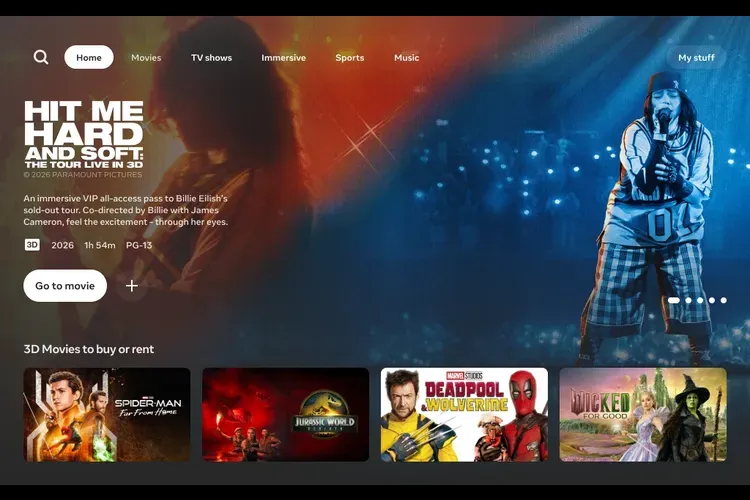
Meta announced Thursday that more than 150 3D movies are now available to rent or purchase in the TV app on its Quest 3 and Quest 3S virtual-reality headsets, with thousands more titles promised for 2027. The move reframes the headset as a premium movie screen rather than a gaming accessory, putting Meta in direct competition with every streaming app and rival spatial platform fighting for the same living-room hours.
Meta did not unveil new hardware on Thursday. It did something arguably harder: it gave people a fresh reason to put on the headset already sitting on their shelf. The company announced that more than 150 3D movies are now available to rent or purchase inside the TV app on the Meta Quest 3 and Meta Quest 3S. The model is deliberately familiar, pay per title or buy to keep, the way digital movie stores have worked for years. The rollout is initially limited rather than a global switch-flip. And the number that should actually get attention is the one attached to the future: Meta says thousands more titles are coming in 2027.
That 2027 line is the tell. A 150-title catalog is a launch, not a library. Thousands of titles is a strategy, and it only makes sense if Meta believes 3D film can do something no other content category has managed inside a headset: become a habit. For anyone who has watched the VR market, the pattern is familiar. Headsets ship, early buyers work through a few showcase experiences, and then the device drifts toward the shelf. Hardware companies have historically solved that problem with content, and the deepest content well in entertainment is movies. Meta is not really selling a ticket here. It is buying engagement.
Home 3D has a graveyard, and it is worth walking through before assuming this works. The early-2010s push into 3D televisions promised a living-room revolution and delivered a drawer full of plastic glasses. Broadcasters that stood up dedicated 3D channels eventually shut them down. Studios kept releasing 3D versions of big films in theaters, where the format still commands a premium ticket, but the living-room version never stuck. The reasons were practical: the glasses dimmed the picture, gave some viewers headaches, and turned a family movie night into a logistics exercise.
VR sidesteps most of that. Each eye gets its own image, so there is no shutter glasses, no dimming, no cross-talk between frames. The screen is not a panel bolted to the wall; it is effectively as large as the wearer wants, floating in virtual space. That is a genuinely different technical proposition from the 3D televisions that failed, and it is the strongest argument Meta has. The catch is equally real: you have to wear a headset, alone, for two hours. That is a fundamentally different social product from a television, and it narrows the addressable audience to people who already own the hardware.
The rent-or-buy model matters more than it looks. Subscription streaming pays studios out of a pool, split by engagement metrics that creators have long complained are opaque. A la carte rental and purchase pays per transaction, which is easier to audit and easier to negotiate. Platform stores typically take a percentage of each digital sale, so Meta has a direct revenue line here, not just a retention feature. For studios sitting on 3D masters from theatrical releases, this is close to found money: much of the conversion work is already done, and the marginal cost of listing is small. For older titles that were never shot or converted in 3D, the math is harder, which is exactly why the 2027 promise of thousands of titles is the number to watch.
Getting to thousands by 2027 requires a pipeline, not a single deal. Someone has to convert or remaster back catalogs, clear rights territory by territory, and price each title so it beats the alternative, which for most households is a streaming app they already pay for. Meta is not alone in this lane. Apple has leaned on 3D film as a showcase for its own headset, and the two companies are effectively racing to convince studios that spatial video is a format worth investing in rather than a novelty. Whichever platform builds the deeper catalog first gets the default position in a category that does not yet have one.
For executives watching this, the lesson is about where the moat actually sits. Meta's headset business does not win on specs alone; it wins if the device becomes the best place to watch something specific. A 3D movie store is a narrow wedge, but it is a wedge into a much bigger question: whether spatial content becomes a real distribution channel or stays a demo. The signals to track are unglamorous. How fast does the catalog grow past 150? Does the initial limited rollout expand? Do studios start timing 3D releases to the store rather than treating it as an afterthought? If those answers move, the 2027 promise stops being a press line and starts being a market.
This story's Key Insights and Take-aways are locked.
Create a free account to unlock Executive Actions for one credit.
Register to UnlockAlways free for Executives Club members. Join the Club
More in Entertainment

GTA 6 banks $3.8bn in one day, torching every launch record
One game just out-earned every video game launch and every single-day film box office haul in history, and the fallout lands on every media CEO's forecast.

GTA VI Racked Up $3.79 Billion in a Single Day, Topping Every Film Ever
A 13-year wait produced a $3.79 billion day, more than any movie has made in its entire run, and it resets the launch math for every studio, streamer, and brand chasing the same attention.

GTA 6 sells 32.5M pre-sales and $3.79B day one, torches 13-year record
Rockstar's sequel didn't just beat Grand Theft Auto V's 13-year-old benchmark; it reset what a launch can be, with 32.5 million pre-sale copies and $3.79 billion in a single day.