
NASA Bets $171M on 302 Small Businesses to Build a Moon Base
The agency's SBIR/STTR program is funding lunar batteries, robotic arms, and landing pads, and the commercial spillover is the part founders should watch.
NASA's SBIR/STTR program selected 302 projects for up to $171 million in seed funding, including Phase I awards of up to $225,000 each and 98 Phase II contracts worth up to $1.3 million each, backing companies such as Opterus Research and Development, Intelligent Fiber Optic Systems, Elementium Materials, and Slate Geotechnical Consultants. The staged structure hands small businesses non-dilutive capital plus a government reference customer, making these awards a leading indicator of where lunar infrastructure and dual-use technology are heading.
NASA just placed a $171 million bet on small businesses, and the shopping list reads like a Moon base supply run. The agency's Small Business Innovation Research and Small Business Technology Transfer program, known as SBIR/STTR, recently selected 302 innovative projects for a total investment of up to $171 million in seed funding. The money splits across two phases. New Phase I contracts receive up to $225,000 each to establish the merit and feasibility of a proposed innovation. Phase II is where it gets serious: 98 contracts valued at up to $1.3 million each, continuing work begun in Phase I projects selected in 2025, targeting demonstration and delivery of the technology. A portion of the selections are STTR awards, reserved for small businesses partnered with research institutions.
The headline number is $171 million, but the more interesting number is 302. That is 302 separate shots on goal aimed at some of NASA's most crucial technology needs for exploration of the Moon and Mars, and, in the agency's own framing, at fueling the U.S. space economy. The work is tied directly to Artemis and the establishment of a U.S. Moon Base. The program sits inside NASA's Research and Technology Mission Directorate and is managed by NASA's Ames Research Center in California's Silicon Valley. For founders and investors, this is about as clear a map as exists of what the agency has decided it cannot buy off the shelf.
Start with power, because nothing else works without it. Opterus Research and Development Inc. holds an SBIR Phase II award to develop a modular system of rollable solar arrays that can bring power to the surface of the Moon and Mars. The arrays can be handled robotically, are compatible with various support structures, and keep working even in dusty surface conditions. The design can scale up to 50 kilowatts, which is enough to matter for real infrastructure rather than a lab demo. NASA says the technology could provide a reliable power source to help both the agency and commercial space companies develop infrastructure on the Moon. Whoever solves power on the lunar surface ends up selling picks and shovels to everyone else.
Then there is the labor problem. Intelligent Fiber Optic Systems Corporation won an SBIR Phase I award to help lunar rovers perform complex tasks independently on the Moon. Its 10-foot extendable robotic arm can both "see" and has a sense of touch, combining a camera with sensors that detect and measure surface textures, contact forces, and temperature. That pairing is what lets a machine work without a human on the joystick: cleaning solar panels, positioning habitat structures, collecting scientific samples from hard-to-reach locations. The Earth market may be just as valuable. NASA notes the same instrumented robotic arms could be used to inspect and repair power lines, nuclear reactors, or other infrastructure in hazardous environments, which is work that otherwise puts people in harm's way.
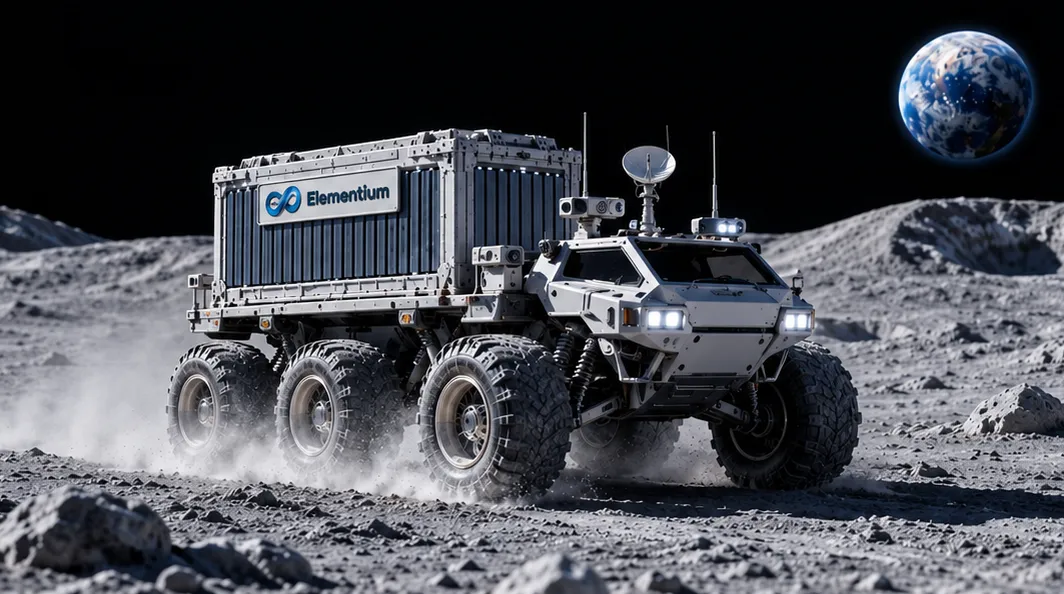
Elementium Materials Inc., selected for an SBIR Phase I award, is attacking the coldest problem in the portfolio: the lunar night, which runs 14 days. Its ultra-cold-tolerant battery module operates down to minus 76 degrees Fahrenheit without active heating, reducing the need for heaters and insulating layers. That matters because every kilogram spent on heaters and insulation is a kilogram not spent on tools and science experiments. NASA says the space and mass saved lets missions launch other payloads instead. The same technology has cold-climate uses on Earth, and the agency flags potential application on Mars. Rovers, habitats, and other infrastructure that can survive the dark is the difference between a visit and an outpost.
Finally, the unglamorous work that decides whether any of this scales. Slate Geotechnical Consultants Inc. and the Colorado School of Mines will collaborate under an STTR Phase I award to evaluate two approaches to preparing lunar regolith for repeated lunar landings, so routine mission activities can have sturdy, reusable landing pads. Skip the pads and the force generated by a rocket can blast out loose, gravel-like regolith from the surface, throw up dust, or create craters, potentially damaging spacecraft and nearby infrastructure. The project will also investigate ways to use rovers to repair and maintain future lunar landing pads. Landing pads are the airport authority of the Moon: boring right up until they are missing.
The structure of the program is the part executives should study closely. Working with SBIR/STTR, a company's path toward commercialization or infusion into NASA missions happens in phases, which means the agency is running a staged, milestone-gated funnel rather than handing out grants. Phase I buys proof of merit and feasibility. Phase II buys demonstration and delivery. For a small company, that is non-dilutive capital and a customer reference at the same time. For NASA, it is a portfolio of options on technologies it needs but does not want to build in-house. Complete lists of the selected proposals are published on the SBIR/STTR program's website, across the 2026 Phase I appendices and the 2025 Phase II list.
The second-order effect is a magnet for talent and supply chains. Companies that win these awards carry a credential that travels: it signals to venture investors, prime contractors, and larger aerospace players that a technology has been vetted against a government requirement. The four examples here, power, robotics, energy storage, and surface construction, are also four of the bottlenecks any permanent lunar presence has to clear. Watch which of the 302 names reappear in Phase II, and which get acquired. That is the tell for where the next layer of space infrastructure is actually being built.
This story's Key Insights and Take-aways are locked.
Create a free account to unlock Executive Actions for one credit.
Register to UnlockAlways free for Executives Club members. Join the Club
More in Science

Anthropic's I.P.O. Made Rank-and-File Researchers Worth Tens of Millions
Researchers who joined just a few years ago are now worth tens of millions, and the windfall resets the pay benchmark for every private A.I. lab still paying in paper.

Sea Lion Culling Strategy Fails: New Model Says Killing Them Won't Save Salmon
The latest research from AAAS overturn a long-held conservation assumption, forcing policymakers to rethink critical resource allocation in marine ecosystems.

Microplastics do more than pile up: they react with water to damage cells
Scientists have found that plastic particles can generate highly reactive molecules in water, a mechanism that could explain links to heart attacks, strokes, and neurological disorders.