

NASA Fired an Engine That Will Never Fly. That Was the Point
The 200-second hot fire of RS-25 No. 10001 at Stennis is a data play for a 2028 Moon landing, and a reminder that flight-worthiness is bought on the ground.
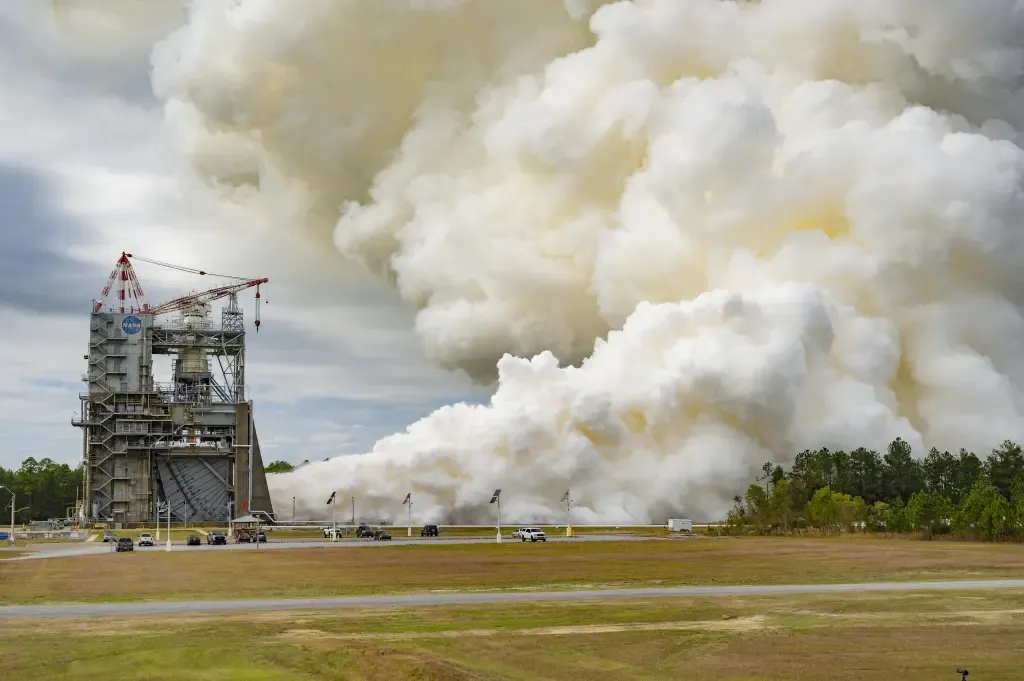
NASA and prime contractor L3Harris Technologies hot-fired developmental RS-25 engine No. 10001 for 200 seconds on Nov. 18 at Stennis Space Center, capturing performance data for future Artemis missions even though the engine will never fly. For decision-makers in long-cycle hardware, the test is a case study in buying down risk with qualification data years before a public 2028 Moon landing date.
NASA fired RS-25 engine No. 10001 on Nov. 18 at the Fred Haise Test Stand at Stennis Space Center near Bay St. Louis, Mississippi, running the developmental engine for the planned duration of three minutes and 20 seconds, or 200 seconds. Here is the part that should stop you: this engine will never fly. It is not going to space. It is going into the data log. NASA and its prime contractor, L3Harris Technologies, used the hot fire to capture critical data to improve engine performance and reliability for future Artemis missions, which is the agency's way of saying it is buying down risk on the most expensive hardware in American human spaceflight.
That distinction matters more than it sounds. NASA states that all RS-25 engines are tested and proven flightworthy at Stennis prior to use. Every engine that does fly has to earn its clearance on the same stands, run by the same crews, under the same instrumentation. The developmental article is the proxy that takes the beating so the flight articles do not have to. The scale explains the caution: for each Artemis mission, four RS-25 engines produce up to 2 million pounds of combined thrust to help launch the Space Launch System rocket. Four engines, one shot, no do-over at the pad. A single underperforming unit does not just cost an engine. It costs a mission, a vehicle, and years of schedule.
The clock this test serves is Artemis IV, which NASA describes as a Moon landing mission in 2028. For that flight, the SLS rocket will launch astronauts aboard the Orion spacecraft from NASA's Kennedy Space Center in Florida. NASA frames the mission as a key step in a broader set of goals: explore the lunar South Pole, establish an enduring human presence on the lunar surface, and build on the agency's foundation for the first crewed mission to Mars. Read that list again and a 200-second burn stops looking like an engineering chore. It is one data point in a chain that runs from a Mississippi test stand to the lunar South Pole.
The test also shows who is actually doing the work. NASA's prime contractor on the effort is L3Harris Technologies, and the test team is drawn from NASA, L3Harris, and Nova Space Solutions. For context, the RS-25 is a heritage engine with Space Shuttle lineage, and L3Harris picked up the RS-25 production line through its 2023 acquisition of Aerojet Rocketdyne. That history cuts both ways. The engine's flight record is deep, but restarting and sustaining production of heritage hardware is a supply chain and workforce problem as much as an engineering one. Specialized suppliers, tooling, and experienced test operators do not scale overnight, and the hot fire cadence is the clearest public signal of whether that base is keeping up.
So what does 200 seconds actually buy? A full-duration hot fire on a test stand is where an engine meets its limits in a controlled setting: dense instrumentation, engineers watching live, and a failure that damages concrete instead of a crew. Ground tests are expensive. Flight failures are catastrophic, in dollars, in schedule, and in public trust. The stand itself is part of the asset base. Named for Fred Haise, the Apollo 13 astronaut, the Fred Haise Test Stand is infrastructure that takes years and serious capital to replicate, which is why test capacity, not factory floor space, is often the real constraint on a launch program.
That makes Stennis a chokepoint. If every flight RS-25 must be proven flightworthy there before use, then stand availability, propellant supply, and operator crews set the tempo for the entire Artemis launch schedule. A developmental engine test in November is therefore a scheduling event as much as a technical one. It tells you the pipeline is moving, that the contractor teams are staffed, and that NASA is still feeding the qualification machine that a 2028 landing date depends on. Programs rarely slip because of one dramatic failure. They slip because the quiet, repetitive test work stops keeping pace.
For executives outside aerospace, the pattern is familiar. The most valuable asset in a long-cycle hardware program is not the product announcement. It is the accumulated evidence that the product works, gathered in a place where being wrong is survivable. NASA is spending a full engine and a full-duration burn to generate that evidence, and it is doing it years before the mission that needs it. That is the discipline that separates programs that hit public dates from programs that explain missed ones. The same logic applies to any capital-intensive bet: qualification data is the moat, test infrastructure is the moat's foundation, and the bottleneck is almost never the thing on the poster.
RS-25 No. 10001 will not fly. It will be torn down, measured, and studied, and whatever it teaches will be folded into the engines that do. For NASA, L3Harris, and the operator crews at Stennis, that is the whole point. The engine that never leaves the ground is the reason the ones that do can be trusted with astronauts.
This story's Key Insights and Take-aways are locked.
Create a free account to unlock Executive Actions for one credit.
Register to UnlockAlways free for Executives Club members. Join the Club
More in Science

Anthropic's I.P.O. Made Rank-and-File Researchers Worth Tens of Millions
Researchers who joined just a few years ago are now worth tens of millions, and the windfall resets the pay benchmark for every private A.I. lab still paying in paper.

Sea Lion Culling Strategy Fails: New Model Says Killing Them Won't Save Salmon
The latest research from AAAS overturn a long-held conservation assumption, forcing policymakers to rethink critical resource allocation in marine ecosystems.

Microplastics do more than pile up: they react with water to damage cells
Scientists have found that plastic particles can generate highly reactive molecules in water, a mechanism that could explain links to heart attacks, strokes, and neurological disorders.