
Nine Chinese teeth just handed Homo erectus 200,000 extra years
A Nature study dates Homo erectus in southern China to as recently as 184,000 years ago, and one odd tooth hints the species was not alone there.
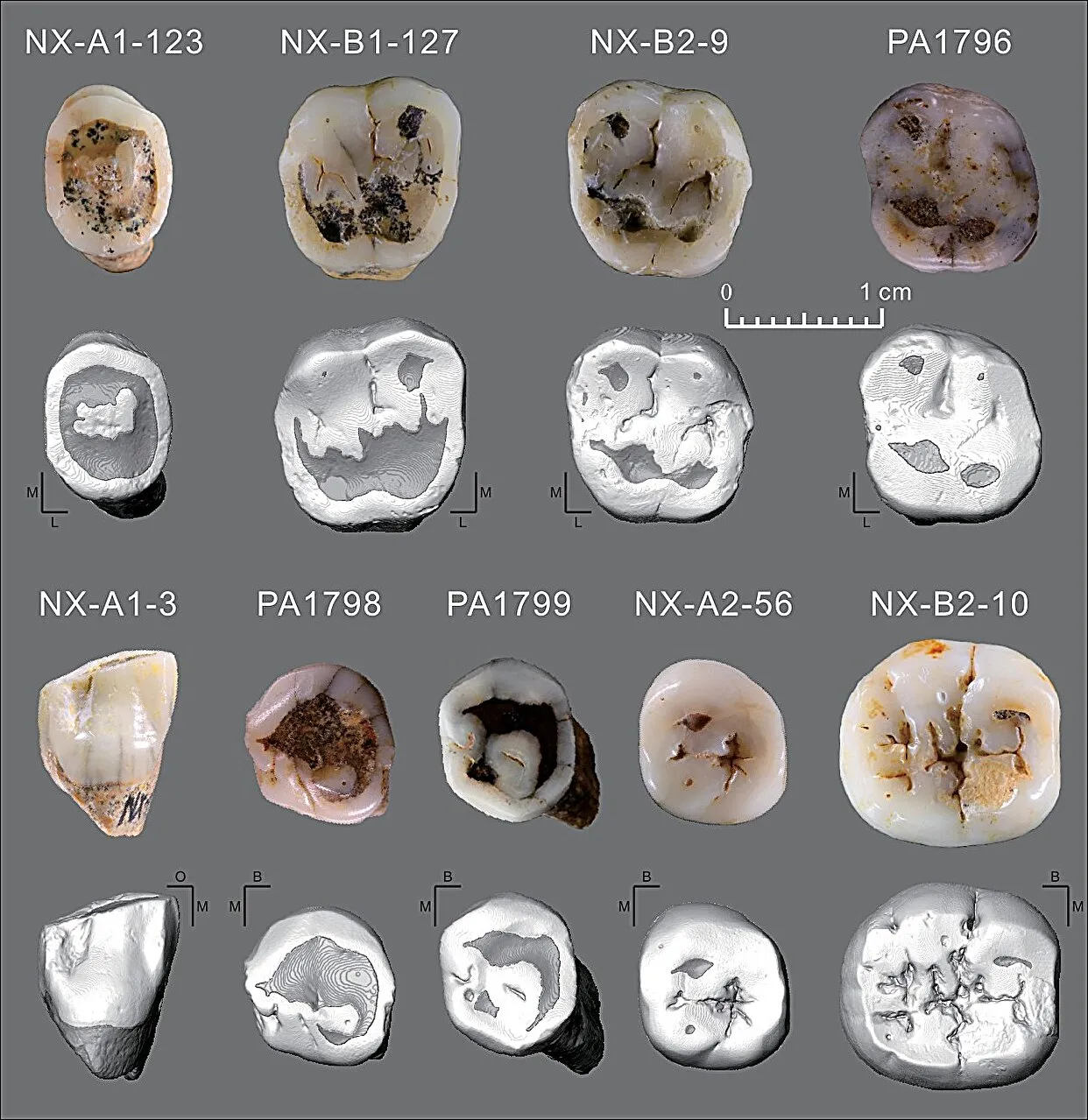
An international team including University of Copenhagen researchers reports in Nature that nine fossil teeth from two caves in southern China date to between 324,000 and 184,000 years ago, extending the known timeline of Homo erectus by roughly 200,000 years. For anyone who tracks how scientific consensus actually moves, the finding shows that a handful of stored specimens plus sharper analysis can rewrite a species' extinction date, and that southern China is now a frontline in human-origins research.
Nine fossil teeth dug from two caves in southern China have just rewritten the expiry date on one of humanity's most important ancestors. An international team including researchers from the University of Copenhagen reports in the journal Nature that the teeth date to between 324,000 and 184,000 years ago, extending the known timeline of Homo erectus by around 200,000 years. Sit with that for a second. A species that textbooks had largely filed away as a long-gone precursor to us was still living in East Asia deep into the Middle Pleistocene, in a landscape far more crowded than the tidy family tree most of us were taught.
The headline number is 200,000 years. The stranger detail is what one of those teeth implies. The study's framing is blunt: a single unusual tooth suggests Homo erectus was sharing southern China with another human species. That turns a straightforward extinction-date correction into something far more interesting. This was not one archaic lineage shuffling toward its final chapter in an empty landscape. It was a neighborhood with more than one occupant, and the question of who else was there is now firmly on the table.
Homo erectus, conventionally translated as "upright man," is the ancestor that first carried the human story out of Africa and across Eurasia. It is also, by the standards of early human species, a marathon runner. Its fossil record conventionally spans well over a million years, and it is associated with some of the earliest stone tool traditions and, in many accounts, the controlled use of fire. If you have ever seen a museum diorama of a stocky, brow-ridged figure gripping a hand axe, that is almost certainly Homo erectus. The species has long served as the baseline against which every later human lineage gets measured.
Teeth are the workhorses of human-origins research, and this study shows why. Enamel is the hardest tissue the body produces, so it survives long after bone has crumbled to nothing. Caves, meanwhile, are natural time capsules: sheltered from rain, sun, and scavengers, they accumulate sediment layer by layer, and southern China has long been one of the most productive frontiers in the field. Nine teeth is a small sample by any standard. It is also enough, when the dating holds, to move a species' known lifespan by a fifth of a million years.
That is the part worth pausing on. The study extends the known timeline of Homo erectus by around 200,000 years, which means the youngest of the nine teeth sits far later than the previous end point for the species in this region. In a discipline where a single jawbone can trigger a decade of argument, that is not a rounding error. It narrows the gap between when Homo erectus was supposedly gone from this part of the world and when other human species were moving through Asia. Overlap in time is the precondition for overlap in space, and overlap in space is the precondition for the kind of contact that leaves traces in the genome.
Genetic research over the past two decades has already established that early modern humans interbred with other human lineages, which is why so many people alive today carry small amounts of DNA from species that no longer exist. Every finding that pushes an archaic species' survival further forward widens the window in which those encounters could have happened. The teeth do not prove contact, and the study does not claim they do. What they do is make the crowded version of the human story harder to dismiss, and the crowded version is the one that keeps winning.
It also matters who did the work. This is an international collaboration, with University of Copenhagen researchers among the authors, and it lands in Nature, the journal that functions as the field's front page. Findings published there do not stay inside the discipline. They get absorbed into museum labels, documentary scripts, undergraduate syllabi, and the mental model a curious 15-year-old carries for the rest of their life. When the timeline of Homo erectus shifts by 200,000 years, the correction propagates outward, and it propagates fast.
For anyone outside the field, the real takeaway is about how provisional our settled timelines are. Homo erectus did not get 200,000 extra years because of a dramatic new excavation. It got them because researchers went back to material that already existed, applied better analysis, and published a result that forces the rest of the field to respond. That is how consensus actually moves: not in a single thunderclap, but in a quiet correction that makes the old diagram wrong. Southern China just produced one. The next one is probably sitting in a drawer somewhere, waiting for someone to look at it properly.
This story's Key Insights and Take-aways are locked.
Create a free account to unlock Executive Actions for one credit.
Register to UnlockAlways free for Executives Club members. Join the Club
More in Science

Anthropic's I.P.O. Made Rank-and-File Researchers Worth Tens of Millions
Researchers who joined just a few years ago are now worth tens of millions, and the windfall resets the pay benchmark for every private A.I. lab still paying in paper.

Sea Lion Culling Strategy Fails: New Model Says Killing Them Won't Save Salmon
The latest research from AAAS overturn a long-held conservation assumption, forcing policymakers to rethink critical resource allocation in marine ecosystems.

Microplastics do more than pile up: they react with water to damage cells
Scientists have found that plastic particles can generate highly reactive molecules in water, a mechanism that could explain links to heart attacks, strokes, and neurological disorders.