
Nine teeth push Homo erectus to 184,000 years ago, in a rainforest
Two Nature papers say Homo erectus survived on mainland Asia far longer than the record showed, ate tropical forest food, and may have overlapped with Denisovans.
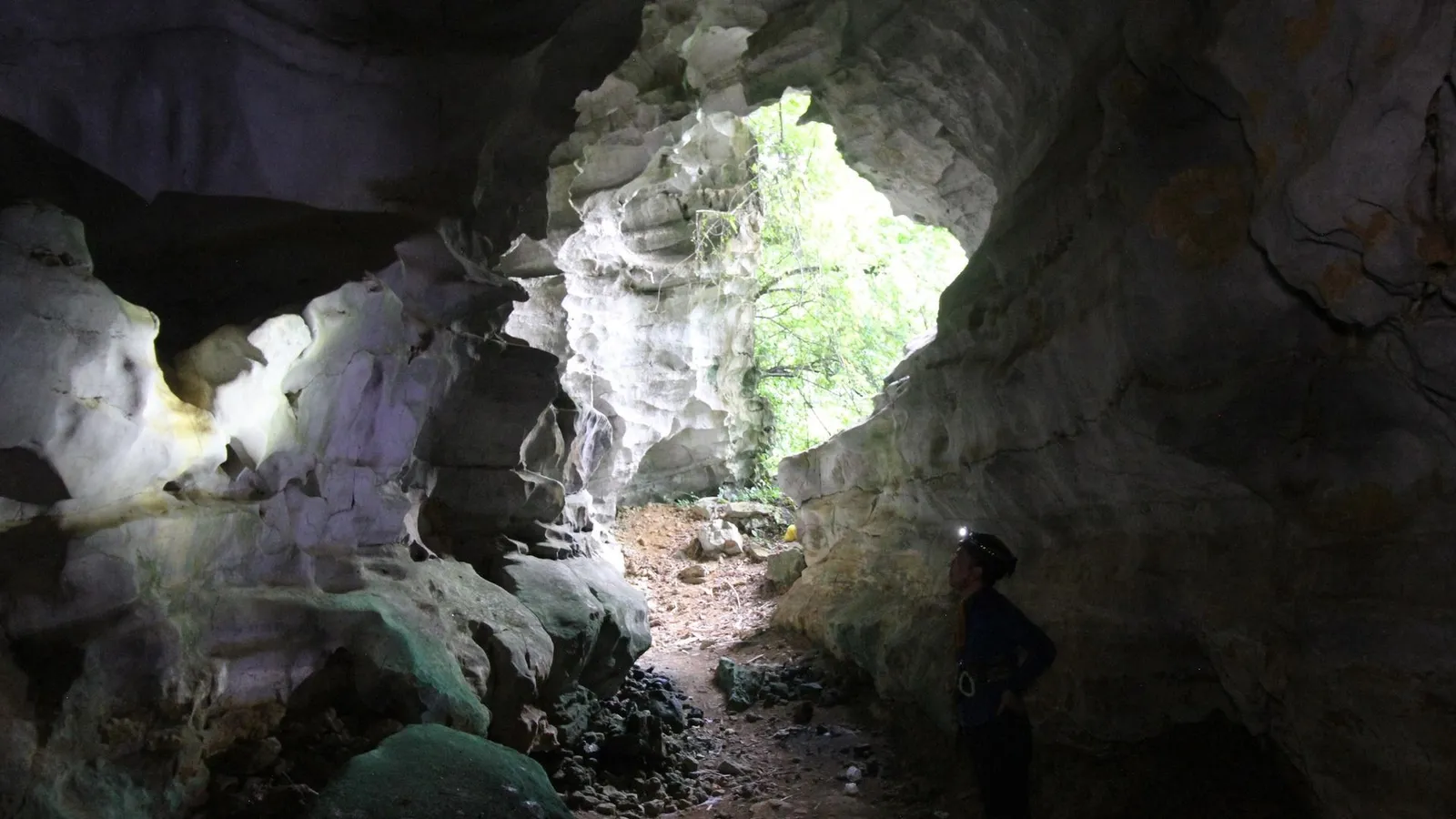
Frido Welker of the University of Copenhagen and Kira Westaway of Macquarie University led two Nature studies on nine fossil teeth from caves in Guangxi, China, dating Homo erectus on the mainland to at least 184,000 years ago. The finding closes a 400,000-to-108,000-year gap in the species' timeline and suggests two hominin populations shared the same rainforest.
Nine fossil teeth dug out of two caves in southern China have pushed Homo erectus's known presence on the Asian mainland from 400,000 years ago to at least 184,000 years ago. Eight of the teeth carry the physical features of H. erectus. The ninth does not match anything scientists can confidently name. Radiometric dating, including measurements of uranium decay in the fossils and the surrounding sediment, places the collection between roughly 324,000 and 184,000 years old. The results, published Nov. 18 in the journal Nature, are the first physical evidence that H. erectus was still living on the mainland far more recently than the fossil record had shown.
The payoff is bigger than a date. It closes a chronological gap that had never been explained: how H. erectus turned up on Java, in Indonesia, as recently as 108,000 years ago when the last mainland trace was 400,000 years old. "This brings the history of H. erectus in East Asia closer in age to the late Javanese examples, raising the possibility that these populations were connected through land bridges at times of lowered sea level," Chris Stringer, a paleoanthropologist at the Natural History Museum in London who was not involved in the research, told Live Science in an email. Frido Welker, a molecular palaeoanthropologist at the University of Copenhagen in Denmark and first author of the study, put the find more simply: "I think it's exciting because it means that there are two hominin populations occupying these rainforest conditions there at the same time."
The teeth came from the Baxian and Naxian caves in Guangxi province, about 9 miles (15 kilometers) apart in a karst landscape of limestone formations that dissolve into the kind of shelter H. erectus would have needed. The caves were not excavated by humans first. Porcupines scavenged and collected bones there, accumulating thousands of mammalian fossils. Among more than 18,000 fossils, including apes, elephants, rhinoceroses and other ancient hoofed animals, researchers found the nine human teeth.
Identifying them required a technique most people have never heard of. DNA degrades faster than protein, so Welker's team sampled five teeth, four that looked like H. erectus and the odd one out, and analyzed the ancient proteins still present, a field known as proteomics. The four similar teeth carried protein signatures matching H. erectus. "The morphology is nicely confirmed by the proteomics," Welker told Live Science. Three of the four were male and one was female, determined by the presence or absence of amelogenin-Y, a protein coded only by the Y chromosome. But parts of the signatures differed from other H. erectus remains found in China, which raises the possibility that these specimens belong to a previously unknown H. erectus population with a slightly different genetic makeup.
The fifth tooth, catalogued as PA1796, is the one that keeps the story open. Protein analysis showed it came from a male, but the sequence data carried no recognizable signature. Welker declined to speculate on the species. "Sequence-wise it doesn't have this Homo erectus substitution and morphologically, it doesn't look like an erectus tooth," he said. John Hawks, an anthropologist at the University of Wisconsin-Madison who was not involved in the study, had previously argued that specimens from the past 400,000 years flagged as H. erectus were actually Denisovans, the ancient humans who lived in Asia, belonged to the Homo longi lineage and disappeared around 30,000 years ago. He now says the morphological and protein findings are convincing evidence that H. erectus did survive until relatively recently in some places. He still thinks PA1796 is most likely a Denisovan, possibly from a divergent branch for which no protein data exists, though it could also be a novel H. erectus population or an atypical individual. "I would have liked to see additional comparisons in the paper to more Denisovan teeth," Hawks said. Stringer agreed the tooth could represent a longi/Denisovan, while noting it is relatively small and comparative data for those groups is sparse.
A second paper, also published Nov. 18 in Nature, attacks the question from a different angle. Kira Westaway, a geochronologist at Macquarie University in Sydney, and her colleagues analyzed trace elements in the same human teeth and in animal teeth from the caves to reconstruct diet and habitat. The signal pointed to tropical, rainforest-like ecosystems, meaning this H. erectus population was eating plants and animals from a setting scientists had assumed only our own species, Homo sapiens, could handle. "Being adaptable and being flexible are not traits that we associate with ancient human species - these are traits that we associate with H. sapiens," Westaway told Live Science. "Suddenly we're seeing H. erectus being able to survive in environments that we didn't think they could possibly survive in."
That reframes H. erectus. The species is generally seen as the first human to venture out of Africa after evolving about 2 million years ago, spreading through eastern Eurasia and reaching China and Indonesia between about 1.6 million and 1.8 million years ago. It is one of the longest-surviving hominin species on record. What the new work adds is ecological range and overlap. Stringer said recent research suggests interbreeding between the H. erectus and Denisovan lineages, and the new evidence increases the likelihood that it happened, at least occasionally. "Rather than being confined to open woodland and grassland environments, H. erectus was considerably more ecologically adaptable than many of us have assumed," he said. Welker, a co-author on the diet study, noted that if the mystery tooth is a separate population, then two different early human groups were this adaptable at the same time.
The caveat is that none of this is settled. Firm identification of PA1796 will have to wait for similar teeth found elsewhere, Welker said. Comparative protein data for Denisovans and Homo longi is thin. And the whole picture rests on nine teeth out of more than 18,000 fossils, recovered from caves that porcupines filled long before any scientist arrived. For anyone watching how scientific consensus actually moves, that is the real story: a single odd tooth, a protein signature that does not match, and a decades-old assumption about which ancient humans could survive where, all now up for revision. The next find in Guangxi, or anywhere in southern China, could settle it.
This story's Key Insights and Take-aways are locked.
Create a free account to unlock Executive Actions for one credit.
Register to UnlockAlways free for Executives Club members. Join the Club
More in Science

Anthropic's I.P.O. Made Rank-and-File Researchers Worth Tens of Millions
Researchers who joined just a few years ago are now worth tens of millions, and the windfall resets the pay benchmark for every private A.I. lab still paying in paper.

Sea Lion Culling Strategy Fails: New Model Says Killing Them Won't Save Salmon
The latest research from AAAS overturn a long-held conservation assumption, forcing policymakers to rethink critical resource allocation in marine ecosystems.

Microplastics do more than pile up: they react with water to damage cells
Scientists have found that plastic particles can generate highly reactive molecules in water, a mechanism that could explain links to heart attacks, strokes, and neurological disorders.