
PixelRAG skips HTML-to-text and cuts AI agent token costs 10x, boosts accuracy
UC Berkeley et al. show parsing is the failure point, replacing it with screenshot-based retrieval using vision-language models.
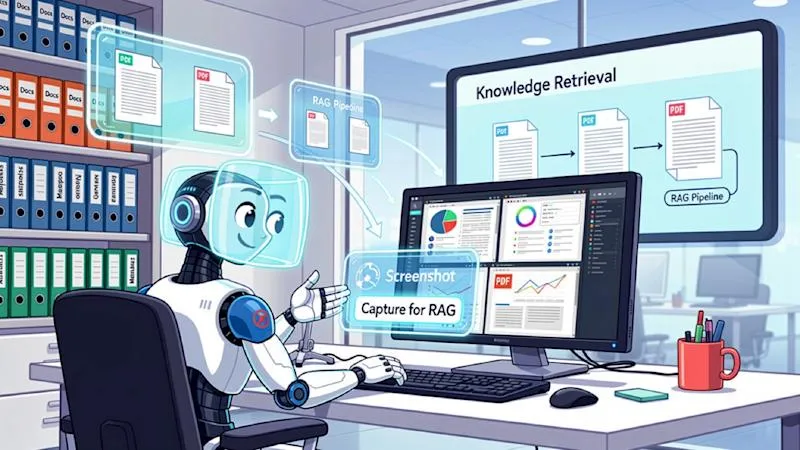
A research team from UC Berkeley, Princeton University, EPFL, and Databricks introduced PixelRAG, a system that bypasses HTML-to-text parsing by rendering pages as screenshots and indexing screenshot tiles for vision-language model reading. For enterprise RAG teams and AI-product leaders, it means fewer wrong answers and drastically lower agent token costs compared with text-based retrieval.
Most enterprise RAG pipelines do one thing the hard way: they take messy web pages and documents, convert them into plain text, then chop that text into chunks for retrieval. PixelRAG flips that assumption. Instead of parsing pages into text, it renders them as screenshots, indexes those images, and feeds retrieved tiles directly to a vision-language model. The payoff in the paper is immediate: across six benchmarks, PixelRAG outperforms text-based RAG, improving accuracy by up to 18.1% over text-based baselines.
The “why now” part is equally important. The researchers did not blame the reader model or the retrieval head. They argue the text conversion step is responsible for the majority of wrong answers. They measured this using SimpleQA, a benchmark of 1,000 factual Wikipedia questions, and quantified where failures come from: parser loss accounts for 36.6% of failures, rank loss 55.2%, and reader loss 8.2%. In other words, the pipeline is losing the answer before it reaches the model, then the answer gets buried, and only a smaller share is attributable to the final reading step.
If you are running enterprise RAG, this lands like an operational gut check. The conversion-to-text step is where teams typically spend their time: HTML parsers, cleaning rules, chunking heuristics, and a growing pile of site-specific duct tape. The paper points directly at that brittleness. The researchers say improving parsers is “an endless process because every website requires special handling.” Even if parsers get better, parsing inevitably discards information. They highlight that images, visual hierarchy, typography, emphasis like bold text, tables, and layout are either discarded outright or turned into imperfect textual approximations. The practical consequence is a loss of the retrieval signals that RAG depends on.
So PixelRAG builds a cleaner end-to-end architecture by eliminating most of that complexity. It rests on a simple capability mismatch: large language models read text, while vision-language models can read images alongside text. PixelRAG takes advantage of that by using rendered pages the way a human would, preserving layout and structure in the input. The system’s pipeline replaces the text parsing pipeline with four stages: rendering, indexing, training, and storage.
Here is how it works in concrete terms. Rendering uses Playwright to render pages at a fixed 875-pixel viewport, then slices them into 1024-pixel-tall tiles. Wikipedia’s 7 million articles produce roughly 30 million screenshot tiles. Assets are cached locally, and rendering is done fully offline. Indexing encodes each tile as a single 2048-dimensional vector using Qwen3-VL-Embedding-2B, then stores vectors in a FAISS approximate nearest-neighbor index. The full index runs to approximately 120 GB in fp16 and supports incremental updates without full re-indexing. Training fine-tunes the retrieval model on synthetic contrastive data generated from the datastore, using dynamic hard-negative mining to filter false negatives. LoRA, a lightweight fine-tuning method updating a small fraction of model weights, is applied to both the language model backbone and the visual encoder. Training on approximately 40,000 pairs reportedly completes in under three hours on a single H100.
Storage is where it gets interesting for cost-minded teams. Raw screenshot tiles for Wikipedia require 5.6 TB, but PixelRAG claims a render-on-demand approach removes the need for persistent storage: it embeds all tiles, deletes the screenshots, and re-renders pages on demand at query time. That means you carry the 120 GB vector index, not the multi-terabyte screenshot archive, which can matter when procurement and infra budgets are tight.
The paper’s performance results are why executives should care. PixelRAG was tested across six benchmarks spanning factual Wikipedia QA, table-based queries, multimodal QA, and live news retrieval. It outperformed text-based RAG across all six. On SimpleQA, it reaches 78.8% accuracy versus 71.6% for the strongest text parser. The gap widens on structured table queries: 48.8% versus 42.5%. The researchers also set an implementation constraint: teams need Qwen3-VL-4B class models or above to see the benefit. Smaller models trail text retrieval by more than 12.5 percentage points.
Then there is the agent angle, and it is the strongest near-term case for board conversations. The paper reports an agent using PixelRAG as its search backend ran on 3.6 million prompt tokens versus 37.5 million for text retrieval. They frame this as 2 to 4 times lower cost than alternatives including Google, while achieving higher accuracy. They add one more lever: image compression can cut that token budget by another third. If you are budgeting for tool use, retrieval calls, and multi-step agent reasoning, those token deltas are not theoretical. They are the difference between an experiment and something you can ship and scale.
Still, the paper is honest about what is not solved. Visual chunking is described as the main unsolved problem. Text retrieval systems have spent years refining how to split documents into meaningful retrieval units based on topic, section, or semantic content. PixelRAG currently slices pages by fixed pixel height, which can cut a table or paragraph mid-tile with no awareness of content boundaries. The researchers explicitly say that text chunking research has dominated, while visual retrieval has received less attention, and they frame chunking as important future work.
Finally, there is the market context. VB Pulse Q1 2026 data from qualified enterprise respondents found intent to adopt hybrid retrieval tripling from 10.3% in January to 33.3% in March, described as the fastest-growing strategic position in the dataset. PixelRAG’s authors point to hybrid deployment as the most practical near-term path: layer visual retrieval on top of existing text systems rather than replacing them. They describe a practical approach as an enhancement layer alongside text retrieval, and say hybrid retrieval combining both text and visual search is straightforward and likely how production deployments evolve.
For executives, the strategic stake is simple. If your RAG system’s accuracy and cost are being dragged down by HTML-to-text parsing and the cascade errors that follow, then “better prompts” will not rescue you. PixelRAG argues the failure is earlier in the pipeline. The board question becomes: where are you paying your biggest tax, and can you shift that tax curve with a retrieval architecture that treats web pages as images to be read, not text to be approximated?
This story's Key Insights and Take-aways are locked.
Create a free account to unlock Executive Actions for one credit.
Register to UnlockAlways free for Executives Club members. Join the Club
More in Business

Elon Musk became the world’s first trillionaire after SpaceX IPO lifted him past $1T
SpaceX shares jumped, and Musk’s $800B pre-IPO value crossed a trillion, reshaping how investors price “moonshots.”

SpaceX IPO priced June 12 at $135: Elon Musk crosses $1T as funds pick up the tab
The SpaceX IPO values the company around $1.77T and estimates Musk’s stake at $866.5B, with broad investor ripple effects.

SpaceX IPO values it at $1.77tn, and Nasdaq fast-tracks its index entry
Forced buyers and tracker funds could amplify buying pressure as SpaceX joins the Nasdaq index on a rule tweak.