
Retrial convicts 30-year-old of arson in deadly Palisades fire
A second trial finally produced a conviction for one of the most destructive wildfires in Los Angeles history, turning a catastrophe story into a criminal-liability story with sentencing still to come.
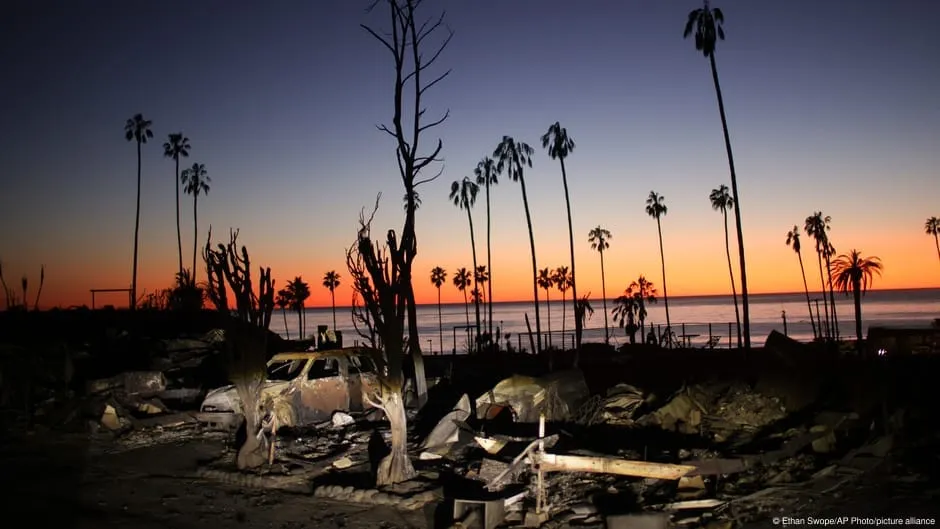
A 30-year-old man has been convicted of arson for causing the Palisades fire, one of the most destructive wildfires in Los Angeles history, with the verdict arriving only after the case was retried. For operators, insurers, utilities and anyone holding California wildfire exposure, the case marks attribution of a mega-fire moving from loss estimates into a courtroom product, with sentencing the next number to watch.
A 30-year-old man has been convicted of arson for causing the Palisades fire, one of the most destructive wildfires in the history of Los Angeles. The verdict, reported by Deutsche Welle, did not arrive on the first pass: the case was retried before it produced a conviction. The report did not name the defendant, detail the evidence, specify the charge tier, or set out a sentencing date, so the headline fact is the conviction itself, and the practical consequence, meaning time behind bars and money owed, is still unresolved.
That single word, retried, is the story. A retrial typically means the first attempt did not end in a final, accepted verdict, whether through a hung jury, a mistrial, or a reversal at the appellate stage, and prosecutors chose to run the whole case a second time rather than fold it. Wildfire arson is brutally hard to prove: the evidence partially burns with the scene, cause-and-origin conclusions rest on forensic specialists reading char patterns and ignition sources, and a jury is asked to connect one person to an outcome measured in a devastated neighborhood. Going back to trial after failing once is a statement of confidence from the prosecution. Winning the second time converts a fire that dominated loss estimates into a criminal case with a named cause and a liable individual.
For context on scale, the Palisades fire became shorthand for the new era of urban wildfire in Los Angeles, a blaze that burned through a densely built, high-value coastal corner of the city and fed a wider insurance and rebuilding crisis across Southern California. "One of the most destructive wildfires in the history of Los Angeles" is not a rhetorical flourish from the source; it is a category that reshapes how carriers price risk, how the state's insurer of last resort absorbs exposure, and how cities plan evacuations. When a fire of that magnitude is ruled arson rather than an equipment failure or a downed line, the entire conversation shifts from climate to conduct, and conduct has a defendant attached.
Arson is not a nuisance charge. In California, arson that burns inhabited structures or causes injury has historically exposed defendants to substantial state prison time, and courts can layer on restitution orders that follow a person for years after release. Because the DW account does not specify the charge tier or the potential exposure, the honest read is that the conviction settles the question of who, not the question of how much. Sentencing is where the precedent gets its teeth, and it is the next milestone for victims, insurers, and defense counsel watching how wildfire cases are priced in court.
The retrial angle also travels beyond this one defendant. California has a long queue of wildfire investigations that never reach a jury because cause cannot be proven to a reasonable doubt, and prosecutors work with finite budgets and forensic capacity. A conviction secured on a second attempt gives fire agencies and prosecutors a reference case for the documentation-heavy approach: origin analysis, digital trails, witness accounts, and expert testimony that can survive trial twice. That matters for how aggressively future ignitions are referred, and for how much investigative work gets funded before the first spark of the next fire season.
For the business world, the verdict cuts two ways. Wildfire liability in California has for years been a story about utilities and equipment, with investors pricing in the possibility that a single spark generates claims large enough to threaten a balance sheet. An arson finding moves one fire out of that bucket, which does not reduce the physical risk of the next fire but does change who is on the hook for this one. Insurers, reinsurers, and the state's residual property carrier all care about attribution, because human-caused fires open the door to subrogation, meaning insurers suing to recover payouts from whoever caused the loss, and because an individual defendant is almost always a shallower pocket than a corporate one.
For the people rebuilding in the burn scar, a criminal conviction is symbolic and financial at once. Restitution in wildfire cases typically cannot come close to covering actual loss, which is why insurance payouts and federal and state recovery programs carry the real weight of reconstruction. The conviction's value is accountability first, reimbursement a distant second.
The strategic read for anyone with California wildfire exposure is that the legal architecture around these fires is maturing. Attribution is becoming a courtroom product, whether the defendant is a 30-year-old man or a utility, and that pulls documentation standards, land management scrutiny, and litigation tails into the same risk model. The Palisades file, previously a stack of loss estimates, now has a conviction on top. Watch the sentencing date next.
This story's Key Insights and Take-aways are locked.
Create a free account to unlock Executive Actions for one credit.
Register to UnlockAlways free for Executives Club members. Join the Club
More in Politics

Cybersecurity Was an Afterthought for Decades. AI Is Now Sending the Bill
The internet's vulnerable code was never fixed, and AI is finding it faster than anyone can patch it, turning decades of technical debt into a live balance-sheet risk.

Hannity vows to name GOP lawmakers skipping votes before the majority expires
A prime-time host is turning the House attendance sheet into a public scoreboard, and Speaker Mike Johnson is sitting right next to him while the Republican majority runs out of days.
White House yanks FDA nominee, blindsiding senators and extending a six-month vacuum
Heidi Overton's abrupt withdrawal leaves the FDA without a confirmed commissioner six months after the last one resigned, and the Senate committee that would vet a replacement found out at the last minute.