
Shenzhou-24 flies Pakistan's first astronaut and China's first year-long stay
The Long March 2F rolled out at Jiuquan on Nov. 17 with a crew plan that puts a Pakistani payload specialist on Tiangong for a week and leaves a Chinese astronaut behind for twelve months.
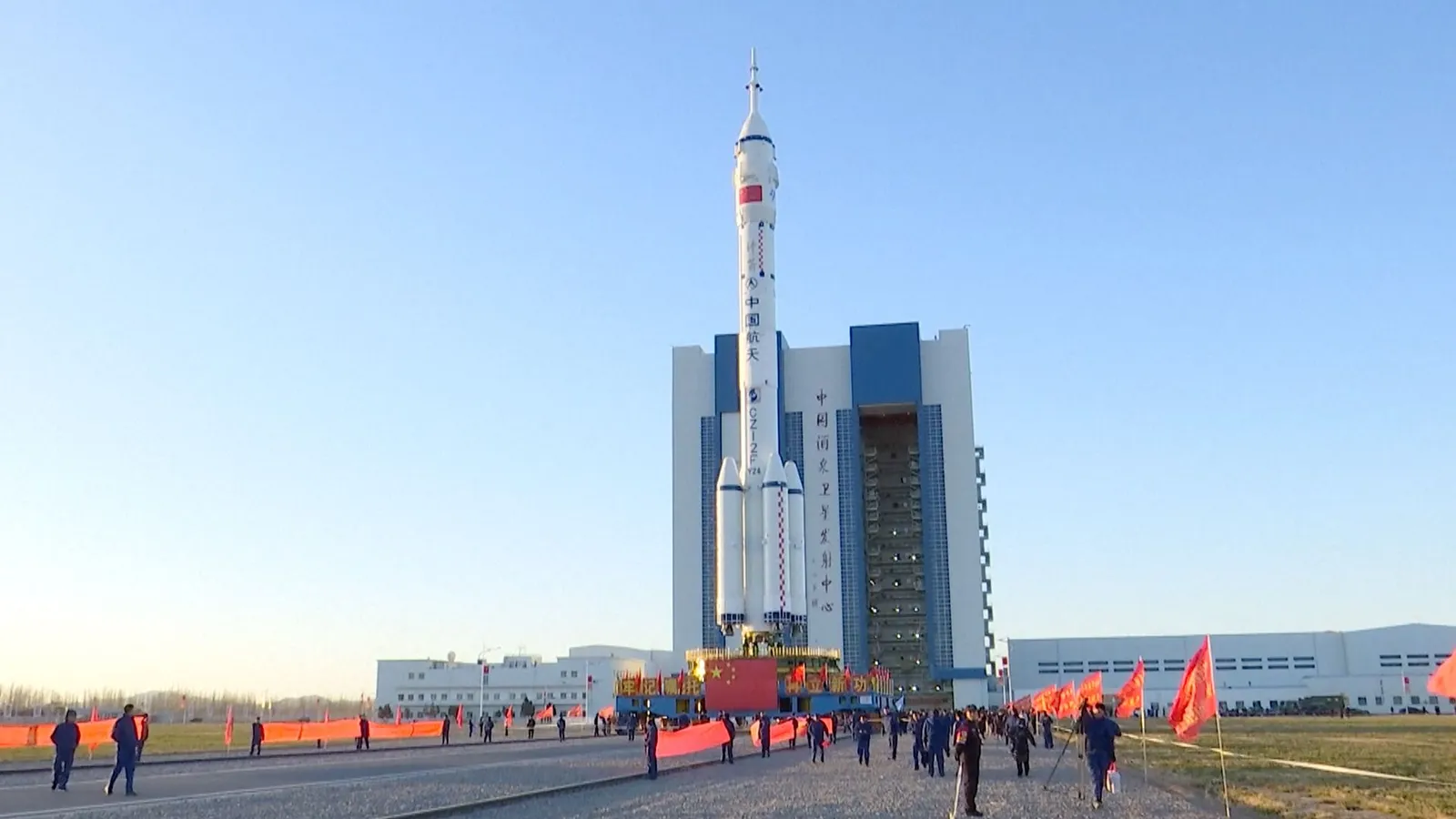
China rolled its Long March 2F rocket and Shenzhou-24 spacecraft to the pad at Jiuquan on Nov. 17 for a mission that will fly one of two Pakistani astronaut candidates to Tiangong, the first foreign national ever on a Shenzhou flight. The same rotation leaves one Shenzhou-23 astronaut aboard for a full year, giving China the long-duration physiology data it needs before crewed lunar flights and handing its station a working template for international guests.
China's space station is about to get its first foreign resident, and the rocket that will carry that astronaut is already standing on the pad. A Long March 2F topped with the Shenzhou-24 crew spacecraft was rolled out at the Jiuquan Satellite Launch Center in northwest China on Tuesday, Nov. 17, according to China Central Television. The 191-foot-tall (58-meter) rocket traveled 0.93 miles (1.5 kilometers) from its vertical integration building to the pad in roughly two hours, a move that started around 4 a.m. EST (0900 GMT, or 5 p.m. Beijing time). Launch is expected within the next week, and for the first time one of the three seats on board belongs to an international astronaut.
China's human spaceflight agency, CMSA, said all facilities and equipment at the launch site are in good condition and that liftoff will happen in the coming days, without giving a date. CMSA typically holds a press conference at Jiuquan a day before launch, and that is when the three-person crew becomes public. This time, one of the two Pakistani astronaut candidates will fly as a payload specialist, making it the first time a foreign national has flown on a Shenzhou spacecraft and the first time a Pakistani astronaut has reached orbit. Shenzhou-24 is China's 18th crewed mission.
The handover mechanics are the genuinely novel part. The three Shenzhou-23 astronauts launched on May 24 and are nearing the end of a six-month mission. One of them will stay aboard Tiangong for another half year, a decision that does two jobs at once: it frees a seat home on the departing Shenzhou-23 for the Pakistani visitor after roughly a week aboard, and it lets a Chinese astronaut complete the country's first year-long stay in orbit. China did not have to build new hardware or add a module to stage its first international flight. It reused a rotation it already runs.
The year-long stay is not a stunt. The longer mission is designed to generate physiological data ahead of crewed lunar flights and other long-duration missions. That is data only time in microgravity can produce: bone density, muscle loss, radiation exposure, and the psychology of confinement. Most station rotations historically run about six months, long enough to be scientifically useful and short enough to manage with current countermeasures. Stretching one crew member to twelve months, while a short-stay guest comes and goes, turns Tiangong into a live test bed for the deep-space questions China needs answered before it sends people to the moon.
Tiangong itself is young by station standards. China approved its human spaceflight program in 1992 and launched its first orbital crewed mission in 2003, with Yang Liwei becoming the first Chinese national in space. The three-module station was completed in late 2022 and has been continuously crewed ever since, on rotating six-month missions with brief handovers between crews. China was historically not part of the International Space Station partnership, and Tiangong has become the centerpiece of its alternative offer to countries that lack a ride to orbit of their own. That offer now has a passenger list.
The commercial question comes next. China says it is looking to double the size of Tiangong in the coming years, which could open the way to further international missions and, potentially, space tourist visits. Treat that as a market signal. A second crewed destination in low Earth orbit changes both the pricing and the politics of access. Buyers of experiments, training, and rides currently negotiate with a small set of Western providers. A bigger Tiangong with a demonstrated willingness to host foreign payload specialists hands those buyers an alternative and hands China a diplomatic lever that costs it very little to pull.
For executives outside aerospace, the read-through is optionality. Countries that cannot buy a seat on a Western vehicle now have a second supplier, and makers of sensors, experiments, and small payloads gain a second destination to design for. That matters most in satellite services, biotech research, and materials work, where microgravity activity is a line item rather than a headline. The Pakistani flight is the proof of concept that makes those conversations easier to start.
What to watch is narrow and soon. CMSA has not published a launch date, and its pre-launch press conference is expected to name the crew, confirming which of the two Pakistani candidates actually flies. For space agencies, satellite operators, and anyone negotiating access to orbit, Shenzhou-24 is a template: short international stays bolted onto an existing rotation, no new vehicle required. For Pakistan, it is a first. For China, it is evidence that its station can host other countries' astronauts, which is the difference between a national project and a platform.
This story's Key Insights and Take-aways are locked.
Create a free account to unlock Executive Actions for one credit.
Register to UnlockAlways free for Executives Club members. Join the Club
More in Science

Anthropic's I.P.O. Made Rank-and-File Researchers Worth Tens of Millions
Researchers who joined just a few years ago are now worth tens of millions, and the windfall resets the pay benchmark for every private A.I. lab still paying in paper.

Sea Lion Culling Strategy Fails: New Model Says Killing Them Won't Save Salmon
The latest research from AAAS overturn a long-held conservation assumption, forcing policymakers to rethink critical resource allocation in marine ecosystems.

Microplastics do more than pile up: they react with water to damage cells
Scientists have found that plastic particles can generate highly reactive molecules in water, a mechanism that could explain links to heart attacks, strokes, and neurological disorders.