
Shrinking ruthenium catalysts lift ammonia output 57-fold, unlocking hydrogen storage
A catalyst tweak that shrinks ruthenium particles is delivering up to 57 times more ammonia, the carrier molecule that could decide whether hydrogen ever becomes a practical fuel.
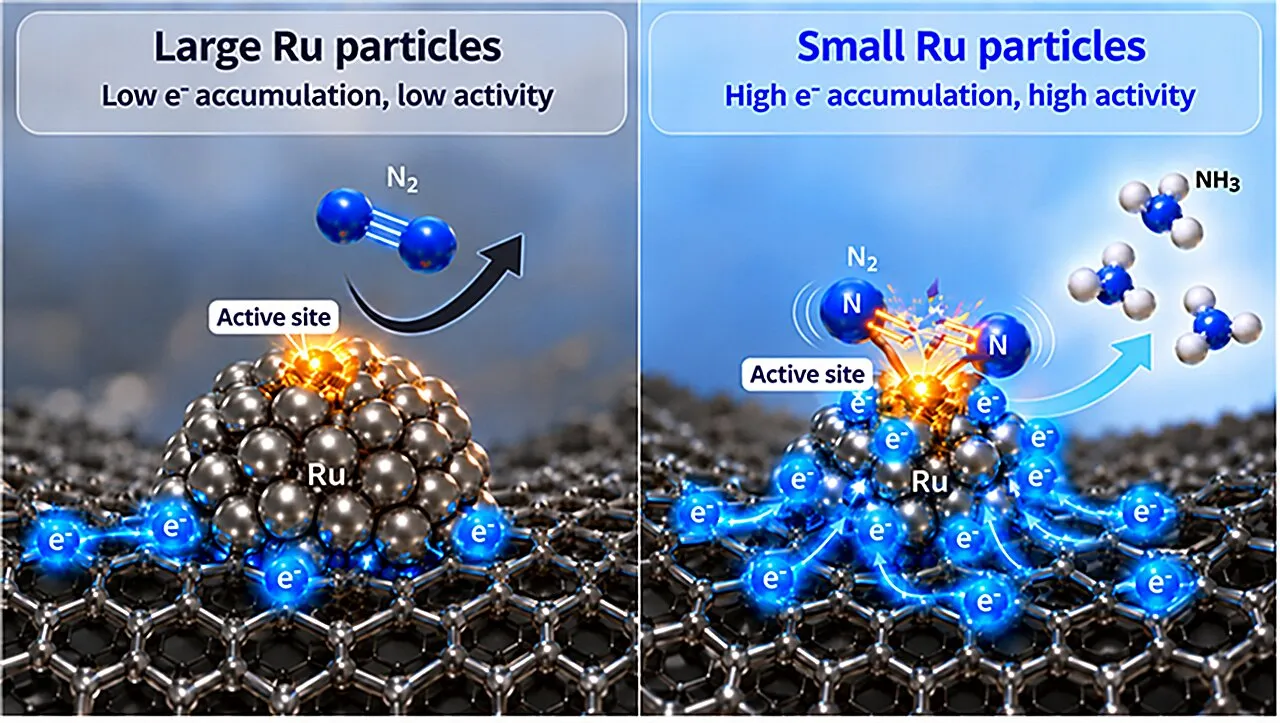
Researchers have found that shrinking ruthenium catalysts boosts ammonia production rates by up to 57-fold, a leap that attacks the efficiency bottleneck in the chemistry behind both fertilizer and hydrogen storage. For executives in energy, chemicals, and shipping, the result sharpens the case for ammonia as a transportable hydrogen carrier while raising the question of whether the gain survives scale-up.
Shrink the catalyst, multiply the output. That is the finding behind a result reported by Phys.org: researchers who reduced the size of ruthenium catalysts pushed ammonia production rates up to 57 times higher. Not 57 percent. Fifty-seven-fold. In a field where gains of a few percentage points are treated as progress, a number like that is the kind that makes chemical engineers sit up and reach for their calculators.
The reason it matters is what ammonia has quietly become: the leading candidate to be hydrogen's "magic container." Hydrogen is a clean fuel, but it is miserable to store and move. It is the lightest element, it leaks through seals, and it needs either extreme cold or crushing pressure to stay liquid. Ammonia, by contrast, is a familiar industrial commodity that already moves around the world in ships and pipelines. It carries hydrogen in a stable liquid form, and when it burns it emits no greenhouse gases. The catch has always been the same: making ammonia efficiently enough to justify using it as a fuel rather than just a fertilizer.
Modern ammonia production runs on the Haber-Bosch process, a century-old chemistry that combines nitrogen from the air with hydrogen under high heat and pressure. It is one of the most consequential industrial inventions in history, and it is also one of the most energy-hungry. Plants typically run at hundreds of degrees Celsius and hundreds of atmospheres of pressure, and the hydrogen they consume has historically come from fossil fuels. That is why ammonia today is both essential, it underpins global fertilizer supply and therefore food security, and expensive to decarbonize.
Catalysts are the lever that makes that chemistry go. They are not consumed in the reaction; they give nitrogen and hydrogen molecules a lower-energy path to combine. Ruthenium is one of the best metals for the job, but it is scarce and costly, which has always limited how much of it industry is willing to load into a reactor. Shrinking the catalyst particles changes that calculus. In catalysis, size is not a cosmetic detail: smaller particles expose far more surface area per gram of metal, and the reaction happens at the surface. Get the same activity from less metal, or more activity from the same metal, and the economics of the entire process shift.
A 57-fold increase in production rate, if it holds outside the lab, attacks the problem from both ends. Faster rates mean smaller reactors, less capital tied up in steel, and lower operating costs per ton of ammonia. Less ruthenium per unit of output means the expensive input stops being the thing that caps scale. For an industry that has spent decades optimizing at the margins, that is a different category of improvement entirely.
The second-order effects are where this gets interesting for anyone watching the energy transition. Ammonia is the most plausible answer to a question that has stalled hydrogen projects for years: how do you move the stuff from where it is cheap to make to where it is needed? Ports, shipping, and heavy industry have all been circling ammonia as the carrier. If production gets cheaper and cleaner, more of those projects clear their investment hurdles. If it does not, hydrogen stays a niche fuel for places that can make and use it on the same site.
The caveats are the usual ones for a lab result. Rate is not the same as yield, durability, or cost per kilogram at industrial scale. Catalysts that shine in a benchtop reactor can sinter, degrade, or lose their edge when run continuously for months. And a 57-fold gain measured under specific conditions does not automatically translate into a 57-fold gain in a commercial plant, where heat integration, pressure, and feedstock purity all get a vote. The next milestones to watch are scale-up demonstrations and how long the shrunken catalyst survives.
For executives, the takeaway is less about chemistry than about optionality. Ammonia sits at the intersection of three things boards care about: food security, energy security, and decarbonization. Any technology that lowers the cost of producing it touches fertilizer margins, hydrogen project economics, and the shipping fuel debate at once. Companies that move early on catalyst efficiency are not just chasing a better process; they are positioning for a world where ammonia is traded as a fuel, not only as a farm input. The 57-fold number is a lab result today. Whether it becomes an industry benchmark depends on the unglamorous engineering work that comes next.
This story's Key Insights and Take-aways are locked.
Create a free account to unlock Executive Actions for one credit.
Register to UnlockAlways free for Executives Club members. Join the Club
More in Science

Anthropic's I.P.O. Made Rank-and-File Researchers Worth Tens of Millions
Researchers who joined just a few years ago are now worth tens of millions, and the windfall resets the pay benchmark for every private A.I. lab still paying in paper.

Sea Lion Culling Strategy Fails: New Model Says Killing Them Won't Save Salmon
The latest research from AAAS overturn a long-held conservation assumption, forcing policymakers to rethink critical resource allocation in marine ecosystems.

Microplastics do more than pile up: they react with water to damage cells
Scientists have found that plastic particles can generate highly reactive molecules in water, a mechanism that could explain links to heart attacks, strokes, and neurological disorders.