
Tarantino's first play books West End to 2027, before it even opens
Sony and Sonia Friedman Productions have locked the Phoenix Theatre until Sept. 12, 2027 for a first-time playwright, betting a star cast can carry a booking that runs years past opening night.
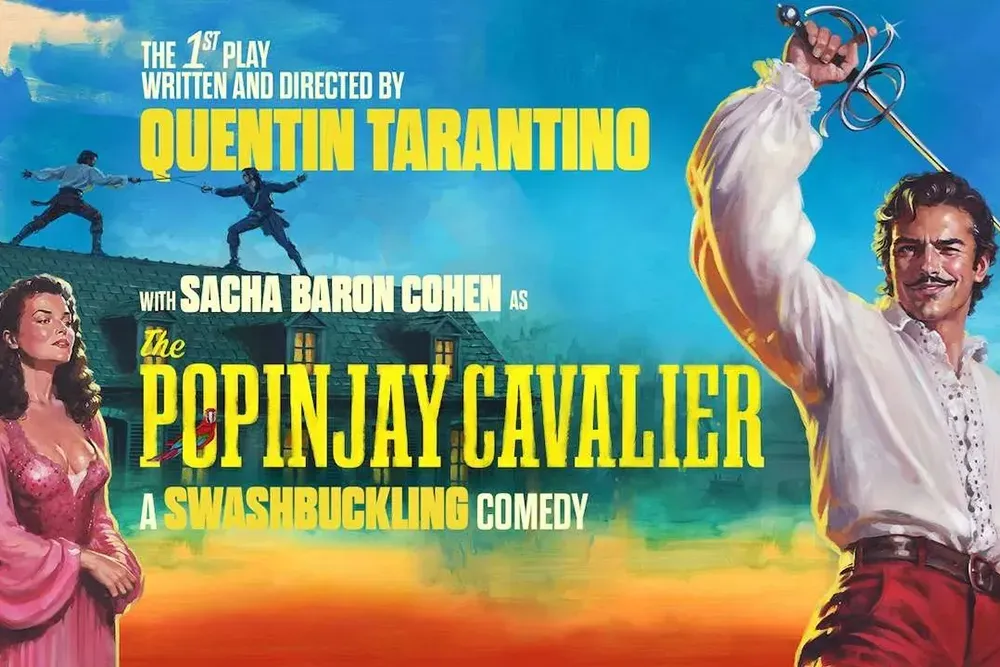
Quentin Tarantino's first ever stage play, "The Popinjay Cavalier," from Sony Pictures Entertainment and Sonia Friedman Productions and starring Sacha Baron Cohen, has extended its West End run at the Phoenix Theatre to Sept. 12, 2027 ahead of a March opening, with the full cast unveiled alongside the extension. The pre-opening commitment ties up a major London house for years on the strength of brand and casting rather than proven demand, a template more studios are testing as live theatre becomes a portfolio asset.
Quentin Tarantino is not easing into the theatre. The Oscar-winning filmmaker's first ever stage play, "The Popinjay Cavalier," has extended its West End run before it has even opened, and will now perform at London's Phoenix Theatre until Sept. 12, 2027. The production, from Sony Pictures Entertainment and Sonia Friedman Productions, is due to open in March. It stars Sacha Baron Cohen, and the full cast was unveiled at the same time as the extension.
Read that sequence again, because the order matters. In the live theatre business, extensions are typically earned, not announced. A show opens, the reviews land, the box office data accumulates, and only then does a producer commit to additional weeks. Booking a West End house through September 2027 before opening night is a different kind of statement, aimed at ticket buyers, rivals, and the wider industry at once: the people financing this production are not hedging. They are betting on the cast list and the names above the title rather than on reviews that do not exist yet.
The names behind it explain part of the confidence. Sonia Friedman Productions is one of the most prolific producing forces in London and New York theatre, and Sony Pictures Entertainment brings studio-scale capital and a global marketing apparatus into a medium that typically runs on far thinner margins. That combination is the real story. In recent years, film and streaming companies have started treating live theatre less as a prestige side project and more as a portfolio asset: a way to develop material, test audience appetite in a room full of paying customers, and keep a story alive beyond a single screen release. A studio attaching itself to a first-time playwright is that logic in its purest form.
Then there is Tarantino himself. For a filmmaker with an Oscar on the shelf and decades of film work behind him, a first play is a different kind of exposure than a movie. A film opens wide, gets judged in a weekend, and moves on. A play is judged nightly, in the same room as the audience, with no second take and no editing room. Whatever happens at the Phoenix Theatre will be attributed to him personally in a way that a studio franchise never is. That is precisely why the pre-opening extension reads as conviction rather than caution.
Sacha Baron Cohen's name does heavy lifting here too. Star casting has become a load-bearing wall of West End economics: a recognizable face on the poster is what converts a tourist walking past a theatre into a same-night ticket buyer. A long booking window, meanwhile, depends on something more durable than opening-night buzz. It depends on tourism flows, group sales, repeat visits, and word of mouth that compounds over months. Committing to Sept. 12, 2027 means the producers believe all of those inputs will hold, not just the first six weeks.
There is a physical constraint in this story that is easy to miss. The Phoenix Theatre is a finite asset. Locking a major West End house for a run that stretches to late 2027 removes that stage, and those performance slots, from the market for every other producer who might want them. In a district where prime venues and prime dates are scarce, a booking of that length is a competitive move as much as a creative one. It also raises the cost of being wrong: dark nights inside a long booking are expensive, and the pressure to fill seats does not pause for a slow month.
What to watch from here is straightforward. The March opening will produce the first real data: reviews, word of mouth, and the pace of advance sales. The cast will need to stay intact, because a star-driven production that loses its star mid-run has a very different commercial profile. And the extension itself will be tested. A booking announced before opening can be quietly restructured if demand disappoints, though doing so carries its own reputational cost.
The strategic stakes reach beyond one London theatre. If a studio-backed, star-cast, first-time-playwright production can hold a West End house for more than a year, the template travels. More film talent gets pulled toward the stage, more studios get comfortable underwriting live performance, and the boundary between screen intellectual property and theatrical property keeps thinning. If it stumbles, the pre-opening extension becomes the cautionary tale: proof that confidence, capital, and casting cannot substitute for the one thing theatre still demands nightly, which is an audience that keeps coming back.
This story's Key Insights and Take-aways are locked.
Create a free account to unlock Executive Actions for one credit.
Register to UnlockAlways free for Executives Club members. Join the Club
More in Entertainment

GTA 6 banks $3.8bn in one day, torching every launch record
One game just out-earned every video game launch and every single-day film box office haul in history, and the fallout lands on every media CEO's forecast.

GTA VI Racked Up $3.79 Billion in a Single Day, Topping Every Film Ever
A 13-year wait produced a $3.79 billion day, more than any movie has made in its entire run, and it resets the launch math for every studio, streamer, and brand chasing the same attention.

GTA 6 sells 32.5M pre-sales and $3.79B day one, torches 13-year record
Rockstar's sequel didn't just beat Grand Theft Auto V's 13-year-old benchmark; it reset what a launch can be, with 32.5 million pre-sale copies and $3.79 billion in a single day.