
Taylor Swift Ends a 13-Year CMA Awards Silence With a 2006 Throwback
Her 'Toy Story 5' single of the year bid turned into a nostalgia play, with Keith Urban on banjo and a stage full of country's old guard.
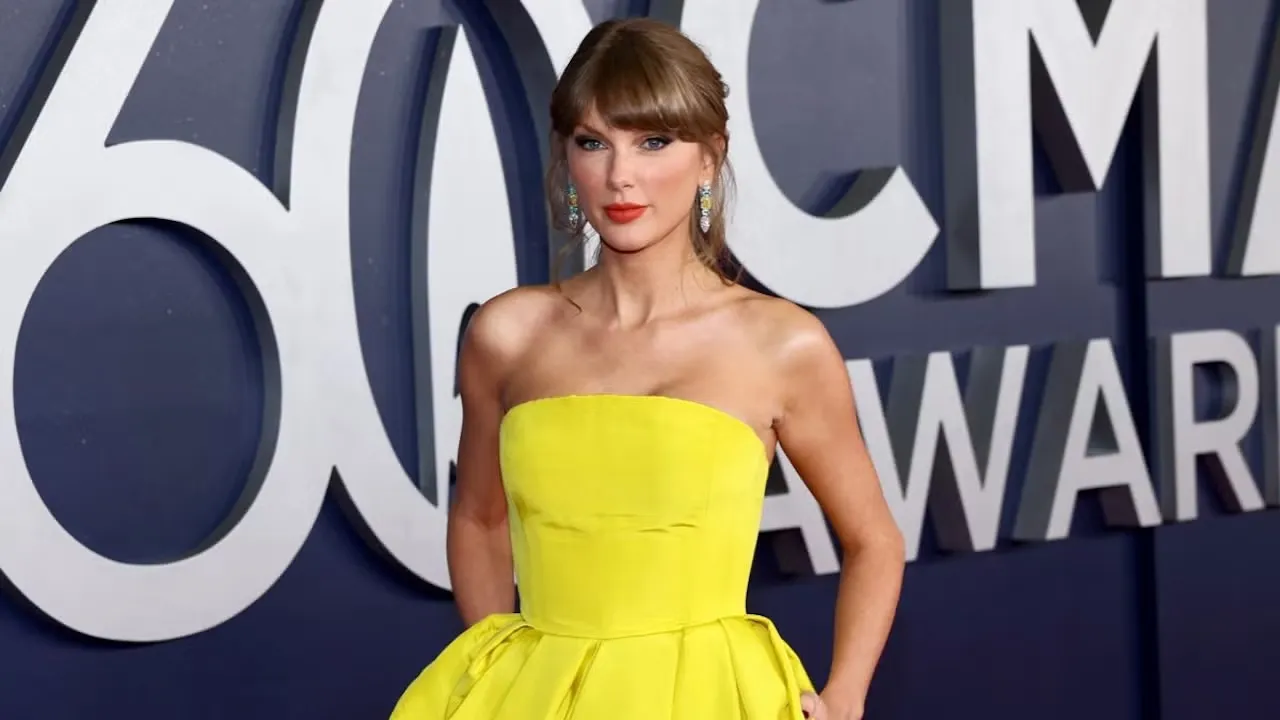
Taylor Swift returned to the CMA Awards on Wednesday for her first performance at the show in 13 years, singing her 'Toy Story 5' single 'I Knew It, I Knew You' before pivoting into her 2006 country hit 'Our Song' with Keith Urban on banjo. The appearance, tied to her 26th CMA nomination, shows how a franchise soundtrack single and a catalog throwback can be packaged into a single competitive awards play.
Taylor Swift walked onto the CMA Awards stage Wednesday night for the first time in 13 years, and she spent the moment doing two things at once. She performed 'I Knew It, I Knew You,' the 'Toy Story 5' anthem that is nominated for single of the year at the 60th annual awards show in Nashville. Halfway through, she pivoted into 'Our Song,' the 2006 country hit that made her a country superstar in the first place. Keith Urban joined her on banjo, playing alongside Swift's backup singers and band. The room got a pop star performing a Disney soundtrack single and a two-decade-old country throwback in the same breath.
The nomination is what put her on that stage, and the field is worth reading closely. 'I Knew It, I Knew You,' which Swift produced alongside Jack Antonoff, is up against Ella Langley's 'Be Her' and 'Choosin' Texas,' Lainey Wilson's 'Somewhere Over Laredo,' and Cody Johnson's 'The Fall.' It is Swift's 26th CMA nomination, a number that quietly reframes the whole night: the artist returning after 13 years is not a nostalgia act asking for a welcome-back hug, she is a repeat nominee competing in a category stacked with the genre's current radio favorites. Wilson, who hosted the show for the third year in a row, is both host and rival in that same category.
The cameo list told its own story. Brad Paisley, Sugarland, Little Big Town, Eric Church, Lainey Wilson and Brooks & Dunn all appeared alongside her. That is not a random guest list; it is a cross-section of Nashville's last two decades, from the duo era to the arena-country boom to the current Lainey Wilson-led wave. For an awards show, assembling that many recognizable names around one performer is a deliberate signal about where the institution places her. It also solves a practical problem: a mash-up with a banjo legend and a rotating cast of country stars gives the broadcast multiple moments to cut to, and gives the audience multiple reasons to keep watching.
Swift's history with the CMAs is unusually well documented for someone who has been away so long. She first attended the show in 2006, the same year 'Our Song' was a country hit, and won her first award in 2007 with the Horizon Award. Two years later she took Entertainer of the Year in 2009, and she still stands as the youngest artist with that honor. By 2013 she received the Pinnacle Award, presented to her by Tim McGraw, Faith Hill, George Strait, Brad Paisley, Keith Urban and Rascal Flatts, a group that doubles as a list of the artists she had previously opened for. That same night she performed 'Red' with Vince Gill and Alison Krauss, which stood as her last CMA performance until Wednesday.
Why the gap matters is a business question as much as a sentimental one. Country is the format that gave Swift her first audience, and the CMA Awards are the industry's annual inventory of who matters to radio, touring and streaming in the genre. A decade away from that room is a long time in a format that has turned over its headliners more than once since 2013. Returning as a nominee, rather than as a legacy honoree or a presenter, is the harder and more valuable version of the comeback. It puts her back in the competitive frame instead of the tribute frame.
The 'Toy Story 5' piece adds a second layer. Soundtrack singles are typically built for a different machine than country radio: a studio franchise, a global release calendar, and a marketing budget that does not depend on one format's playlist committee. Getting one nominated for single of the year at the CMAs means the song crossed over into a category decided by country industry voters. Swift produced it with Jack Antonoff, her longtime collaborator, which ties the project to the pop production world even as it competes in a country category.
For everyone watching from the business side, the lesson is about timing and positioning. Awards shows reward presence, and presence compounds: a performance slot generates clips, clips generate streams, and streams feed the next cycle of nominations. Swift's team spent a scarce resource, her willingness to appear at the CMAs, on a night when she had a nomination to defend and a catalog hit to remind people of. Peers in music, media and brand marketing should read the same playbook: the comeback is strongest when it is competitive rather than ceremonial, and when the nostalgia is deployed as a supporting act instead of the headline.
This story's Key Insights and Take-aways are locked.
Create a free account to unlock Executive Actions for one credit.
Register to UnlockAlways free for Executives Club members. Join the Club
More in Entertainment

GTA 6 banks $3.8bn in one day, torching every launch record
One game just out-earned every video game launch and every single-day film box office haul in history, and the fallout lands on every media CEO's forecast.

GTA VI Racked Up $3.79 Billion in a Single Day, Topping Every Film Ever
A 13-year wait produced a $3.79 billion day, more than any movie has made in its entire run, and it resets the launch math for every studio, streamer, and brand chasing the same attention.

GTA 6 sells 32.5M pre-sales and $3.79B day one, torches 13-year record
Rockstar's sequel didn't just beat Grand Theft Auto V's 13-year-old benchmark; it reset what a launch can be, with 32.5 million pre-sale copies and $3.79 billion in a single day.