

Taylor Swift Lifts CMA Awards to 7.62M Viewers, a Seven-Year High
Swift's return to country's biggest night delivered the show's largest live + same-day audience in seven years, proof that one star can still move a fragmenting TV market.
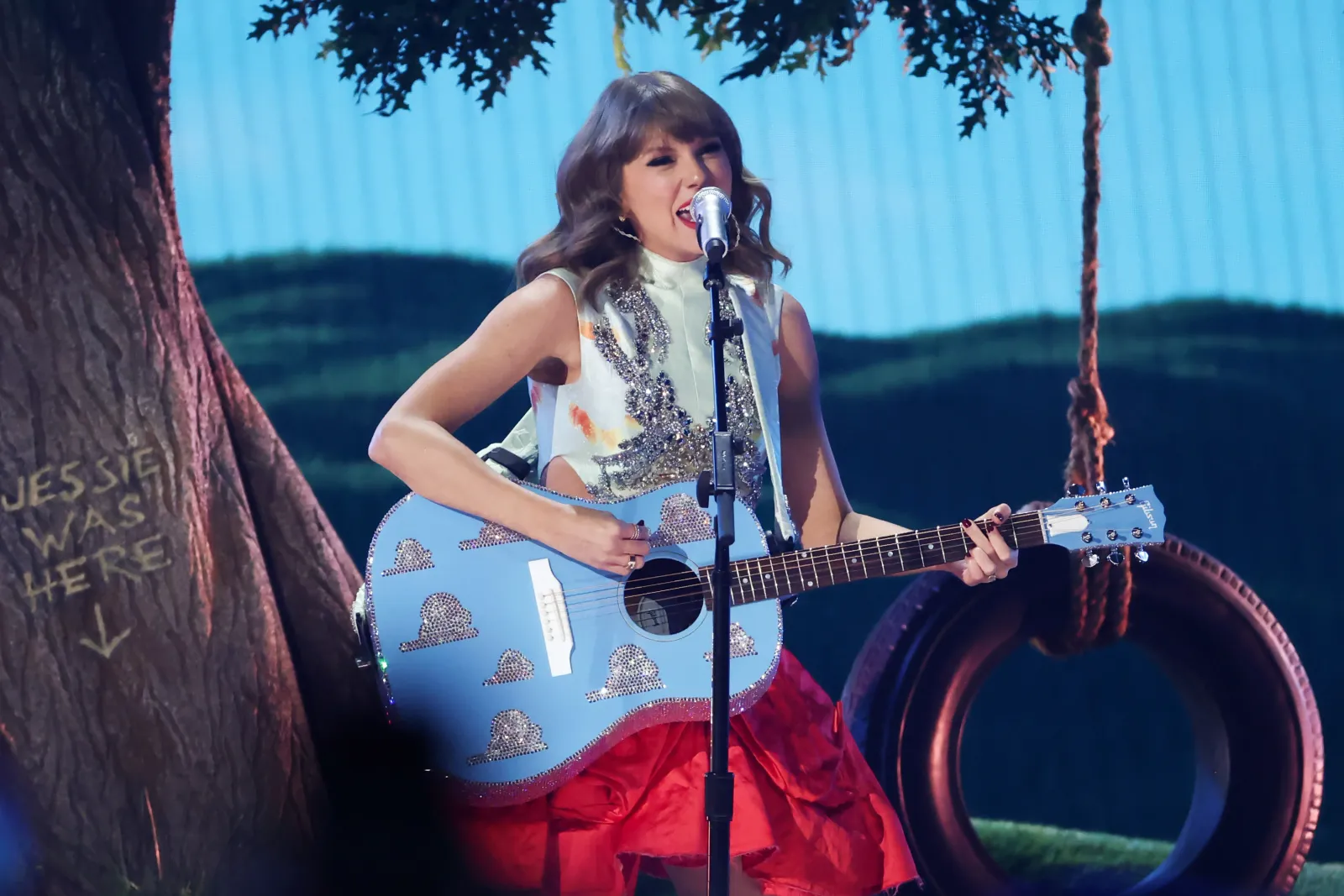
Taylor Swift's return to the 60th annual CMA Awards helped the telecast draw 7.62 million total live + same-day viewers, a seven-year audience high per Nielsen Big Data + Panel. For media, marketing, and talent executives, it is fresh evidence that live, spoiler-proof tentpole events still command premium attention and premium pricing in a fragmenting television market.
Taylor Swift came back to country music's biggest night, and country music's biggest night got its biggest audience in seven years. The 60th annual CMA Awards drew 7.62 million total live + same-day viewers on Wednesday, according to Nielsen Big Data + Panel, the ceremony's largest audience in seven years. The telecast was star-studded by design, but the draw was the return: Swift, back at the CMA Awards, and the fanbase that followed her there. That is the whole story in one number, and the number is doing a lot of work.
Start with what the metric actually measures. Live + same-day counts everyone who watched as the show aired or later that same day, which is the audience that still sets the price of television advertising. It is not a cumulative tally that keeps growing for a month, and it is not a social-media proxy. It is the closest thing the industry has to a headcount of simultaneous attention. In a market where viewers splinter across streaming services and catch highlights on their phones the next morning, a seven-year high on that specific measure is not a rounding error. It is evidence that the tentpole still works, provided the tentpole has a reason to exist.
The measurement itself is worth a beat. Nielsen Big Data + Panel blends large-scale data from set-top boxes and smart TVs with the company's traditional panel of households, a methodology built to produce steadier estimates as viewing habits get messier. For the people who sell and buy the ad inventory around a broadcast like this, the currency matters as much as the count. A number produced on a bigger sample travels further in a negotiation.
Then there is Swift. She built her career in country music before crossing over into something closer to a global institution, and the CMA Awards were part of that rise. Her return is a homecoming, and homecoming is the cheapest and most effective marketing in entertainment. Fans who left country behind with her came back for one night. That is the halo effect in its purest form: one booking, one narrative, and a three-hour broadcast gets lifted.
The economics follow from there. Awards shows are among the last genuinely live, spoiler-proof, DVR-resistant blocks of advertising inventory on television. Brands pay a premium for attention that happens at the same moment for millions of people, because that is the attention that gets talked about the next day. A seven-year high hands the show's sales team a story to walk into the next upfront with, and it hands country music's broader commercial machine, from touring to streaming to merchandise, a fresh piece of evidence that the genre's crossover moment is still compounding.
The caveat is important, and it is the part most coverage will skip. One night does not reverse a decade. Awards show audiences have broadly declined as viewing has fragmented, and 7.62 million is a strong number for the 2020s, not a return to the peaks of the 2010s. The lesson is not that awards shows are back. The lesson is that scarcity of shared moments is itself the product, and whoever can manufacture a genuine reason for people to show up at the same time still wins.
That reframes the second-order effects. For talent, it means the leverage is in the return, not the appearance: showing up somewhere you have not been in years is worth more than showing up everywhere. For networks and rights holders, it means the tentpole strategy only pays when the tentpole has a narrative engine, not just a red carpet. For marketers, it means live events remain the last place where a brand can buy simultaneous attention at scale, and the price of that attention is set by nights like this one.
For the executives reading this, the takeaway is uncomfortable in its simplicity. Attention is not scarce because there is too little content. It is scarce because there are too few moments everyone agrees to share. The CMA Awards just proved, again, that a single star with a single reason to come home can still assemble 7.62 million people in the same room at the same time. That is the asset. Everything else is distribution.
This story's Key Insights and Take-aways are locked.
Create a free account to unlock Executive Actions for one credit.
Register to UnlockAlways free for Executives Club members. Join the Club
More in Entertainment

GTA 6 banks $3.8bn in one day, torching every launch record
One game just out-earned every video game launch and every single-day film box office haul in history, and the fallout lands on every media CEO's forecast.

GTA VI Racked Up $3.79 Billion in a Single Day, Topping Every Film Ever
A 13-year wait produced a $3.79 billion day, more than any movie has made in its entire run, and it resets the launch math for every studio, streamer, and brand chasing the same attention.

GTA 6 sells 32.5M pre-sales and $3.79B day one, torches 13-year record
Rockstar's sequel didn't just beat Grand Theft Auto V's 13-year-old benchmark; it reset what a launch can be, with 32.5 million pre-sale copies and $3.79 billion in a single day.