
The Milky Way's black hole may have a food supply: two colliding stars
Astronomers traced mysterious gas clouds near the galactic center to a massive stellar pair whose colliding winds make dense clumps, material that could eventually feed the supermassive black hole.
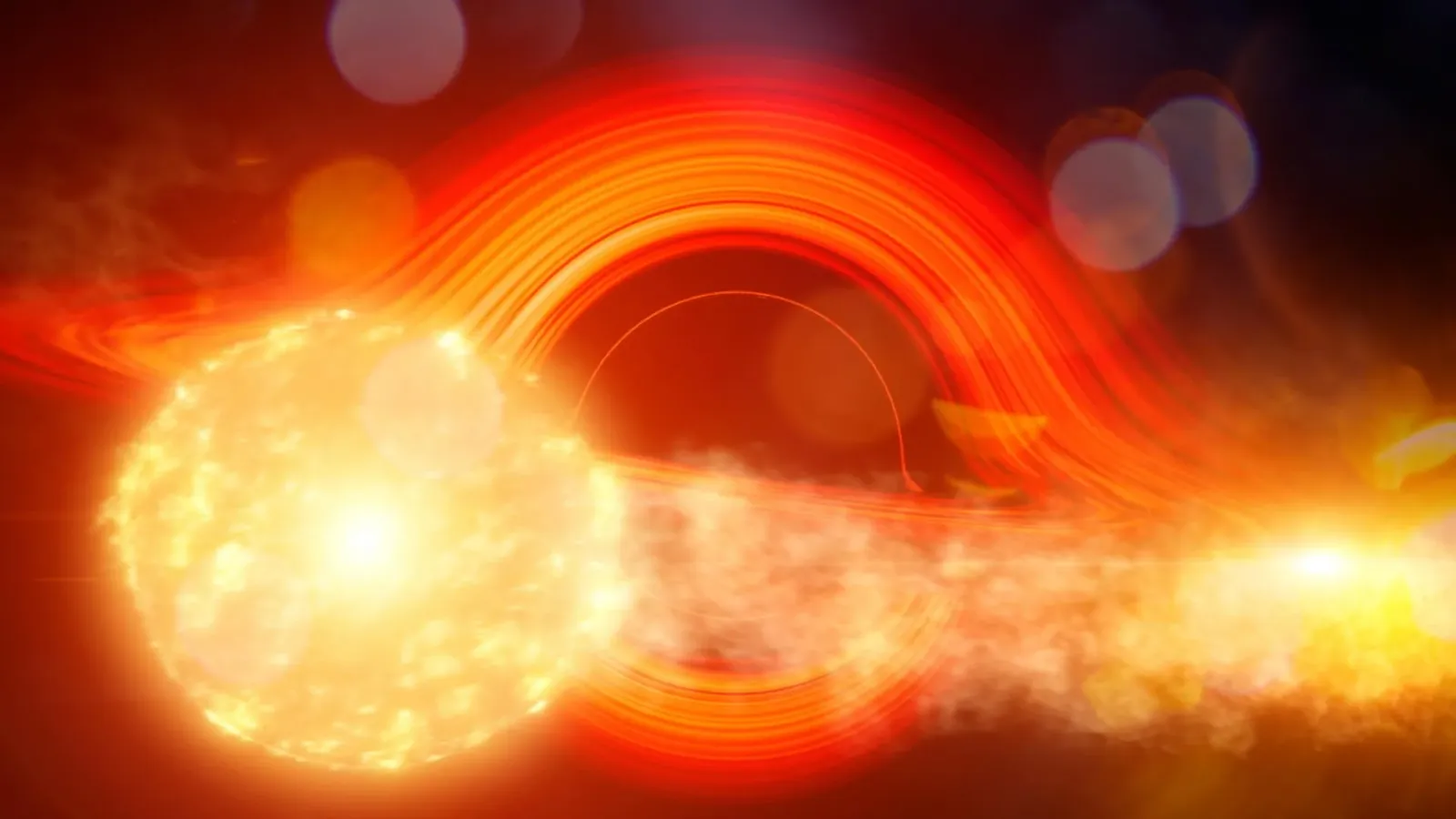
Astronomers have traced mysterious gas clouds near the Milky Way's central supermassive black hole back to a massive pair of stars whose colliding winds appear to create dense clumps of material. The finding matters because those clouds may eventually feed the black hole, linking ordinary stellar activity to the growth of one of the most extreme objects in the galaxy.
Two massive stars near the center of the Milky Way appear to be doing something no one expected: manufacturing the raw material that may eventually feed the galaxy's supermassive black hole. That is the conclusion astronomers reached after tracing mysterious gas clouds near the galactic center back to a massive pair of stars, whose colliding winds appear to create dense clumps of material. The clouds, in other words, are not random debris drifting past the black hole. They have a plausible origin story, and it involves two stars effectively throwing punches at each other.
The mechanism is the interesting part. A single massive star typically drives a wind of hot gas outward in all directions, and that wind is thin and diffuse. On its own, it rarely compresses into anything dense. Put two such stars close enough together, however, and their winds collide. That collision region compresses gas, and the result, according to the astronomers, is dense clumps of material. Those clumps are the mysterious clouds. It is a supply chain that starts with stellar weather and ends, potentially, at the edge of a black hole.
For context, supermassive black holes grow by taking in matter. Gas that drifts too close spirals inward, forms a disk, heats up through friction, and eventually crosses the event horizon. Historically, that is also why some galactic centers blaze as quasars while others stay dim: the difference is usually not the black hole itself, it is the food supply. So finding a stellar-scale process that manufactures dense clumps near the center is not a curiosity. It is a candidate answer to a standing question about how these objects get fed, and it points the search for their fuel upstream of the black hole rather than at it.
The surprise comes from the scale mismatch. The black hole at the heart of the Milky Way is supermassive, meaning millions of times the mass of the Sun. The two stars responsible for the clouds are massive by stellar standards, but they are still stars. The idea that a pair of them could influence the diet of a cosmic giant inverts the usual intuition that only big forces shape big objects. In this picture, small, local, and easily overlooked events upstream can determine what happens at the most extreme destination in the galaxy.
There is also a repeatability question worth appreciating. Massive stars live fast and die young by stellar standards, and massive stars are, historically, often found in pairs rather than alone. If colliding winds from such pairs routinely produce dense clumps, then the mechanism is not a one-off. It becomes a process, which changes the question from whether stars can feed a black hole to how often, and how much. That is the kind of reframing that turns a single observation into a research program.
There is a larger frame here too. Astronomers have long noted that supermassive black holes and the galaxies around them appear to grow in tandem, which is why the question of what feeds a black hole is really a question about how galaxies evolve. If stellar activity near a galactic center can generate the dense clumps that seed that feeding, then the connection between ordinary stars and cosmic giants becomes more literal than metaphorical. The black hole's next meal may be written in the lives and deaths of stars.
The word to hold onto is "may". The clouds may eventually feed the black hole, and the winds appear to create the clumps. Appearance and eventuality are doing real work in those sentences, and the honest version of this story is that astronomers have found a convincing origin for the material, not a confirmed delivery to the black hole's doorstep. Confirming the last leg of that journey, whether the clumps survive the trip inward and actually reach the accretion flow, is the next observational job. Until then, the finding is a strong lead rather than a closed case.
Why should anyone outside astrophysics care? Because the result reframes where growth comes from. The growth of a supermassive black hole is one of the biggest and slowest processes in the galaxy, and this work suggests its inputs may be generated by something as small and violent as two stars colliding. For anyone who thinks about systems, supply chains, or capital, the pattern is familiar: the constraint that matters is often not the giant at the center. It is whatever is quietly producing the inputs upstream. Here, the upstream is two stars. The giant is a black hole, and it may be eating what they make.
This story's Key Insights and Take-aways are locked.
Create a free account to unlock Executive Actions for one credit.
Register to UnlockAlways free for Executives Club members. Join the Club
More in Science

Anthropic's I.P.O. Made Rank-and-File Researchers Worth Tens of Millions
Researchers who joined just a few years ago are now worth tens of millions, and the windfall resets the pay benchmark for every private A.I. lab still paying in paper.

Sea Lion Culling Strategy Fails: New Model Says Killing Them Won't Save Salmon
The latest research from AAAS overturn a long-held conservation assumption, forcing policymakers to rethink critical resource allocation in marine ecosystems.

Microplastics do more than pile up: they react with water to damage cells
Scientists have found that plastic particles can generate highly reactive molecules in water, a mechanism that could explain links to heart attacks, strokes, and neurological disorders.