
Voyager 1 hits one light-day: 24 hours to send a single command
The 1977 probe is now a full day's light-travel from Earth, and with 4 watts bleeding off every year, NASA is rationing a nuclear battery to keep science alive past 2027.
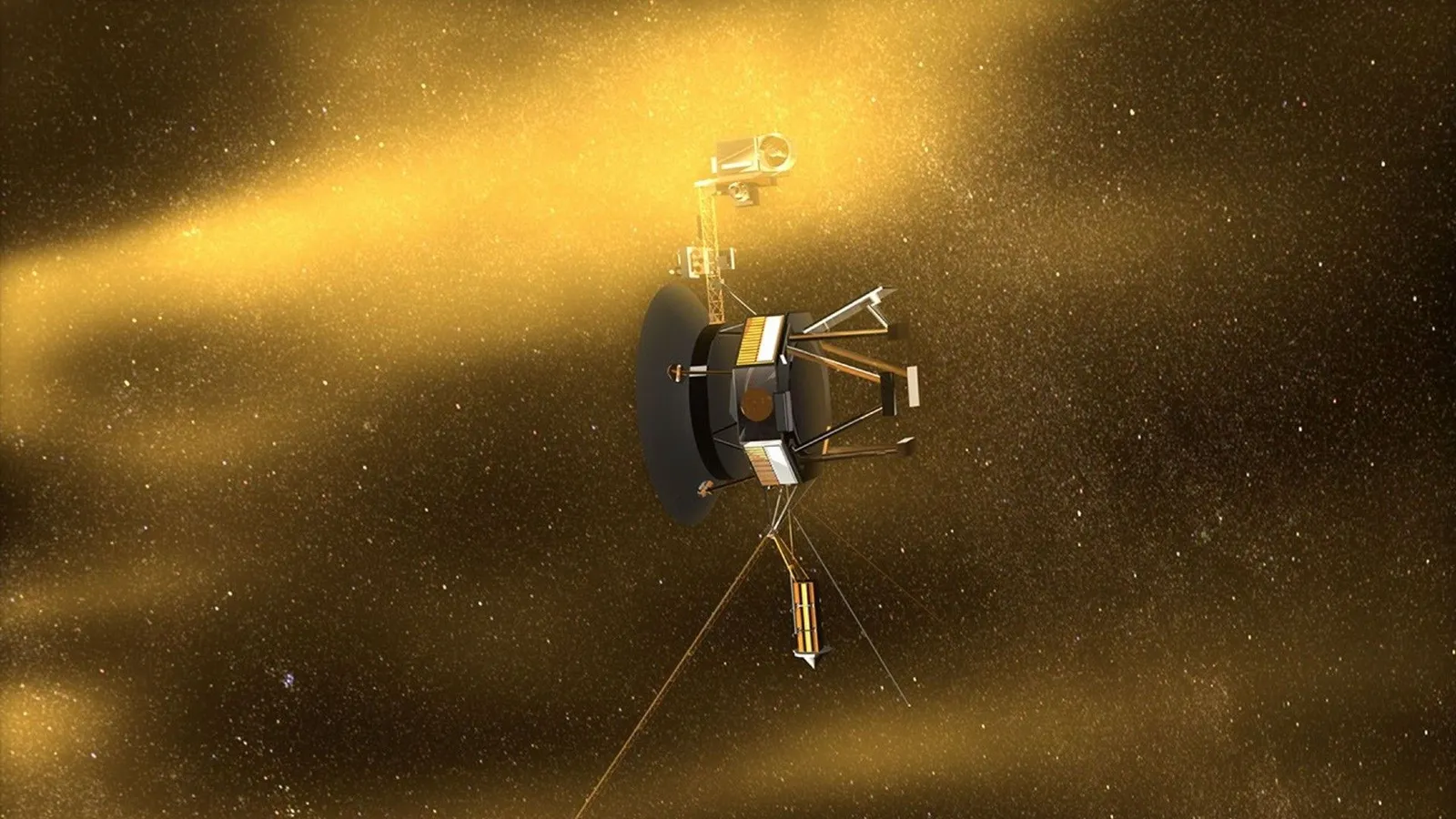
Voyager 1, the NASA probe launched in 1977, crossed the one light-day mark on Nov. 18, meaning commands now take 24 hours to arrive, while project manager Suzanne Dodd and the JPL team manage a power supply losing 4 watts a year. For anyone running a long-lived asset, the mission is now a live case study in rationing scarce power and transferring institutional knowledge before the hardware, or the people who know how to run it, gives out.
On Wednesday, Nov. 18, Voyager 1 became the first spacecraft in history to sit one light-day from Earth. That is not a distance you can picture, so here is the operational version: a command sent from NASA's Jet Propulsion Laboratory now takes a full 24 hours to reach the probe, and any answer takes another 24 hours to come back. Nobody is flying this spacecraft in real time. "One of the reasons that one light-day is so special is that it has never happened before that we were in contact with a spacecraft at this distance, and it may never happen again," JPL mission manager Kareem Badaruddin said. Voyager 1's twin, Voyager 2, will not reach the same mark until 2035.
The two probes launched in 1977 on what was supposed to be a tour of the outer solar system, and they have been overdelivering ever since. Voyager 1 looked at Jupiter and Saturn up close before veering for a flyby of Saturn's moon Titan and Saturn's rings, a pathway that brought it above the plane of the solar system in the early 1980s. Voyager 2 took a slightly slower track that let it see Jupiter, Saturn, Uranus and Neptune. Voyager 1 crossed into interstellar space in August 2012 and has kept sending data since; Voyager 2 made the same crossing in November 2018. NASA expects Voyager 1 to keep working until at least 2027.
The science has not stopped, it has changed shape. "Current science is continuing our investigation on magnetic field strength and direction, plasma density, and energetic particle detection. What is important is to measure how these phenomena change as the spacecraft travels further away from the sun," Suzanne Dodd, project manager for the Voyager missions at JPL, told Space.com. JPL project scientist Linda Spilker added that the team will keep watching plasma and magnetic fields near the spacecraft and any solar effects such as shocks or pressure fronts. "Key Voyager science going forward includes observing the extent to which our sun continues to affect interstellar space, all the way out to Voyager 1," she said. "Where does the sun's influence end and pristine interstellar space begin? Perhaps Voyager may last long enough to answer that question." The team also wants to watch the magnetic field around the spacecraft continue to change direction from the sun out to interstellar space, a finding nobody expected when the probes launched.
Lasting is the hard part. Each Voyager loses 4 watts of power a year. They launched with 470 watts in 1977, generated by a nuclear power source that keeps dwindling, which forces harder choices as both missions approach their 50th years of operations. Instruments have already been shut off, and earlier this year both spacecraft were directed to perform a "Big Bang" of power redistribution to preserve as much power as possible without sacrificing science. Dodd said the team does not anticipate major changes to spacecraft operations until after the 50th anniversary passes for each spacecraft next August and September. Voyager 2 launched a few weeks before Voyager 1, so it hits the milestone first.
A JPL representative said the "Big Bang" should keep the remaining science instruments going until then, though "there is also the thermal state of the spacecraft to balance." Power margins remain "very thin," especially because the spacecraft are so cold in interstellar space. Then there is what the team cannot model. Last month Voyager 1 suddenly stopped responding to commands for roughly 48 hours before recovering. "The goal of the mission is science, so the team is not just concerned with keeping in contact with the Voyagers, but keeping the science instruments going as long as possible," the representative said. "The further away the spacecraft get from Earth, the more they learn about how interstellar space changes further away from the heliopause."
Keeping a 48-year-old machine alive at that range is a staffing problem as much as an engineering one. The Voyager team now spans multiple generations of engineers. Badaruddin pointed to the most junior members, Nshan Kazaryan and Bhavana Gupta, who are already taking on key roles in anticipation of more responsibility later. Kazaryan negotiates tracking schedules with the Deep Space Network, the set of three antennas used to follow distant missions, to keep tabs on the Voyagers. Gupta has built documentation pulling critical details from the spacecraft's command and control systems so the team can "give detailed instructions" if something goes wrong. Badaruddin also credited senior team member Jack Lippincott, whose knowledge of DSN operations and data interpretation proved critical when violent weather hit the region around one of the network's antennas in recent weeks.
The stakes are simple. This is the only ongoing experiment on what happens to a human-built object at the edge of the sun's influence, and the clock is running on both the power supply and the people who know how to run it. "It has taken decades of exceptional engineering to get Voyager 1 to the one light-day milestone, and hopefully much further before the mission ends," Dodd said. Badaruddin framed the moment plainly: no one has ever stayed in contact with a spacecraft this far out, and it may never happen again. For anyone running a long-lived asset, the lesson travels well. End-of-life is a budget problem before it is a failure problem, and the knowledge required to spend that budget wisely has to be transferred long before the last watt is spent.
This story's Key Insights and Take-aways are locked.
Create a free account to unlock Executive Actions for one credit.
Register to UnlockAlways free for Executives Club members. Join the Club
More in Science

Anthropic's I.P.O. Made Rank-and-File Researchers Worth Tens of Millions
Researchers who joined just a few years ago are now worth tens of millions, and the windfall resets the pay benchmark for every private A.I. lab still paying in paper.

Sea Lion Culling Strategy Fails: New Model Says Killing Them Won't Save Salmon
The latest research from AAAS overturn a long-held conservation assumption, forcing policymakers to rethink critical resource allocation in marine ecosystems.

Microplastics do more than pile up: they react with water to damage cells
Scientists have found that plastic particles can generate highly reactive molecules in water, a mechanism that could explain links to heart attacks, strokes, and neurological disorders.