

Voyager 1 is a full day from Earth, and its power is running out
The 1977 probe is 16.1 billion miles out, the first human object whose radio calls take 24 hours to arrive, and its shrinking power supply is the real deadline.
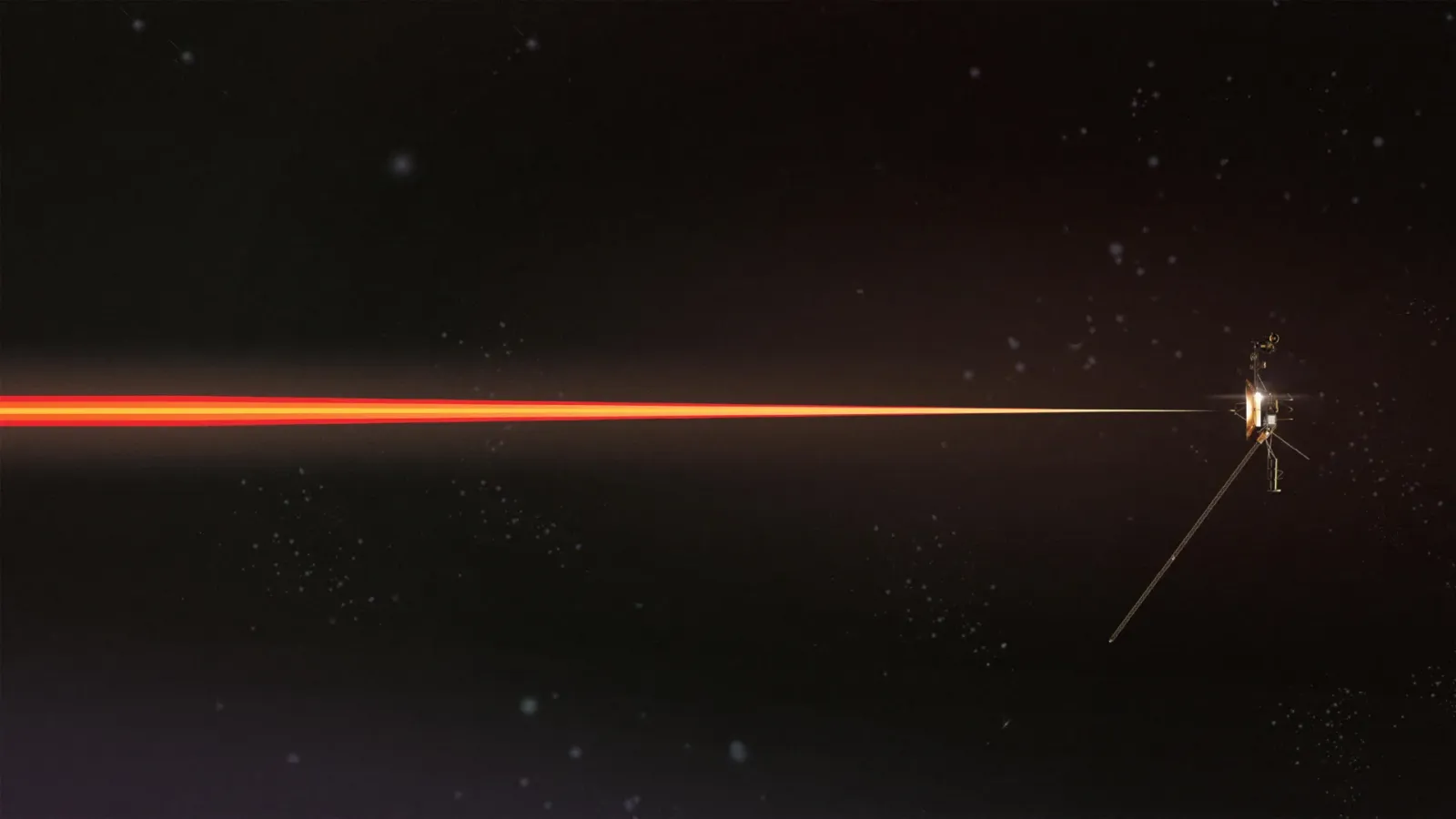
NASA's Voyager 1 has become the first spacecraft distant enough that its signals take a full 24 hours to reach Earth, hitting 16.1 billion miles nearly 50 years after launch. For decision-makers, the milestone is a live case study in operating a long-lived asset with dwindling power, a two-day command loop, and no possibility of real-time repair.
NASA's Voyager 1 is now 16.1 billion miles from Earth, and that distance has produced a genuine first: its radio signals take a full 24 hours to reach us. Not 24 hours to get an answer. Twenty-four hours one way. The probe, launched nearly 50 years ago, is the first spacecraft to cross that threshold, which makes it the first human-made object whose conversations with home run on a one-day delay in each direction. Put a number on the round trip and it gets stranger still: ask Voyager 1 a question today, and the earliest you can hear back is the day after tomorrow.
Light is the speed limit of the universe, and even at roughly 186,000 miles per second it needs a full day to cover the gap. For the engineers who still tend the spacecraft, that latency is not a metaphor. It is the shape of every decision. A command is drafted, uplinked, and then everyone waits. If the fix does not take, the diagnosis arrives a day later and the next attempt costs another two days. Compare that with Mars, where round trips are measured in minutes, or the Moon, where they are measured in seconds. Voyager 1 is no longer a remote-controlled machine. It is a correspondence.
For context, Voyager 1 left Earth in 1977 carrying a golden phonograph record and a mission to fly past Jupiter and Saturn. It did that, then kept going. In 2012 it crossed into interstellar space, the region beyond the sun's wind where the surrounding medium takes over, and it has been the most distant human-made object ever since. Nearly five decades of operation is the headline achievement; the 24-hour signal delay is simply the receipt. Nothing else built by humans is that far away, and nothing else has stayed functional for that long while getting there.
The milestone is also a countdown. Voyager 1 runs on radioisotope thermoelectric generators, which turn the heat of decaying plutonium into electricity. There is no refueling, no solar array that helps this far from the sun, and no repair crew. Output falls a little every year, so NASA has spent the past decade making unglamorous choices about which instruments stay on, which go dark, and which science is worth the watts. The spacecraft has shown its age in other ways too. A data glitch in 2024 took months to trace and work around, a reminder that a 1970s computer with memory measured in kilobytes is still doing real physics at the edge of the solar system.
The 24-hour mark matters beyond symbolism because of what it costs to listen. NASA's Deep Space Network, the set of large antenna complexes positioned around the globe so that at least one can always point at a given spacecraft, is the only thing standing between Voyager 1 and silence. That same network supports missions far closer to home, from lunar orbiters to Mars rovers, and it is a shared, finite resource. Every extra hour of light-time is another hour of antenna time, another hour of scheduling, and another hour in which nothing can be corrected in real time.
What Voyager 1 is really demonstrating is graceful degradation at extreme range. The probe cannot be patched in real time, cannot be rebooted by a technician, and cannot be recovered if a command goes wrong. So the mission has been engineered around autonomy, redundancy, and the assumption that every instruction is a one-shot bet placed two days in advance. That is an increasingly relevant template. As more hardware heads outward, from commercial lunar landers to future deep-space relays, the same physics applies: the farther you go, the more the machine has to think for itself and the less a ground crew can save it.
The strategic stakes are simple and uncomfortable. Voyager 1 is a nearly 50-year-old asset with a shrinking power budget, a two-day command loop, and no replacement on any drawing board. It is still producing science because its designers built margin into a machine they could not service. For anyone running long-lived infrastructure, that is the lesson worth stealing: the systems that survive are the ones designed to keep working while they lose capability, not the ones designed to be perfect on day one. Voyager 1 has roughly a day of lag and no way home. It is still talking.
This story's Key Insights and Take-aways are locked.
Create a free account to unlock Executive Actions for one credit.
Register to UnlockAlways free for Executives Club members. Join the Club
More in Science

Anthropic's I.P.O. Made Rank-and-File Researchers Worth Tens of Millions
Researchers who joined just a few years ago are now worth tens of millions, and the windfall resets the pay benchmark for every private A.I. lab still paying in paper.

Sea Lion Culling Strategy Fails: New Model Says Killing Them Won't Save Salmon
The latest research from AAAS overturn a long-held conservation assumption, forcing policymakers to rethink critical resource allocation in marine ecosystems.

Microplastics do more than pile up: they react with water to damage cells
Scientists have found that plastic particles can generate highly reactive molecules in water, a mechanism that could explain links to heart attacks, strokes, and neurological disorders.