
Voyager 1 is now more than one light-day from Earth, still answering
NASA's 1977 probe is so distant that a radio signal takes 24 hours one way, and its survival is a masterclass in backups, safe modes, and fault protection for anyone building systems meant to last.
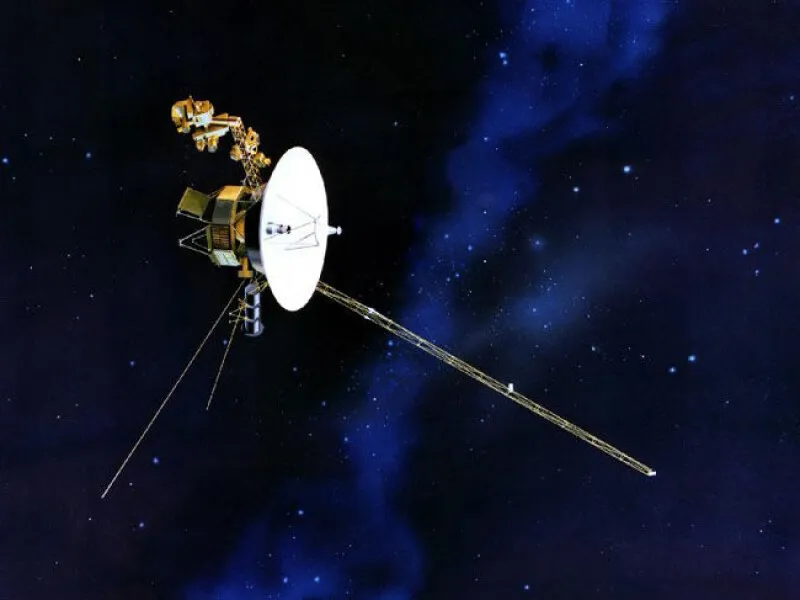
NASA's Voyager 1, launched in 1977, is now more than one light-day from Earth, with a radio signal taking 24 hours to reach it and two science instruments still operating. For decision-makers, the probe's nearly 50-year run, credited by original imaging team member Dr Garry Hunt to reliable Mariner equipment, fault protection, backups, and safe modes, is a case study in engineering for extreme longevity.
NASA's Voyager 1 has crossed a line that no other human-made object has crossed: it is now more than one light-day from Earth. That means a radio signal sent from Earth takes 24 hours to reach the probe. The spacecraft was launched on September 5, 1977, from Cape Canaveral in Florida, and it has spent almost 50 years getting there. Planning for the mission began in the 1960s, while NASA was working feverishly to put a man on the Moon ahead of the Soviet Union. A rare alignment of the outer planets made a tour of Jupiter, Saturn, Uranus, and Neptune possible. Voyager 1 took a route that prioritized Saturn's moon Titan, which ruled out a later encounter with Pluto. Voyager 2 eventually visited all four planets.
The remarkable part is not just the distance. It is that Voyager 1 still answers at all. Dr Garry Hunt, a member of Voyager's original imaging team, told The Register that the mission's real success came from the way it used reliable equipment. 'Voyager's real success is the way it used reliable equipment,' Hunt said. 'Well-tested Mariner equipment, and special new things that had come about for it.' He also pointed to the spacecraft's fault protection. 'We had fault protection on board as well. If anything goes wrong, it automatically switches to a backup. So there was always a backup. There was always a safe mode.' Hunt added that radiation protection was essential because designers did not fully know Jupiter's magnetic environment. 'When we designed this, we didn't really know the magnetic environment around Jupiter, and to be told it was so strong, 1,000 times stronger than we anticipated, really threw everything up in the air, and so that had to be dealt with.'
Voyager 1 completed a flyby of Jupiter in 1979 and passed Saturn and Titan in 1980. Its final imaging sequence in 1990 produced the solar system 'Family Portrait,' including the famous Pale Blue Dot image of Earth. The cameras were then switched off for good. Thirty-six years after those final pictures, Voyager 1 remains in contact with Earth, with two science instruments still operating: the magnetometer and plasma wave subsystem. Others have been shut down over the decades to conserve the dwindling power supplied by its radioisotope thermoelectric generators (RTGs).
Hunt paid tribute to the succession of project managers and engineers who have kept the probe running over the years. 'I think this was a really wonderful example of project management, of clever management of engineering, and interesting science coming out of it, which has made history books and gone to be a catalyst for other things in the future,' he said. That is not just nostalgia. Voyager 1 may now take two days to answer a call from Earth. After almost 50 years, the remarkable thing is that it still answers at all.
For executives, the Voyager story is a rare natural experiment in longevity. The probe was built with technology from the 1970s, yet it is still operating because its designers assumed things would fail. They built in backups, safe modes, and radiation protection. They also chose well-tested Mariner equipment alongside special new things that had come about for the mission. In a business climate that often rewards speed over durability, Voyager 1 shows the compounding value of designing for failure. A backup that sits idle for decades can be the difference between a mission that ends in 1990 and one that is still in contact today.
The power problem is the quiet clock inside the mission. RTGs convert heat from radioactive decay into electricity, and their output declines over time. That is why engineers have shut down instruments one by one. Every shutdown buys a little more time for the remaining science. The magnetometer and plasma wave subsystem are now the last two instruments running. For any organization managing a long-lived asset, the lesson is to plan the endgame before the power runs out. The teams that kept Voyager alive had to make hard choices about what to turn off, when, and in what order. That is capital allocation by another name.
Hunt's tribute to project managers and engineers is also a reminder that the soft side of hard technology matters. The mission has required a succession of project managers and engineers over the years. The reason it lasted is not one heroic fix. It is a culture of fault protection, safe modes, and redundant systems. For founders, operators, and investors, the takeaway is uncomfortable but useful: the systems that last are rarely the ones with the most impressive launch specs. They are the ones with the most boring, reliable backups. Voyager 1 is now more than one light-day away. It may take two days to answer a call. But after almost 50 years, it still does. That is the whole point.
This story's Key Insights and Take-aways are locked.
Create a free account to unlock Executive Actions for one credit.
Register to UnlockAlways free for Executives Club members. Join the Club
More in Science

Anthropic's I.P.O. Made Rank-and-File Researchers Worth Tens of Millions
Researchers who joined just a few years ago are now worth tens of millions, and the windfall resets the pay benchmark for every private A.I. lab still paying in paper.

Sea Lion Culling Strategy Fails: New Model Says Killing Them Won't Save Salmon
The latest research from AAAS overturn a long-held conservation assumption, forcing policymakers to rethink critical resource allocation in marine ecosystems.

Microplastics do more than pile up: they react with water to damage cells
Scientists have found that plastic particles can generate highly reactive molecules in water, a mechanism that could explain links to heart attacks, strokes, and neurological disorders.