
Voyager 1 is now one light day from Earth, a first for humanity
The 1977 probe's signal now takes a full 24 hours to reach Earth, turning a five-year mission into a 49-year masterclass in keeping legacy hardware alive.
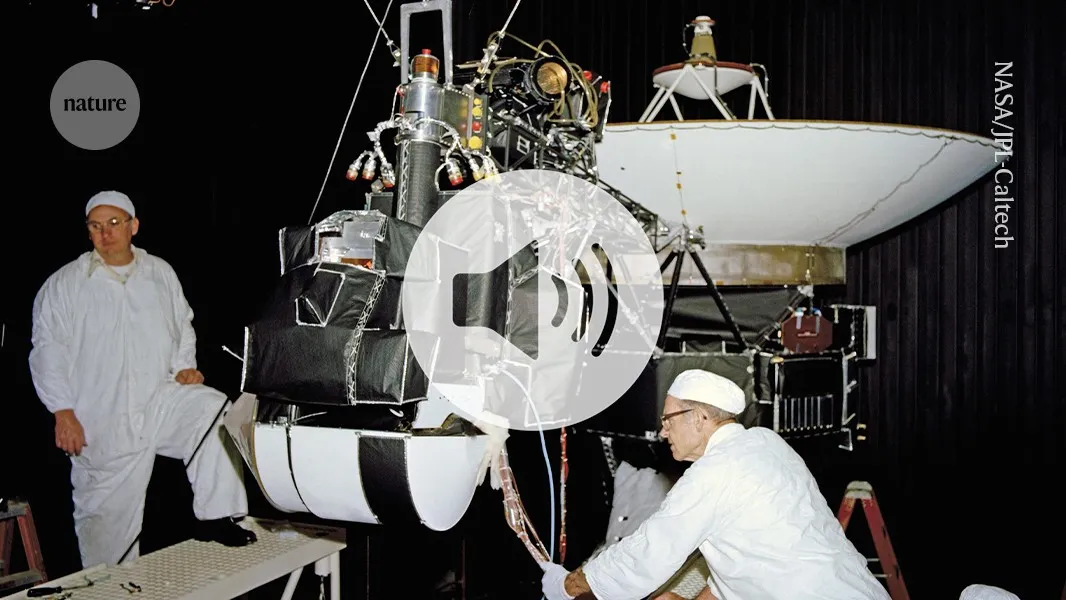
NASA's Voyager 1, launched in 1977, has become the first human-made object to sit one light day from Earth, a milestone Nature's news team flagged in a briefing published 20 November 2026. For operators and boards, the record is a case study in long-horizon asset management: power rationing, remote repair, and small teams keeping legacy systems running decades past their design life.
Voyager 1 is now a full light day from Earth. That means the radio signal carrying its data takes 24 hours to cross the gap, one way, and it makes the 1977 probe the first human-built object to reach that distance. Nature's news team flagged the milestone in a briefing chat published on 20 November 2026, alongside a second, very different item: how vampire bats survive on a diet of nothing but blood. Two stories about machines and animals operating at the edge of what physics and biology allow.
The number is worth sitting with. A light day is roughly 25.9 billion kilometers, or about 16 billion miles. Voyager 1 crossed into interstellar space in 2012 and has been adding distance ever since at roughly 17 kilometers per second. For scale: the Pale Blue Dot image, the famous portrait of Earth as a speck of dust, was taken in 1990 from about 6 billion kilometers out. Voyager 1 has since put more than four times that distance behind it. Nothing else humans have launched is further away, and nothing currently flying is close to catching it.
The record is a distance record, but the real achievement is endurance. Voyager 1 was built for a five-year tour of Jupiter and Saturn. It flew past Jupiter in 1979 and Saturn in 1980, then kept going because the hardware would not quit. Its power comes from radioisotope thermoelectric generators, which convert the heat of decaying plutonium into electricity and lose roughly four watts of output every year. NASA has responded the way any operator of a legacy system would: shut things down, one instrument at a time, to keep the transmitter alive. In 2024, a failed memory chip in the flight data subsystem scrambled its science data, and engineers diagnosed and patched it from roughly 24 billion kilometers away. The fix worked.
The link itself is the quiet miracle. Voyager 1's transmitter puts out about 20 watts, roughly the power of a refrigerator light bulb, and by the time that signal reaches Earth it has spread so thin that NASA's Deep Space Network needs 70-meter dishes to hear it. The received power is measured in fractions of a billionth of a watt. Every command sent back up has to be right the first time, because a round trip now takes two full days.
Why should anyone outside a planetary science lab care? Because Voyager is the best available case study in long-horizon engineering, and the incentives behind it are almost impossible to replicate today. The mission has outlived its original designers' careers, several NASA administrations, and the entire commercial space industry that grew up around it. Its annual operating cost has historically been a rounding error next to a new flagship mission, which is precisely why it is still alive: nobody has a reason to kill it, and a small team has every reason to keep it running. That is a governance lesson as much as an engineering one. Assets that keep producing value for decades usually survive on small budgets and stubborn owners.
The second half of Nature's briefing is a reminder that extreme constraints produce extreme adaptations. Vampire bats live on blood, a diet that is almost uniquely hostile: low in carbohydrates, loaded with protein, and offering almost no margin for error. Researchers have documented heat-sensing organs in the bats' noses that let them find warm blood vessels under fur, kidneys built to flush excess water and urea out fast, and a metabolism that can run on the amino acids in a meal. The strangest part is social. A bat that fails to feed can starve within a couple of days, so roost-mates regurgitate blood for each other, a system of reciprocal sharing that researchers have studied for decades as a textbook example of cooperation under scarcity.
Put the two together and the briefing's real theme shows up. Voyager 1 and the vampire bat are both solving the same problem: how to keep operating when the environment gives you nothing and the margin is thin. Voyager does it with redundancy, power rationing, and a ground team that treats a 49-year-old spacecraft as a system to be nursed rather than replaced. The bat does it with hardware, in the literal sense, plus a social safety net. Neither solution is glamorous. Both are the reason the thing is still alive.
The record itself will stand for a long time. Voyager 1 is heading toward the Oort cloud, the distant shell of icy bodies that marks the outer edge of the Sun's gravitational reach. For context, reaching the inner edge is typically described as a roughly 300-year trip, and exiting the far side could take tens of thousands of years. The probe will run out of power long before then, sometime in the 2030s on current projections, and its signal will fade to nothing. But the distance it has already covered does not go away. Somewhere out there, a machine built by engineers who have long since moved on is still moving at 17 kilometers per second, and for one more day, it is still answering.
This story's Key Insights and Take-aways are locked.
Create a free account to unlock Executive Actions for one credit.
Register to UnlockAlways free for Executives Club members. Join the Club
More in Science

Anthropic's I.P.O. Made Rank-and-File Researchers Worth Tens of Millions
Researchers who joined just a few years ago are now worth tens of millions, and the windfall resets the pay benchmark for every private A.I. lab still paying in paper.

Sea Lion Culling Strategy Fails: New Model Says Killing Them Won't Save Salmon
The latest research from AAAS overturn a long-held conservation assumption, forcing policymakers to rethink critical resource allocation in marine ecosystems.

Microplastics do more than pile up: they react with water to damage cells
Scientists have found that plastic particles can generate highly reactive molecules in water, a mechanism that could explain links to heart attacks, strokes, and neurological disorders.