
Voyager 1 Just Hit One Light-Day Out. Four Landmarks Went Gold
At 5:16 a.m. EST on Nov. 18, the farthest human-made object crossed a threshold where every message now takes 24 hours to arrive, and four U.S. landmarks lit up to mark it.
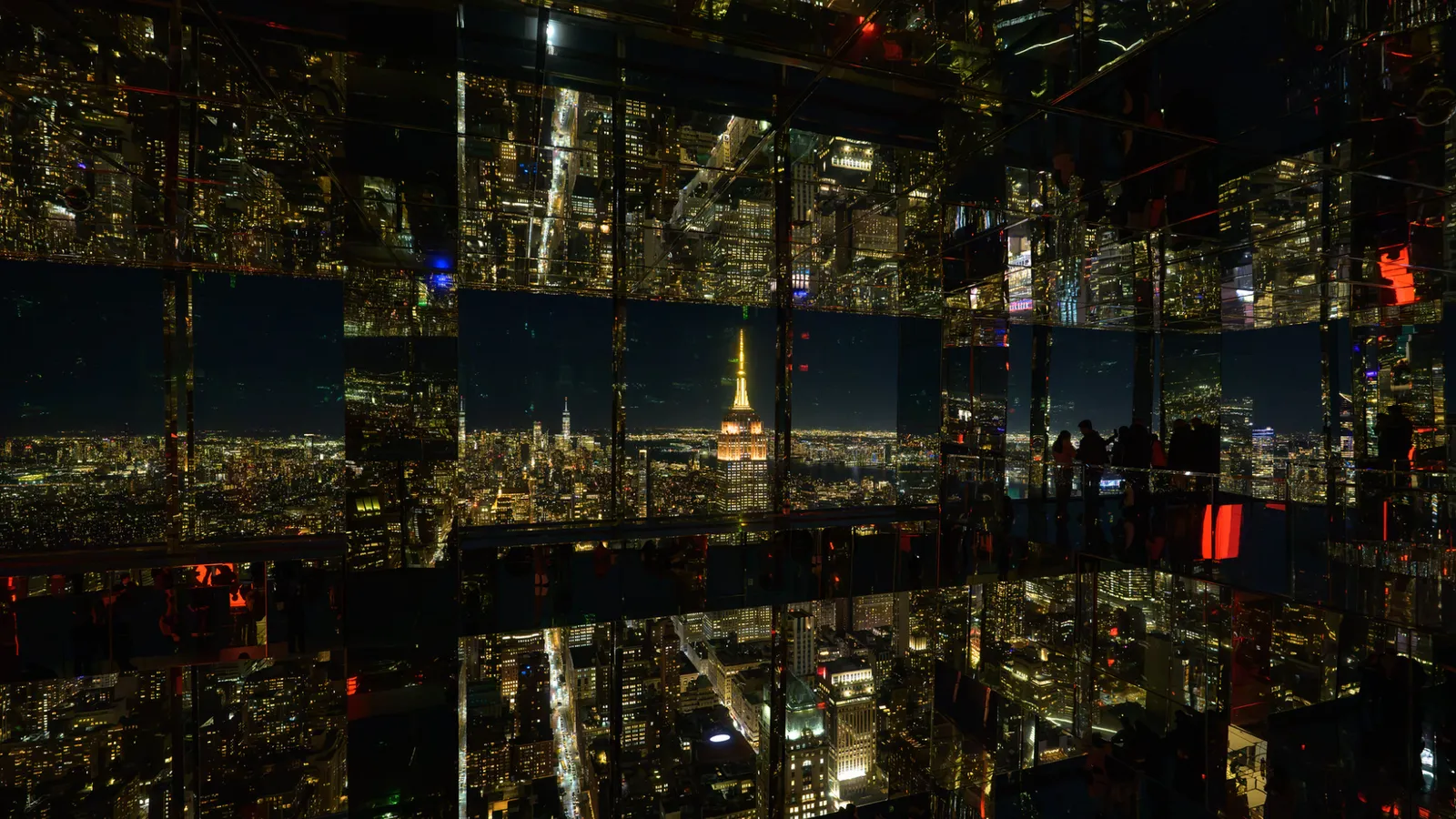
NASA's Voyager 1 reached one light-day from Earth at 5:16 a.m. EST on Nov. 18, roughly 16 billion miles away, and the Empire State Building, the Space Needle, the Willis Tower and the Skydeck Chicago all glowed gold in tribute to the Golden Record it carries. For decision-makers, the milestone is a case study in long-horizon bets, delayed feedback, and how a physics fact becomes a global marketing moment.
At 5:16 a.m. EST on Nov. 18 (1016 GMT), NASA's Voyager 1 crossed a line no human-made object has crossed before: one light-day from Earth. That is about 16 billion miles, or roughly 26 billion kilometers, of nothing. The number sounds like trivia. It is not. One light-day means a single particle of light needs a full 24 hours to travel between us and the spacecraft. So every command we send now takes a day to arrive, and every signal Voyager 1 sends back takes a day to reach us. A message written this morning lands tomorrow. Its answer arrives the day after. Voyager 1 has stopped being something we talk to in real time. It has become something we write letters to.
The celebration was visible from the street. On the night of Nov. 17, the Empire State Building in New York City glowed in gold. The color was not decorative. It points to the Golden Record, the gold-plated disc bolted to both Voyager 1 and Voyager 2. New York was not alone. The Space Needle in Seattle, Washington, plus the Willis Tower and the Skydeck Chicago in Chicago, Illinois, were all illuminated gold for the same occasion. The shot of the Empire State Building's tribute was taken from SUMMIT One Vanderbilt in New York City and credited to NASA photographer Bill Ingalls.
Strip away the ceremony and this is a communications milestone, not just a distance record. When the round trip stretches to two days, the operating model changes completely. You cannot steer by feel. You write instructions, you wait, you read the answer, and you live with the delay. That is the same discipline any operator faces with a remote asset: offshore crews, satellites, deep-sea rigs, a warehouse on another continent. Latency forces you to plan in batches and to trust people you cannot reach in the moment. Voyager has been running that playbook longer than most companies have existed.
Then there is the gold itself, and the object it honors. The Golden Record serves as an inanimate ambassador for Earth, carrying information about humanity, our planet, the other species who live here, the languages we speak, the music we listen to, and much more. It even includes instructions for building a record player to play it. That last detail is the whole point: the record was designed for a reader who may not share our physics, our alphabet, or our idea of a machine. It is a message built to be legible to a stranger with no context, which is a harder design problem than most product teams ever attempt.
The Voyager mission has made, and continues to make, scientific discoveries and observations throughout our solar system and now in interstellar space. Voyager 1 launched in 1977, built for a tour of the outer planets, and it is still transmitting from beyond the heliosphere. Both Voyager 1 and Voyager 2 carry the Golden Record. So the same hardware that delivered planetary science for decades now also carries the only physical artifact of human civilization that has a chance of outliving the planet that made it. One mission, two jobs, and a return curve that keeps bending upward nearly five decades after launch.
That is the part worth stealing. Most institutions optimize for the next quarter, the next board meeting, the next earnings call. Voyager's operators inherited a bet made by people who never expected to see the payoff. The spacecraft is still generating firsts because someone funded a program long enough for compounding to do its work. Boards talk constantly about long-term thinking. This is what it actually looks like on a Tuesday morning at 5:16 a.m., when a probe 16 billion miles away quietly becomes the first thing humans have ever put a full light-day from home.
The landmark lightings deserve a second look too. Four major buildings turned gold in one night, and the cost to NASA was close to zero. The Empire State Building, the Space Needle, the Willis Tower and the Skydeck Chicago converted an abstract physics threshold into something a person walking down the street could see and photograph. That is a masterclass in earned distribution: give people a symbol they can stand in front of, and they will do the amplifying for you. Any organization with a milestone worth marking should study the mechanics. The building does the marketing. The story does the rest.
For founders, operators, and investors, the lesson is uncomfortable and simple. Voyager 1 did not reach a light-day because of one brilliant decision. It got there because a long series of people kept the lights on for something whose payoff was decades away, and because the system was designed to keep working when nobody could reach in and fix it. Build at least one thing with that shape: a program, a product, a piece of infrastructure that outlasts the launch window and the people who signed off on it. Then, when it hits its milestone, light up a building.
This story's Key Insights and Take-aways are locked.
Create a free account to unlock Executive Actions for one credit.
Register to UnlockAlways free for Executives Club members. Join the Club
More in Science

Anthropic's I.P.O. Made Rank-and-File Researchers Worth Tens of Millions
Researchers who joined just a few years ago are now worth tens of millions, and the windfall resets the pay benchmark for every private A.I. lab still paying in paper.

Sea Lion Culling Strategy Fails: New Model Says Killing Them Won't Save Salmon
The latest research from AAAS overturn a long-held conservation assumption, forcing policymakers to rethink critical resource allocation in marine ecosystems.

Microplastics do more than pile up: they react with water to damage cells
Scientists have found that plastic particles can generate highly reactive molecules in water, a mechanism that could explain links to heart attacks, strokes, and neurological disorders.