
Voyager 1 nears one light-day out, and the Empire State goes gold
A 1977 spacecraft is about to become the first human-made object to sit a full light-day from Earth, and the gold light over Manhattan is a lesson in latency, autonomy, and building things that outlast their makers.
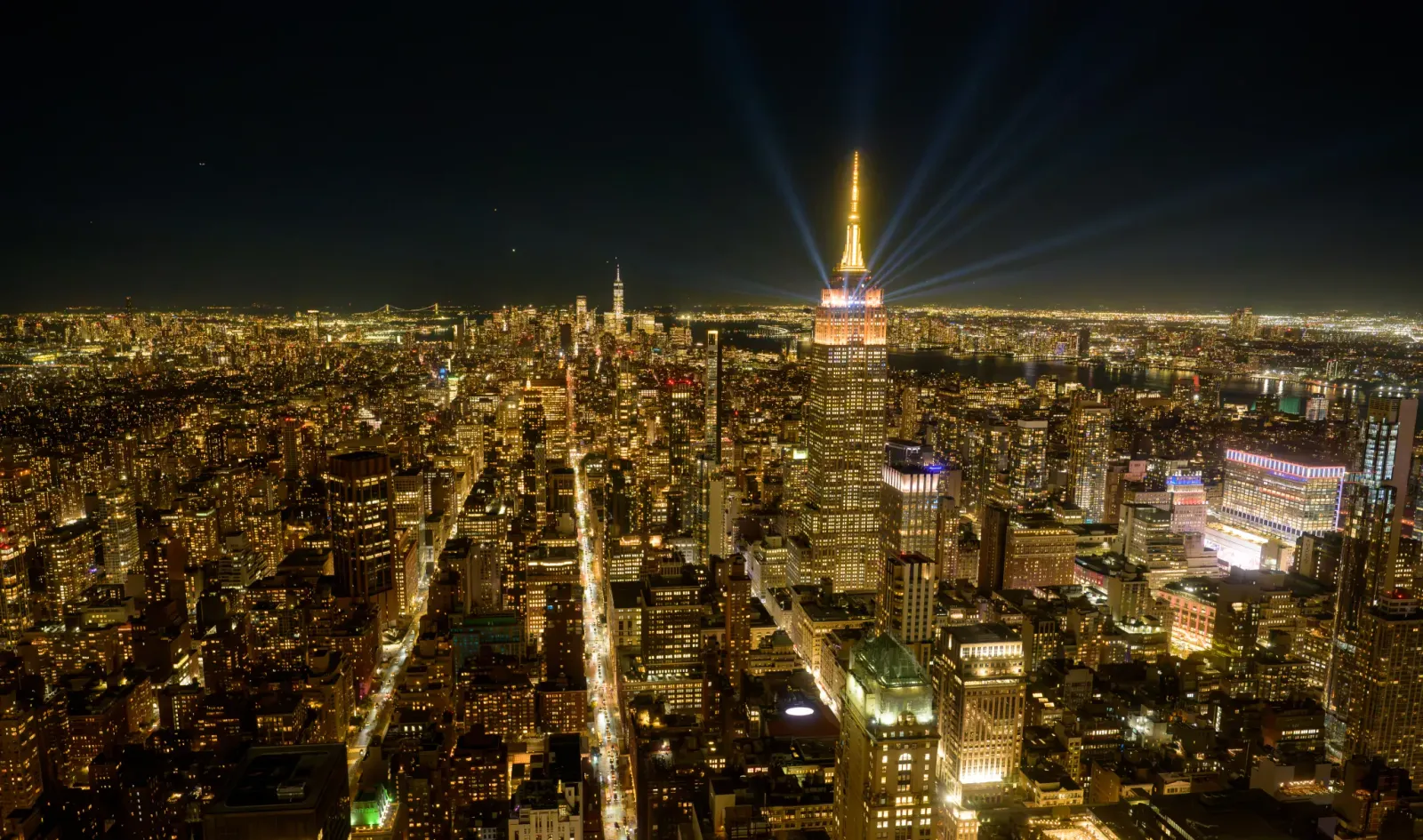
NASA marked Voyager 1's approach to one light-day from Earth on Nov. 17, 2026 by lighting the Empire State Building gold, a nod to the gold-plated copper Golden Record the spacecraft carries. For operators and boards, the milestone is a case study in running an asset so remote that every command takes two days to round-trip, and in why the longest-lived systems are designed for autonomy and legibility rather than hands-on control.
On Nov. 17, 2026, the Empire State Building was lit gold, and the reason sat roughly 25.9 billion kilometers away. NASA marked the moment Voyager 1 was about to pass one light-day from Earth, a distance no other human-made object has ever reached. The gold was not decorative: it matches the gold-plated copper phonograph record flying aboard the spacecraft, the Golden Record, which carries sounds and images selected to portray the diversity of life and culture on Earth. The photograph is credited to NASA's Bill Ingalls. One landmark, one 1977 machine, and a gap between them that light itself needs a full day to cross.
A light-day is exactly what it sounds like: the distance light covers in 24 hours, about 25.9 billion kilometers, or 16.1 billion miles. Put it in units a comms team would recognize. Sunlight reaches Earth in roughly eight minutes. A signal from Voyager 1 now takes a full day to arrive, which means a round trip is two days. There is no joystick for this mission and there never could be. Every command is written, checked, uploaded, and then waited on. If something goes wrong out there, the spacecraft has to notice it, decide what to do, and act, all before anyone on Earth hears about it.
Voyager 1 launched in 1977, the same year the Apple II went on sale and the first Star Wars film opened. For context, it crossed into interstellar space in 2012 and has kept transmitting since, on a signal that arrives at Earth extraordinarily faint by the time it reaches the antennas listening for it. Its power supply decays a little every year, which turns every instrument into a budget line: keep it running and spend the watts, or shut it down and save them. That is a 49-year-old asset still producing data, still making news, and still, apparently, worth lighting a skyscraper for.
The operational lesson is blunt. At one light-day of separation, latency stops being a nuisance and becomes the architecture. You cannot troubleshoot in real time, so you build systems that troubleshoot themselves. You cannot improvise, so you pre-commit decision rules and encode them. Any operator running infrastructure in a remote region, a plant on the far side of the world, or a fleet of autonomous anything faces a milder version of the same constraint: the further an asset sits from the person who understands it, the more the design has to carry the judgment.
Then there is the Golden Record itself, the gold-plated copper disc that gave the Empire State Building its color. Its contents were chosen to portray the diversity of life and culture on Earth for an audience with no shared language, no shared history, and no way to ask a follow-up question. That is the hardest brief in communications, and it is not so different from the one a founder faces pitching an investor who has never seen the category, or an operator writing documentation for a colleague who joins in three years. Legibility to a stranger is a design problem, not a marketing one.
The lighting is also a small case study in attention economics. A landmark goes gold, a photographer files the frame, and a distance record becomes a story people share. The marginal cost of the gesture is trivial next to the reach it generates, because the asset doing the work, the building, already exists and the underlying story is genuinely remarkable. Companies spend enormous sums manufacturing moments like this. NASA got one by pointing at something true.
The harder question is the one boards actually argue about. Voyager 1 has been funded across five decades, multiple administrations, and countless budget cycles, and its returns are scientific and cultural rather than quarterly. Most public companies cannot underwrite a 49-year program, and most private ones cannot either. What they can do is notice which of their own assets are built to compound slowly: the documentation, the standards, the infrastructure, the reputation. Those are the things that keep transmitting after the people who built them have moved on.
So the gold light over Manhattan is more than a nice photo. It is a reminder that the longest-lived things humans make are usually the ones designed with an unknown reader in mind, whether that reader is a future engineer, a future customer, or something that will never answer back. Voyager 1 will keep drifting, the distance will keep growing, and at some point the signal will stop. Until then, the useful question for anyone building something meant to last is simple: if the only thing that survived was your work, and it arrived a day late, would it still make sense?
This story's Key Insights and Take-aways are locked.
Create a free account to unlock Executive Actions for one credit.
Register to UnlockAlways free for Executives Club members. Join the Club
More in Science

Anthropic's I.P.O. Made Rank-and-File Researchers Worth Tens of Millions
Researchers who joined just a few years ago are now worth tens of millions, and the windfall resets the pay benchmark for every private A.I. lab still paying in paper.

Sea Lion Culling Strategy Fails: New Model Says Killing Them Won't Save Salmon
The latest research from AAAS overturn a long-held conservation assumption, forcing policymakers to rethink critical resource allocation in marine ecosystems.

Microplastics do more than pile up: they react with water to damage cells
Scientists have found that plastic particles can generate highly reactive molecules in water, a mechanism that could explain links to heart attacks, strokes, and neurological disorders.