
Webb catches a star 350 times the sun's width devouring its companion
Astronomers led by Columbia's Viraj Karambelkar say the Andromeda event nicknamed Bao is the first direct sighting of a merger theorists predicted for decades, though they cannot yet rule out that both stars survived.
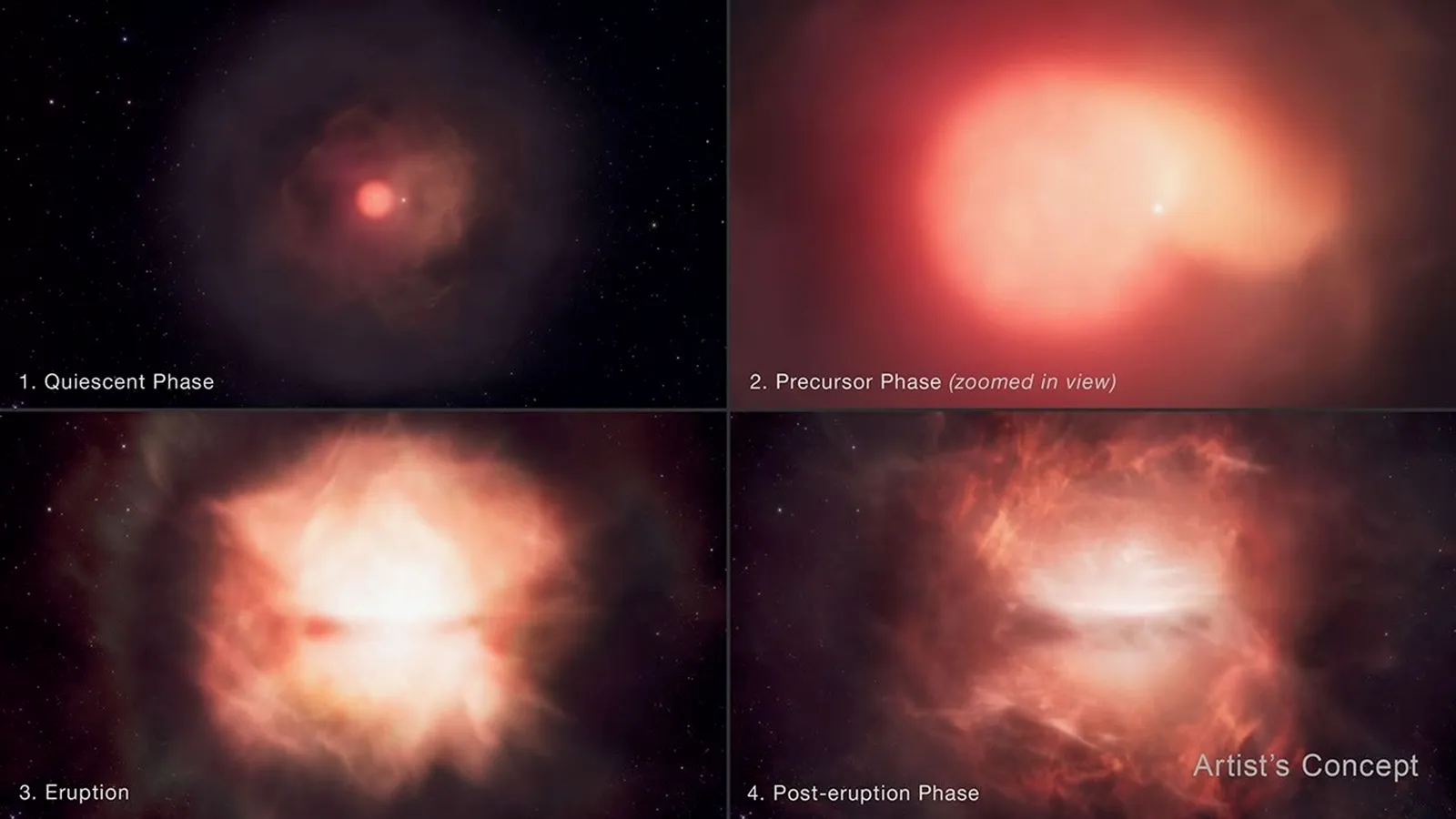
Astrophysicist Viraj Karambelkar of Columbia University and colleagues report in the journal Nature that they watched a red giant in the Andromeda galaxy, nicknamed Bao, engulf a companion star, the first direct observation of a process theorized for decades. For decision-makers, the finding shows how long-baseline monitoring plus one precisely timed observation can convert a decades-old theory into evidence, a template the coming survey telescopes are built to industrialize.
A dying star roughly seven times heftier and 350 times wider than our sun has been caught in the act of swallowing its companion, and astronomers say it is the first direct look at a merger they had only ever modeled on paper. The red giant, designated WNTR23bzdiq, sits about 2.5 million light-years away in the Andromeda galaxy. The binary system it belongs to has been nicknamed Bao. The work, led by Viraj Karambelkar, an astrophysicist at Columbia University in New York, was detailed Nov. 18 in the journal Nature.
The clinching evidence landed in December 2025, when NASA's James Webb Space Telescope observed the star just 47 days after a giant eruption of light. That narrow window let the team reconstruct what happened before, during and after the merger. Their conclusion: a companion star about 70% the mass of our sun rammed into the giant's heart. "I was absolutely flabbergasted when we saw this," Karambelkar said.
This is not a thing the sky gives up easily. "Catching a star engulfing its companion in the act is very difficult," Karambelkar told Space.com. "When a star engulfs its companion, its effect is very subtle - like throwing a bucket of water in a large ocean. We need sensitive telescopes monitoring the sky for a long time in order to catch this effect." For context, dying stars of this type are understood to swell to hundreds of times their original size, consuming anything orbiting nearby. In a binary system, that can mean the dying star merging with its companion. The signal is not a bang you notice in a single night; it is a slow brightening spread across years, which is precisely why nobody had caught one before. Andromeda, for context, is the Milky Way's nearest large galactic neighbor, which is part of why it is such a well-watched patch of sky.
The trail was long and mostly archival. In 2023, using NASA's now-defunct NEOWISE space telescope and the WINTER telescope at Palomar Observatory in California, the scientists noticed the star was brightening. Digging through earlier records, they found the red giant had gradually started growing more luminous back in 2018. The team had previously suggested the brightening came from the giant engulfing a companion: as that companion spiraled toward the giant's core, it would generate friction, heat and light, explaining the rising luminosity. Two instruments, one of them already retired, plus a stack of old measurements, is what turned a hunch into a hypothesis worth chasing.
Then, near the end of 2025, came the eruption. Webb's observation 47 days later let the researchers characterize the event in detail, and they now propose the explosion happened when the companion, about 70% of the sun's mass, hit the giant's core. The eruption expelled material equal to roughly 0.1 to 0.2 times the mass of the sun. "Stars engulfing their companions have been theorized for many decades, and this event provides the first observations of this theoretical prediction," Karambelkar said.
Karambelkar is careful not to oversell it. The findings suggest two stars merged into one, but "it is not the only possibility," he said. "The other possibility is that both stars survived, in a much shorter orbit. In order to conclusively determine what happened, we need to continue monitoring what the system does, once the heft of the eruption settles down." That is notable scientific hygiene: the first-of-its-kind claim ships with an explicit rival hypothesis attached, and the only way to settle it is more watching.
More are coming. "Now that astronomers may have found the first such merger, I can't wait to find more," Karambelkar said. "Upcoming telescopes like the Nancy Grace Roman Space Telescope and the Vera Rubin Observatory will be very useful in discovering many more such events."
Why this matters beyond the astronomy: the discovery was not one lucky snapshot. It was years of brightness records, a survey telescope that no longer exists, a working instrument at Palomar, and one precisely timed Webb observation, stitched into a single story. That is the operating model the next generation of sky surveys is built to scale. Rubin and Roman are designed to watch enormous swaths of sky repeatedly, turning rare, faint, slow-burning events from accidents into a pipeline. For a field that has theorized this process for decades without a single direct sighting, the payoff is a method as much as a result. The same logic travels well outside astrophysics: the value of a signal often depends on how long you have been watching and on whether you kept the old data. Bao is what that looks like when it works.
This story's Key Insights and Take-aways are locked.
Create a free account to unlock Executive Actions for one credit.
Register to UnlockAlways free for Executives Club members. Join the Club
More in Science

Anthropic's I.P.O. Made Rank-and-File Researchers Worth Tens of Millions
Researchers who joined just a few years ago are now worth tens of millions, and the windfall resets the pay benchmark for every private A.I. lab still paying in paper.

Sea Lion Culling Strategy Fails: New Model Says Killing Them Won't Save Salmon
The latest research from AAAS overturn a long-held conservation assumption, forcing policymakers to rethink critical resource allocation in marine ecosystems.

Microplastics do more than pile up: they react with water to damage cells
Scientists have found that plastic particles can generate highly reactive molecules in water, a mechanism that could explain links to heart attacks, strokes, and neurological disorders.