
Webb catches first live star merger: one star swallowed its neighbor
Astronomers confirmed the first real-time stellar merger, a supergiant in Andromeda that absorbed a sun-like companion in under seven years and survived.
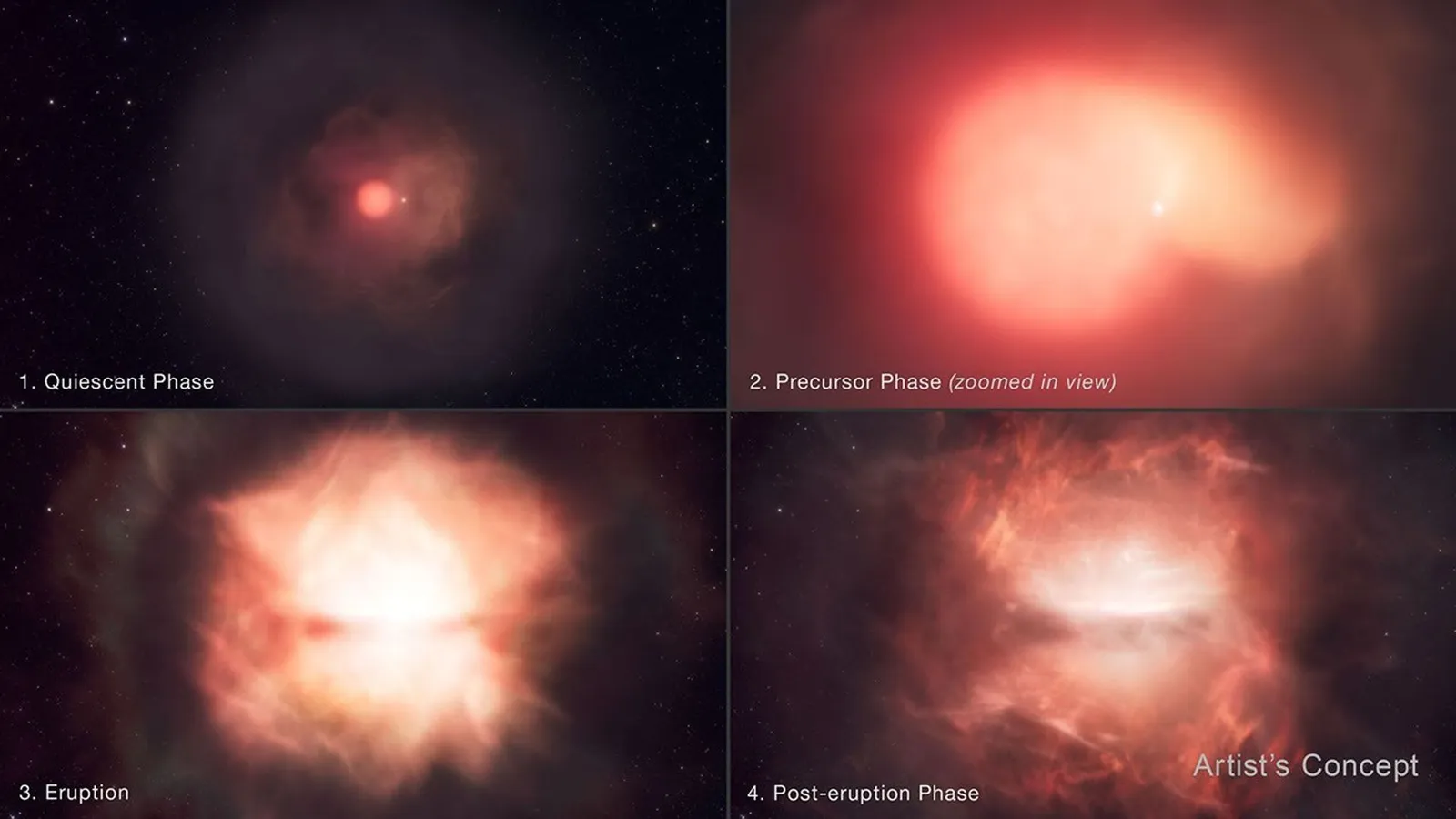
Columbia astrophysicist Viraj Karambelkar and co-author Kishalay De used NASA's James Webb Space Telescope to confirm the first real-time stellar merger, a supergiant in Andromeda swallowing a smaller companion in under seven years. The result gives astronomers a rare clock for common envelope evolution and a template for spotting future mergers with NASA's Roman Space Telescope.
For the first time, astronomers have caught two stars in the act of merging: a supergiant and a star slightly smaller than the sun. The pair orbited each other for thousands of years, then came together in just under seven years, a span short enough for researchers to watch from start to finish. The discovery was described in a study published Nov. 18 in the journal Nature. Viraj Karambelkar, an astrophysicist at Columbia University and first author of the study, said in a NASA statement: "Stellar mergers are very, very difficult to observe in real time because they are hard to predict." He added: "However, we noticed something unusual was going on in 2023 and continued to monitor the system to see what it would do."
The drama unfolded next door, in the Andromeda galaxy, the closest major galaxy to ours. The stars' imminent merger was originally picked up by NASA's now-retired Near-Earth Object Wide-Field Infrared Survey Explorer, a spacecraft designed to spot asteroids but also discovered many other interesting changes in the night sky. Researchers noticed that a previously stable binary star system in Andromeda had begun to brighten. Follow-up observations from the Wide-Field Infrared Transient Explorer, a near-infrared instrument at the Palomar Observatory in California, revealed that the galaxy had also started spewing dust. Karambelkar's team backed up those observations with data from the James Webb Space Telescope in December 2025. They dubbed the binary pair "Bao" after its formal name, AT 2025abao, and started keeping tabs.
What they found was a countdown. Sometime in 2018, the smaller component of Bao bumped into the surface of the supergiant Bao. From there, things escalated quickly. The stars started exchanging gas in a process known as common envelope evolution. The larger Bao dragged its smaller companion closer and closer, until it was finally sucked into the supergiant's core, releasing a gigantic burst of energy. Study co-author Kishalay De, an astronomer at Columbia University, said in the statement that this dramatic culmination was "almost like a bomb exploding inside a living star."
The researchers were surprised by not only the speed of this interaction but also its outcome. Bao could have easily exploded into a supernova, transformed into a neutron star or collapsed into a black hole. Instead, it seems to have settled back into a single massive star. That survival is the twist. A merger that looked like a bomb going off inside a living star did not destroy the star. It rejuvenated it, at least for now. Future observations will give scientists a sense of how the new, rejuvenated Bao is holding up after its act of cosmic cannibalism.
Why does this matter beyond one weird star? Common envelope evolution is a known phase in binary star systems, but catching it in real time is rare. Astronomers typically have to reconstruct past mergers from after-the-fact clues. Bao gives them a live case study, with a start date, a duration, and a survivor. The team's analysis could also help inform future studies of supergiant stars and binary systems. Getting a clearer picture of how common envelope evolution works could allow astronomers to reconstruct how previous mergers went down.
The discovery also shows how scientific value can come from instruments built for something else. NEOWISE was designed to spot asteroids, yet it flagged the brightening that led to this result. JWST, built as a general-purpose infrared observatory, provided the follow-up data. Palomar's near-infrared instrument caught the dust. That chain of old survey, new follow-up, and space telescope is likely to become more common. Karambelkar predicts Bao will be far from the last merging stars scientists spot, thanks to NASA's new Nancy Grace Roman Space Telescope.
For leaders watching the space economy, the lesson is not just about stars. It is about optionality. A retired asteroid hunter became the first alert. A general-purpose telescope became the closer. A predicted rarity became a confirmed event because someone kept monitoring. The same pattern shows up in tech, finance, and biotech: the asset you built for one mission can surface the signal that matters in another. The question is whether your organization has the follow-up capacity to act when the anomaly appears.
The stakes for astronomy are straightforward. If Roman can find more mergers, researchers can move from one-off stories to a statistical sample. That could sharpen models of how massive stars live, pair up, and end. It could also help explain why some binaries merge quietly while others explode. Bao is the first live look, but it is probably not the last. The next step is to watch the new star and see whether its act of cannibalism leaves lasting scars.
This story's Key Insights and Take-aways are locked.
Create a free account to unlock Executive Actions for one credit.
Register to UnlockAlways free for Executives Club members. Join the Club
More in Science

Anthropic's I.P.O. Made Rank-and-File Researchers Worth Tens of Millions
Researchers who joined just a few years ago are now worth tens of millions, and the windfall resets the pay benchmark for every private A.I. lab still paying in paper.

Sea Lion Culling Strategy Fails: New Model Says Killing Them Won't Save Salmon
The latest research from AAAS overturn a long-held conservation assumption, forcing policymakers to rethink critical resource allocation in marine ecosystems.

Microplastics do more than pile up: they react with water to damage cells
Scientists have found that plastic particles can generate highly reactive molecules in water, a mechanism that could explain links to heart attacks, strokes, and neurological disorders.