
A 6-million-year-old whale may have the most lopsided face in mammal history
Peru's Scaphokogia huachafo was so distorted that researchers first blamed post-mortem damage; the revision turns a broken skull into a seafloor hunting tool.
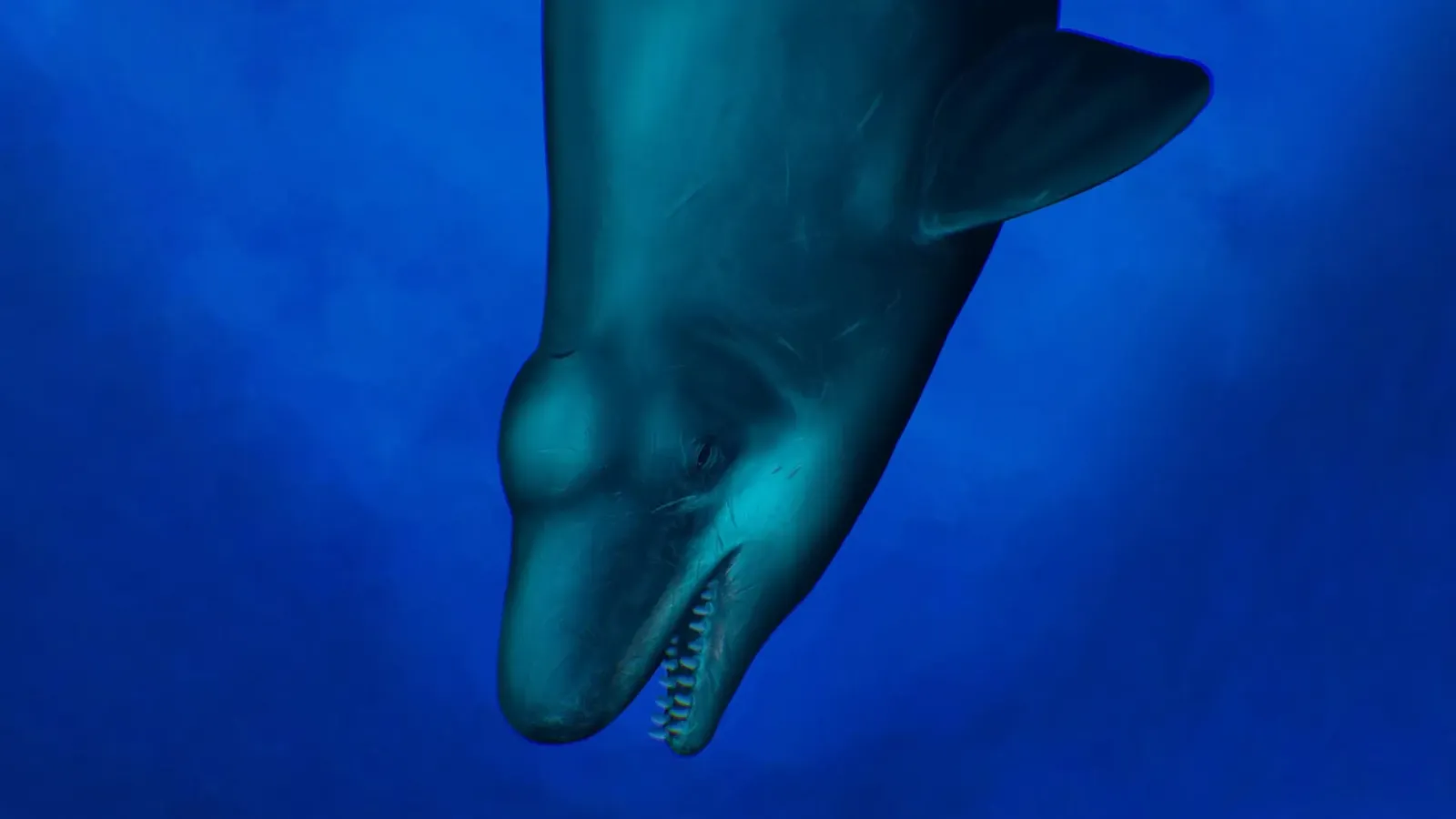
Researchers studying the extinct pygmy sperm whale Scaphokogia huachafo, discovered in Peru and roughly 6 million years old, concluded that its extreme facial asymmetry was not post-mortem damage but an extraordinary evolutionary adaptation for hunting along the seafloor. For decision-makers, the case is a sharp reminder that outliers filed as defects are often functional signals that were never asked the right question.
Roughly 6 million years ago, a small whale swam in the waters off what is now Peru with a face so crooked that the scientists who pulled its skull out of the ground assumed something had crushed it. It had not. The extinct pygmy sperm whale Scaphokogia huachafo carried an enormous downward-curving snout and a skull so distorted that researchers initially thought it had been damaged after death, the ordinary wear that fossil bone collects over millions of years. Then they looked again and landed somewhere far stranger: this may be the most asymmetrical face of any mammal ever documented. Not the largest. Not the oldest. The most lopsided.
Two things make that claim land. The first is the setup: roughly 6 million years ago, in Peru, in a marine world that no longer exists. The second is the reversal. The distortion is not a burial accident. It appears instead to have been an extraordinary evolutionary adaptation for hunting along the seafloor. A skull that read as broken was, in fact, a piece of equipment.
For context, the pygmy sperm whales alive today are small, deep-diving hunters, a long way from the blockbuster sperm whale of Moby Dick fame. They are the sort of animal that spends its life in dim water working for squid, and they sit on the same broad branch of the toothed whale family tree as Scaphokogia huachafo. That lineage is ancient and durable. This particular form is not: it has been extinct for about 6 million years.
Now, no toothed whale is perfectly symmetrical. Their skulls typically lean, with the blowhole set off center, a quirk tied to how they generate and aim sound underwater. Extreme asymmetry is a different matter. A face bent that far past the norm is the kind of thing that usually signals injury, disease, or a bad reconstruction. That is exactly why the first diagnosis of post-mortem damage was reasonable, and why the revision is worth paying attention to.
The working explanation is functional: the shape paid for itself. A snout that curves steeply downward points at the sediment, and for an animal hunting along the seafloor, the front of the head is a probe as much as a nose. Asymmetry can also shape how sound is produced and directed, which matters enormously for a hunter that likely relied on echolocation rather than sight in murky water. Nature rarely hands out this kind of weirdness for free. It hands it out when a narrow, specific job rewards it.
There is a trade-off hiding in that logic. Evolutionary history is full of animals that specialized hard and then vanished when the niche they had overfit to shifted underneath them. Scaphokogia huachafo is extinct, and its surviving relatives are small, cryptic animals that most people will never see. A crooked face tuned for one kind of hunting is an advantage right up until the seafloor changes, the prey moves, or the water does. Specialization buys performance and sells resilience. That is a deal every operator, and every species, eventually has to price.
Which brings the story to the part that outlives the whale. The most interesting thing here is not the snout. It is the first mistake. Researchers looked at an extreme outlier and filed it under damage, which was the sensible move and, in this case, the wrong one. Fossil collections historically hold plenty of specimens written off as broken, crushed, or poorly preserved, and some of those judgments were made before anyone asked what the odd shape would have been good for. Anomalies get dismissed as noise until someone treats them as signal. That is true in a museum drawer and equally true in a quarterly dataset.
There is a practical edge too. For decades, engineers have been trying to build underwater sensors that work the way animal sonar does, and the design lesson from a face like this is that asymmetry is not automatically a defect to be corrected. For hardware that has to perform in one specific environment, a one-sided, environment-tuned design can beat a balanced generalist. That is a design philosophy rather than a finding from this fossil, but the fossil is a useful reminder that the strategy has been field-tested for millions of years.
The strategic stakes come down to how you read your own outliers. Every organization has a Scaphokogia: the metric that will not behave, the customer whose behavior makes no sense, the feature nobody requested that a small group uses obsessively. The default move is to call it damage and move on. The whale suggests the alternative: ask what job the weirdness is doing before you write it off, and only then decide whether to fix it or fund it. Six million years after it died, Scaphokogia huachafo is still making that argument, and it has a very crooked face to make it with.
This story's Key Insights and Take-aways are locked.
Create a free account to unlock Executive Actions for one credit.
Register to UnlockAlways free for Executives Club members. Join the Club
More in Science

Anthropic's I.P.O. Made Rank-and-File Researchers Worth Tens of Millions
Researchers who joined just a few years ago are now worth tens of millions, and the windfall resets the pay benchmark for every private A.I. lab still paying in paper.

Sea Lion Culling Strategy Fails: New Model Says Killing Them Won't Save Salmon
The latest research from AAAS overturn a long-held conservation assumption, forcing policymakers to rethink critical resource allocation in marine ecosystems.

Microplastics do more than pile up: they react with water to damage cells
Scientists have found that plastic particles can generate highly reactive molecules in water, a mechanism that could explain links to heart attacks, strokes, and neurological disorders.