
Elon Musk hits first-ever $1T status after SpaceX IPO, reshaping billionaire math
The SpaceX IPO propelled Elon Musk into the world’s first trillionaire club, and the capital markets will remember how.

Elon Musk became the world’s first trillionaire following the IPO of SpaceX, according to Forbes Executive Editor Luisa Kroll and Forbes Reporter Matt Durot on Forbes Talks. For decision-makers, it signals how scaling, liquidity events, and investor expectations can rewrite valuations overnight.
On Forbes Talks, Forbes Executive Editor Luisa Kroll and Forbes Reporter Matt Durot discuss the moment Elon Musk crossed a line the world has never seen before: he became the world’s first trillionaire after the IPO of SpaceX. That is the headline reality. But the more interesting part is what it says about how the modern market builds, validates, and then multiplies value.
The trigger, per the discussion, is the SpaceX IPO. An IPO is not just a new ticker symbol, it is a public market stamp of approval. Before that kind of liquidity event, SpaceX’s value lived largely in private funding rounds and investor expectations. After an IPO, the company’s perceived value and market capitalization become visible to everyone, including institutions that move slow but manage huge pools of capital. When a founder’s stake is big enough, a shift from private valuation logic to public market pricing can turn a “someday” narrative into a number you can’t hide from.
For executives and boards, this matters because it changes the bargaining chips around ownership and timing. In private markets, valuations can grow in stair-steps fueled by strategic conviction and repeat investor participation. But those valuations are still negotiated. Public markets, by contrast, force a constant negotiation with reality. Investors can compare growth rates, margins, and risk profiles across the entire exchange universe. They can also price uncertainty every day, not just when a new round closes. That difference is what makes a trillionaire moment possible off one discrete event: the IPO converts private optimism into a market-determined figure.
There is also a governance and incentives angle that usually gets under-discussed until it becomes enormous. When a company goes public, directors and executives inherit additional layers of scrutiny: disclosure requirements, reporting cycles, and a shareholder base that expects accountability. For founders like Musk, liquidity events can increase bargaining power, but they can also tighten constraints. Once billions of dollars of wealth are tied to public pricing, stakeholder attention rises, and with it the pressure to defend narratives with performance. The Forbes Talks framing centers on the outcome after SpaceX’s IPO. The second-order effect is that the market will now measure not just the company, but the credibility of the founder’s long-term bets.
Regulation is the less glamorous sibling of all this, but it is always in the room when an IPO changes lives. Public listings are not just “how founders cash out.” They are also how regulators and exchanges establish rules for transparency, trading, and investor protections. Even when the underlying technology and operating plan are moving fast, the IPO route demands disclosure discipline. That discipline can create friction, but it also creates confidence for capital allocators who need standardized information to make decisions at scale. When the market then prices the company in a way that elevates the founder to the first trillion-dollar tier, it is effectively the culmination of that regulatory pathway plus the company’s ability to meet public-company expectations.
Now zoom out to why peers should care. Musk becoming the world’s first trillionaire after the IPO of SpaceX is not only a human-interest milestone. It is a proof point about what public capital can do when it believes in a growth engine and when liquidity arrives at the right moment. For CEOs planning fundraising, board members guiding go-to-market and capital structure choices, and CFOs thinking about timing and shareholder outcomes, this is a reminder that valuation shocks can be tied to discrete market events, not only to quarterly operating performance. An IPO can re-rate an entire story, and that re-rating can cascade into founder wealth, employee expectations, and the investor class that follows.
In other words, the Forbes Talks takeaway is the moment itself. But the operational lesson is in the mechanics: IPO liquidity can turn private valuation into public price discovery, and public price discovery can create outcomes that redefine what “possible” looks like for the market. Executives in high-growth sectors will watch this closely, not to chase the exact number, but to understand the leverage points that make it attainable: scale, investor belief, and the timing of when the company becomes legible to the biggest pool of capital on earth.
This story's Key Insights and Take-aways are locked.
Create a free account to unlock Executive Actions for one credit.
Register to UnlockAlways free for Executives Club members. Join the Club
More in Business

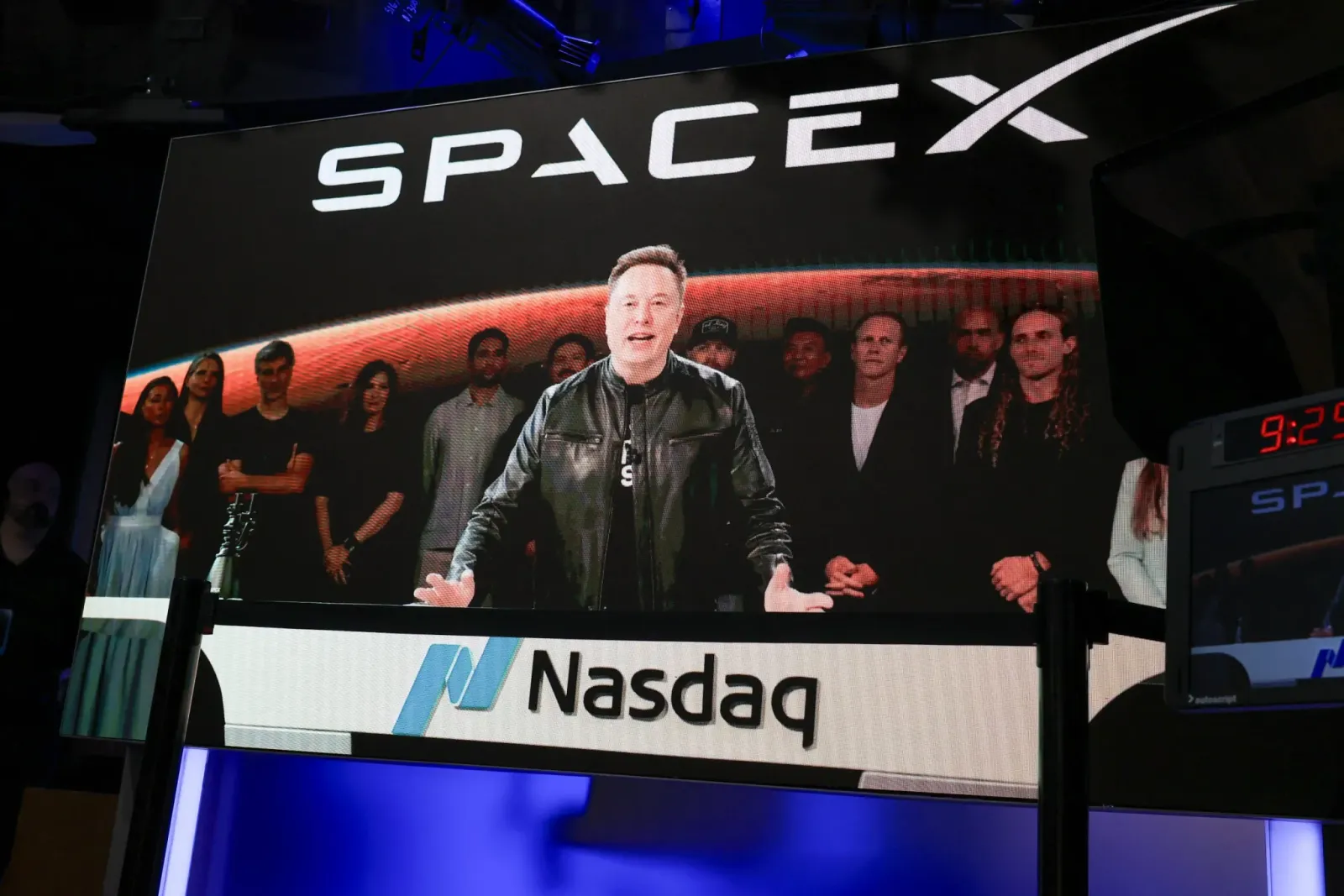
SpaceX debuts Friday on Nasdaq at $135, surges to $160.95, valued near $1.8T
A Nasdaq opening pop turns SpaceX into a public company overnight, forcing new money questions fast.
Elon Musk became the world’s first trillionaire after SpaceX IPO lifted him past $1T
SpaceX shares jumped, and Musk’s $800B pre-IPO value crossed a trillion, reshaping how investors price “moonshots.”
SpaceX stock closes at $161.11 after $2.1T debut valuation shatters expectations
The IPO priced at $135, surged on Nasdaq and Texas, and immediately rewired how executives think about mega-debuts.