
Two NASA Mars Missions Halt Science at Once, and One May Have Weeks Left
Perseverance has lost both UHF radios and Odyssey is down to two working reaction wheels, leaving NASA's Mars relay network thinner than it has been in years.
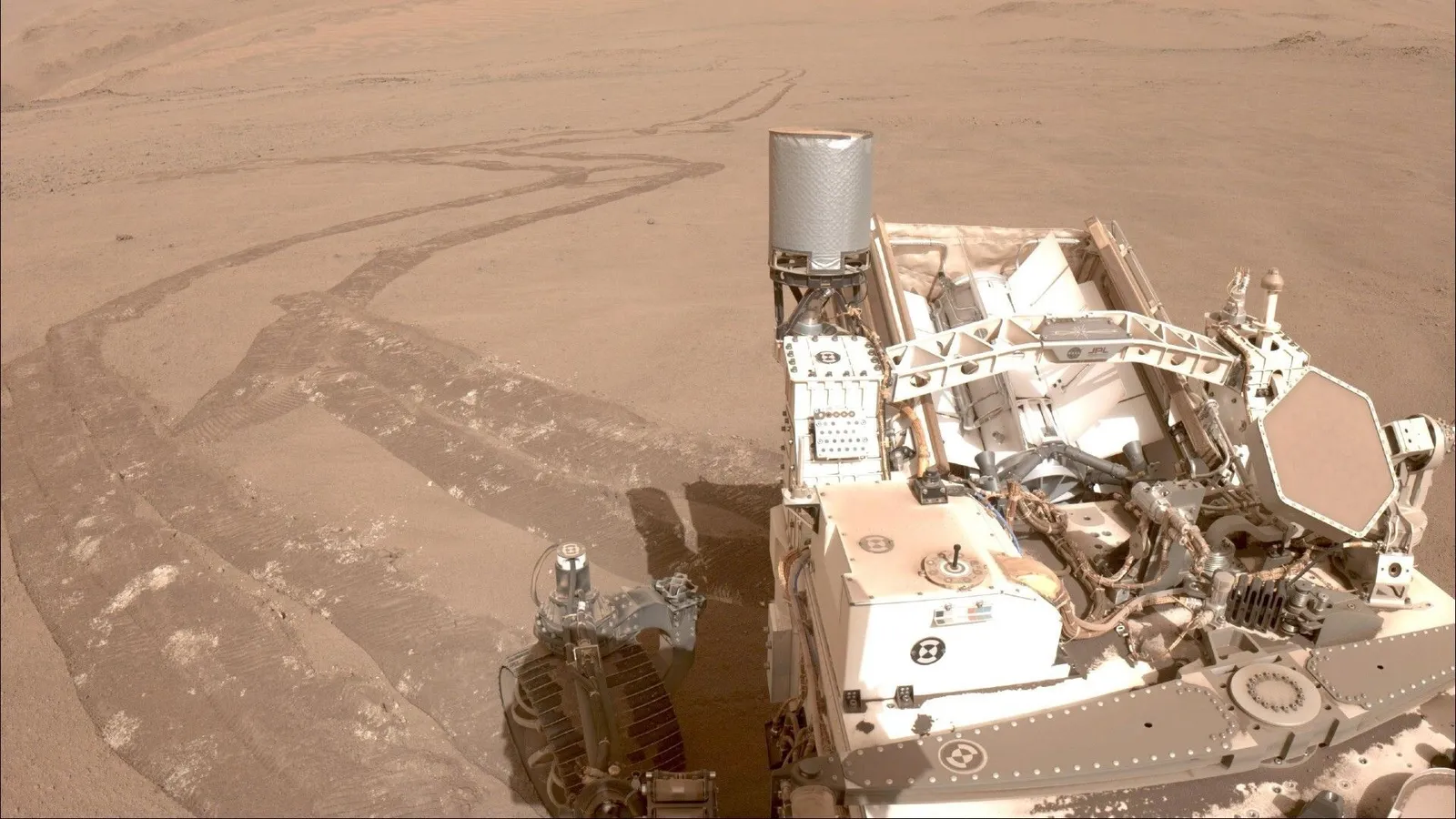
NASA announced Thursday (Nov. 19) that its Perseverance rover and Mars Odyssey orbiter have both stood down from science work, Perseverance from a UHF radio failure and Odyssey from a reaction wheel fault. For anyone running long-lived, hard-to-service infrastructure, the pair of failures is a live test of how much redundancy Mars operations actually have.
Two of NASA's Mars explorers are out of action at the same time. NASA announced Thursday (Nov. 19) that the Perseverance rover and the Mars Odyssey orbiter have both stood down from science work, Perseverance because of an antenna failure and Odyssey because of a balky reaction wheel. The agency says it hopes both can return to work at Mars by the end of November. The stakes are not symmetrical. Perseverance is stable and talking to Earth through a slower backup path. Odyssey, which arrived at the Red Planet in October 2001, is one wheel away from a thruster-only existence, and NASA says it has enough hydrazine fuel left to hold its orientation that way for just a month or two.
The Perseverance failure arrived with almost theatrical timing. On Oct. 11, the car-sized rover set a new distance record for off-Earth driving, rolling past the 28.06 miles (45.16 kilometers) logged by its smaller cousin, NASA's Opportunity rover. Nineteen days later, the mission team noticed that the rover's main UHF downlink radio, the one it uses to send data home via relay satellites in Mars orbit, had stopped sending its usual "heartbeat" pings to the main computer. Perseverance caught the problem on its own and did what it was programmed to do: it switched to its backup UHF radio and dropped into a protective "safe mode," shutting down all non-essential systems. The team pulled it back out, then found a second problem. "The backup UHF radio was transmitting at about half of its expected power output," NASA officials wrote in Thursday's update.
So both radios are now off the table. Perseverance is communicating with Earth directly, without relay orbiters, using its high-gain antenna to reach NASA's Deep Space Network dishes. That path carries lower data rates, and the team wants to spend what bandwidth it has on diagnostics. Science work, including observations by the rover's cameras, is paused. Fans noticed before NASA said anything: the mission website has not posted a new raw image since Nov. 7. NASA's message is calm. "The rover is stable and communicating with the team," officials wrote. "The team is hopeful the rover could return to science by the end of November, and NASA will provide further updates in the future as the team works the issue."
Odyssey's problem may be the more serious of the two. The orbiter carries four reaction wheels, the spinning devices that let a spacecraft hold its orientation without burning fuel. Three of the four must work for that job. Odyssey lost one in 2013. The latest failure surfaced on Nov. 4, when the orbiter went into safe mode and stayed there until Nov. 6 while the team diagnosed the issue. Engineers have made some progress, at one point getting the faulty wheel to move on command. "Further testing is being conducted to confirm whether the wheel is recoverable," NASA officials wrote. Two weeks out of safe mode, Odyssey still has not resumed its science or data-relay work. The goal, per NASA, is to return it to both during the last week of November.
That matters well beyond one spacecraft. Odyssey has operated at Mars longer than any other spacecraft, and it has long served as a communications relay for NASA's surface craft, helping them send information home. Its science record is the reason Mars geologists keep citing it. "Odyssey created the first global maps detailing the composition of the Martian surface, which have become foundational for Mars geologists," NASA officials wrote. Those maps also helped identify hazards at landing sites, spot locations of scientific interest for landers and rovers, and map water molecules in the top 3 feet (1 meter) of the surface, including buried ice that could be useful to the first astronauts on Mars.
If the wheel cannot be recovered, Odyssey's days are numbered. The mission team would have to orient the orbiter using only its thrusters, and NASA says the spacecraft has enough hydrazine left to do that for just a month or two. That is the difference between a graceful retirement and a hard stop, and it lands in the same window as Perseverance's own outage.
Stack the two failures together and a pattern shows up. Perseverance's science payoff, including a wealth of complex organic compounds found in Martian rock, some of which might themselves be signs of life, depends on getting its samples back to Earth for analysis, scientists stress. That return trip depends on relay and communications infrastructure that is now thinner than it was three weeks ago. Odyssey is 24 years into a mission that has outlasted every other spacecraft at Mars. Aging hardware, single points of failure, and a small number of orbiters doing double duty as science platforms and data pipes is a familiar risk profile for anyone running long-lived infrastructure, whether it sits in orbit or in a data center.
The near-term read is simple. NASA expects both craft back by the end of November, and Perseverance's problem looks like a radio issue rather than a rover issue. The longer-term read is that Mars operations now hinge on a handful of aging assets, and the agency is about to find out how much slack the system really has. For operators of any expensive, remote, hard-to-service fleet, the lesson is the one NASA is living through this month: a spare that has never been stress-tested is a spare you cannot count on.
This story's Key Insights and Take-aways are locked.
Create a free account to unlock Executive Actions for one credit.
Register to UnlockAlways free for Executives Club members. Join the Club
More in Science

Anthropic's I.P.O. Made Rank-and-File Researchers Worth Tens of Millions
Researchers who joined just a few years ago are now worth tens of millions, and the windfall resets the pay benchmark for every private A.I. lab still paying in paper.

Sea Lion Culling Strategy Fails: New Model Says Killing Them Won't Save Salmon
The latest research from AAAS overturn a long-held conservation assumption, forcing policymakers to rethink critical resource allocation in marine ecosystems.

Microplastics do more than pile up: they react with water to damage cells
Scientists have found that plastic particles can generate highly reactive molecules in water, a mechanism that could explain links to heart attacks, strokes, and neurological disorders.