
Uragasaurus kalasinensis, Thailand dinosaur, had a neck as long as a cricket pitch
A newly described plant-eater from 150 million years ago adds a fresh data point to dinosaur body-plan diversity.
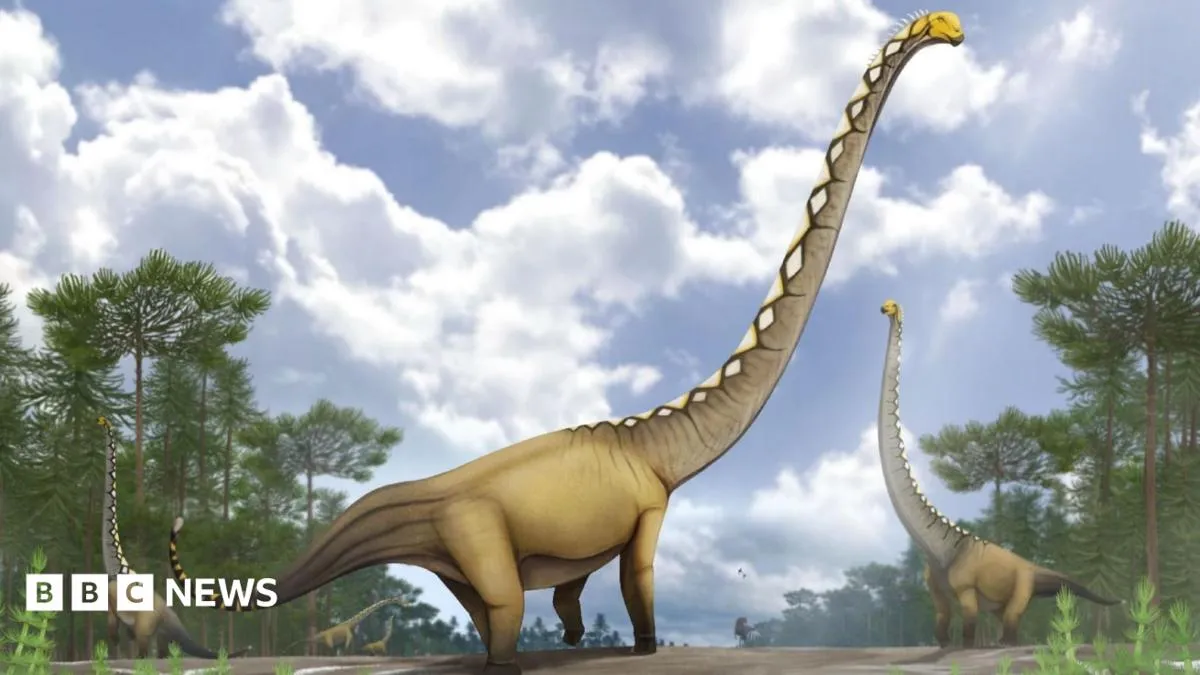
Researchers identified a new plant-eating dinosaur species, Uragasaurus kalasinensis, in Thailand. The discovery dated to about 150 million years ago deepens what we can infer about dinosaur evolution and ecology.
A team studying fossils from Thailand has named a new plant-eating dinosaur species: Uragasaurus kalasinensis. The key detail is its neck length, described as being as long as a cricket pitch, which is the kind of fact that immediately changes how you imagine an animal moving, feeding, and surviving in its environment.
Uragasaurus kalasinensis is thought to have lived about 150 million years ago, placing it firmly in the long stretch of the Jurassic period when dinosaurs were already diversifying across landmasses. That “about” matters. For fossils, precision is often limited by the availability and condition of specimens, and by how scientists correlate layers of rock to deep time. Still, the headline number is clear enough to situate the dinosaur within an era where body shapes and feeding strategies were rapidly exploring different solutions.
Now, why should a discovery like this matter outside of the fossil-hobby universe? Because new species descriptions are not trivia for academia. They are new constraints for how scientists model dinosaur evolution, including what kinds of feeding adaptations were possible and when. Neck length is not just a curiosity. A longer neck can signal different feeding heights, reach ranges, and behaviors, especially for plant eaters trying to exploit vegetation that might otherwise be out of reach. Even without turning this into sci-fi “how it hunted” storytelling, adding a credible anatomical outlier like this gives researchers a sharper baseline for comparing other dinosaurs and reconstructing how traits spread.
This is also a reminder of how science moves through accumulation and verification. A new species name like Uragasaurus kalasinensis means someone had to sift through morphology details, compare the fossil remains to known dinosaurs, and make the case that it is distinct enough to earn its own taxonomic identity. That process matters because the public sees “a new dinosaur,” but the research world sees “a claim that must survive scrutiny.” In the background, there is always a tension between excitement and evidence. The practical goal is not just to name something, but to make sure the traits being highlighted are consistent with the fossil record and do not collapse under later re-examination.
For decision-makers who think in terms of ecosystems, there is a parallel here. In modern industries, product categories evolve when new examples broaden or break assumptions. Dinosaur evolution works similarly at a slower, geological pace. Each credible find can reshape the “search space” for future questions. If the neck length of Uragasaurus kalasinensis really did enable a distinct feeding niche, it nudges researchers to revisit which vegetation structures existed and how other plant-eating dinosaurs might have competed or coexisted. That can ripple into broader reconstructions of Jurassic habitats, even though today’s story only gives us the species name, the neck-length highlight, and the approximate 150 million-year timeline.
There is another second-order effect worth noting: public attention can increase both funding interest and fieldwork urgency. When a discovery captures the imagination, it often helps rally support for continued excavation and conservation of fossil sites, which are finite resources. Thailand, and the surrounding region’s geology, become part of a global conversation about where the next “missing piece” might come from. That is not a guarantee of faster science, but it can influence which projects get prioritized and sustained.
For boards, investors, and executives watching the broader science and museum ecosystem, this is a small but real signal: the frontier still produces new, specific organisms with distinctive traits. That has implications for education, cultural institutions, and knowledge-driven organizations that rely on public trust and credible outputs. The strategic stakes are not that everyone needs to become a dinosaur expert. The stakes are that credible discoveries, like Uragasaurus kalasinensis thought to have lived about 150 million years ago, keep proving that careful observation can still upend comfortable assumptions about the past.
In other words, the cricket-pitch neck is the hook, but the real payoff is methodological. When new species are described with enough anatomical and temporal grounding to matter, they tighten the map of how life diversified. And when that map tightens, every subsequent model, museum exhibit, and scientific question has to adjust, one fossil at a time.
This story's Key Insights and Take-aways are locked.
Create a free account to unlock Executive Actions for one credit.
Register to UnlockAlways free for Executives Club members. Join the Club
More in Science

Alaska's 1,580-foot tsunami had warning signs. Scientists just found them.
Rapid glacier retreat, heavy rainfall, and thousands of tiny tremors preceded Alaska's 1,580-foot tsunami, a warning for every coastal community in a warming world.

The rare mutation that lets high-risk brains dodge Alzheimer's
Scientists found a natural defense against protein buildup, opening a new path to preventive treatments.

3,000 steps a day may halve Alzheimer's decline, study finds
New research links a modest daily walk to less tau buildup and nearly half the cognitive and functional decline, even for those with early signs.